
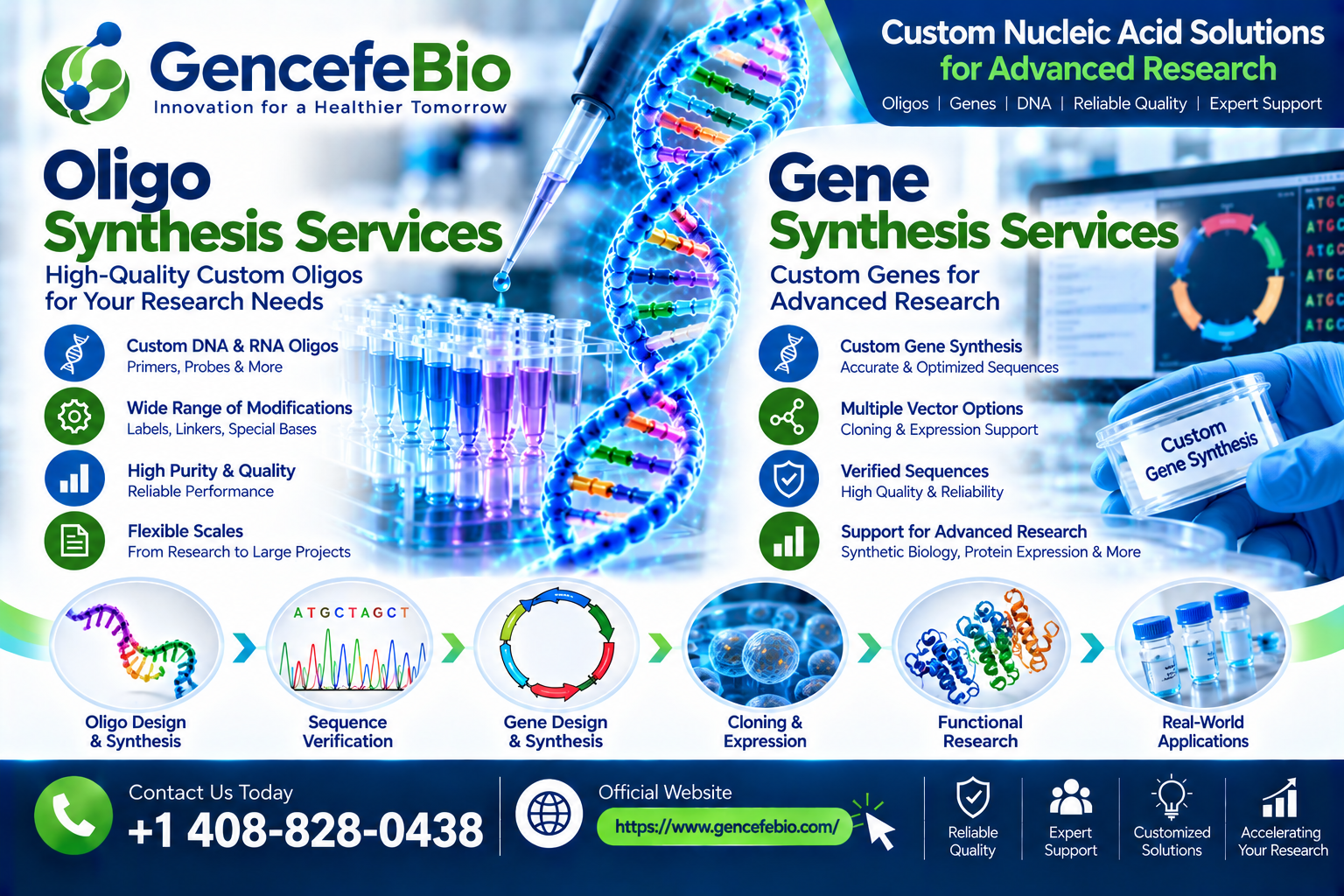
As biotechnology, pharmaceutical research, diagnostics, synthetic biology, and academic science become increasingly sequence-driven, researchers are relying more heavily on customized nucleic-acid tools. Two important capabilities supporting this shift are oligo synthesis services and gene synthesis services, which help convert digitally designed nucleotide sequences into physical research materials for molecular biology workflows.
Oligonucleotides are short DNA or RNA sequences commonly used as primers, probes, controls, and assembly components. Gene synthesis, by contrast, is typically used to create longer DNA sequences such as complete genes, coding regions, and engineered constructs. Together, these services can support faster experimental planning, greater sequence control, and more reproducible research.
What Are Oligo Synthesis Services?
oligo synthesis services provide custom short DNA or RNA sequences manufactured according to a researcher-defined design.
These oligonucleotides can support a wide range of laboratory applications, including:
- PCR primers
- Sequencing primers
- Hybridization probes
- Research controls
- Gene assembly
- Genotyping
- Mutagenesis
- Assay development
- Synthetic biology workflows
The appropriate sequence length, purity, quantity, and modification depend on the intended application.
Why Oligo Synthesis Services Matter
Oligonucleotides are among the most frequently customized reagents in molecular biology.
Researchers may choose oligo synthesis services when standard catalog products do not match a specific target.
For example, a project may require a primer designed for one genomic region, a probe for a selected sequence, or an oligo carrying a particular modification.
This flexibility makes custom oligos useful for both routine and advanced research.
Important Oligo Design Considerations
Successful oligo design requires more than selecting a nucleotide sequence.
Sequence Length
The ideal length depends on the intended use and binding requirements.
Base Composition
GC content and sequence composition can influence hybridization and amplification.
Secondary Structure
Some sequences may form hairpins or other unwanted structures.
Purity
Routine experiments and highly sensitive assays may require different purification levels.
Modifications
Depending on project requirements, oligos may include fluorescent labels, linkers, affinity groups, spacers, or other functional modifications.
A technically demanding sequence may benefit from review before manufacturing begins.
Quality Control in Oligo Synthesis
Quality control is important because oligo performance can directly influence experimental results.
Depending on the service, documentation may include:
- Identity information
- Purity
- Quantity
- Concentration
- Modification details
- Mass confirmation
Researchers should determine the required specification based on the intended experiment rather than automatically selecting the same purity level for every project.
What Are Gene Synthesis Services?
gene synthesis services produce longer DNA sequences according to a researcher-defined nucleotide design.
Instead of isolating and modifying DNA from a natural biological source, researchers can design a sequence digitally and request its physical synthesis.
Applications may include:
- Recombinant protein expression
- Molecular cloning
- Functional genetics
- Synthetic biology
- Reporter systems
- Assay development
- Antibody research
- Pathway engineering
This approach can reduce the number of upstream molecular biology steps required for some projects.
Why Gene Synthesis Services Are Valuable
gene synthesis services allow researchers to create DNA constructs tailored to a specific experiment.
Potential advantages include:
Defined Sequence Control
Researchers can specify the exact sequence required.
Variant Construction
Different gene versions can be produced for comparative studies.
Sequence Optimization
Coding sequences may sometimes be redesigned for a particular expression system while preserving the intended protein sequence.
Access to Difficult Templates
Synthetic production can reduce reliance on naturally available DNA templates.
Gene Synthesis for Protein Expression
One major application of gene synthesis services is recombinant protein research.
A typical workflow may involve:
Target Selection → Sequence Design → Gene Synthesis → Cloning → Expression → Protein Evaluation
Researchers can design a gene encoding:
- A full-length protein
- A specific domain
- A protein variant
- A recombinant antigen
- A fusion protein
The design of the DNA can influence downstream expression and experimental performance.
How Oligo and Gene Synthesis Work Together
These two services often support different stages of the same research project.
For example:
Sequence Design → Custom Oligos → Gene Assembly → Gene Synthesis or Verification → Cloning → Functional Research
Oligos can serve as primers, probes, and assembly components, while synthesized genes provide complete DNA constructs for downstream studies.
This combination gives researchers flexibility across both short-sequence and long-sequence applications.
Applications in Synthetic Biology
Synthetic biology depends heavily on designed DNA.
Custom oligos may support:
- DNA assembly
- Sequence verification
- Regulatory-element construction
- Mutagenesis
Synthesized genes may support:
- Engineered pathways
- Protein expression
- Biological circuits
- Functional testing
Together, oligo synthesis services and gene synthesis services can help researchers move efficiently through the design-build-test cycle.
Applications in Molecular Diagnostics Research
Oligos are widely used in assay development as:
- Primers
- Probes
- Reference sequences
- Controls
Synthesized genes or DNA constructs may also be used as:
- Positive controls
- Target templates
- Standardized reference materials
Defined synthetic sequences can help create more controlled assay-development conditions.
Applications in Antibody and Protein Research
Gene synthesis can support the production of recombinant proteins and antigens.
Oligos may then support cloning, amplification, sequencing, or downstream assay development.
This allows both services to contribute to broader research programs involving:
- Antibody generation
- Protein characterization
- Biomarker research
- Drug discovery
The best approach depends on the scientific objective.
Sequence Verification Is Critical
Accuracy is especially important in nucleic-acid research.
A single incorrect nucleotide can influence:
- Protein coding
- Primer binding
- Gene expression
- Regulatory function
- Experimental interpretation
Researchers should carefully review all submitted sequences and define the level of verification required for each project.
Choosing Oligo Synthesis Services
When selecting a provider, research teams may consider:
- Supported DNA and RNA lengths
- Purification options
- Available modifications
- Quality-control documentation
- Synthesis scale
- Packaging
- Technical support
- Turnaround expectations
A provider’s ability to communicate about difficult sequences can be as important as basic manufacturing capability.
Choosing Gene Synthesis Services
For gene synthesis services, useful factors include:
- Supported gene length
- Sequence complexity
- Vector options
- Cloning support
- Sequence verification
- Delivery format
- Technical communication
- Project scalability
Complex genes may require redesign or additional review before successful production.
Reproducibility and Documentation
Good documentation is essential for long-term research.
Teams should record:
- Exact sequence
- Batch number
- Purity
- Concentration
- Modification details
- Vector information
- Storage conditions
- Experimental use
This makes it easier to reproduce results and compare data across multiple studies.
Frequently Asked Questions
What are oligo synthesis services?
Oligo synthesis services produce custom short DNA or RNA sequences for PCR, sequencing, probes, controls, gene assembly, and other research applications.
What are gene synthesis services?
Gene synthesis services create defined DNA sequences such as complete genes or coding regions based on a researcher-specified design.
What are oligos used for?
Oligos are commonly used as primers, probes, controls, sequencing reagents, and assembly components.
What are synthesized genes used for?
They may support cloning, recombinant protein expression, synthetic biology, functional research, and assay development.
Can oligos contain modifications?
Yes, depending on technical capability, custom oligos may include selected labels, linkers, or other functional modifications.
Can synthesized genes be optimized?
In some projects, gene sequences may be adjusted for an intended expression system while preserving the encoded protein.
Is gene synthesis the same as DNA sequencing?
No. Sequencing reads an existing DNA molecule, while synthesis creates a new DNA molecule from a defined sequence.
Can oligo and gene synthesis be used together?
Yes. Oligos may support gene assembly, cloning, verification, and downstream analysis around a synthesized gene.
Why is sequence verification important?
Even a small sequence error can affect expression, binding, or experimental outcomes.
How should a provider be selected?
Technical capability, verification, quality control, scientific support, customization, documentation, and reproducibility are important considerations.
Media Contact
Research & Business Enquiries
Contact: +1 408-828-0438
Official Website: https://www.gencefebio.com/