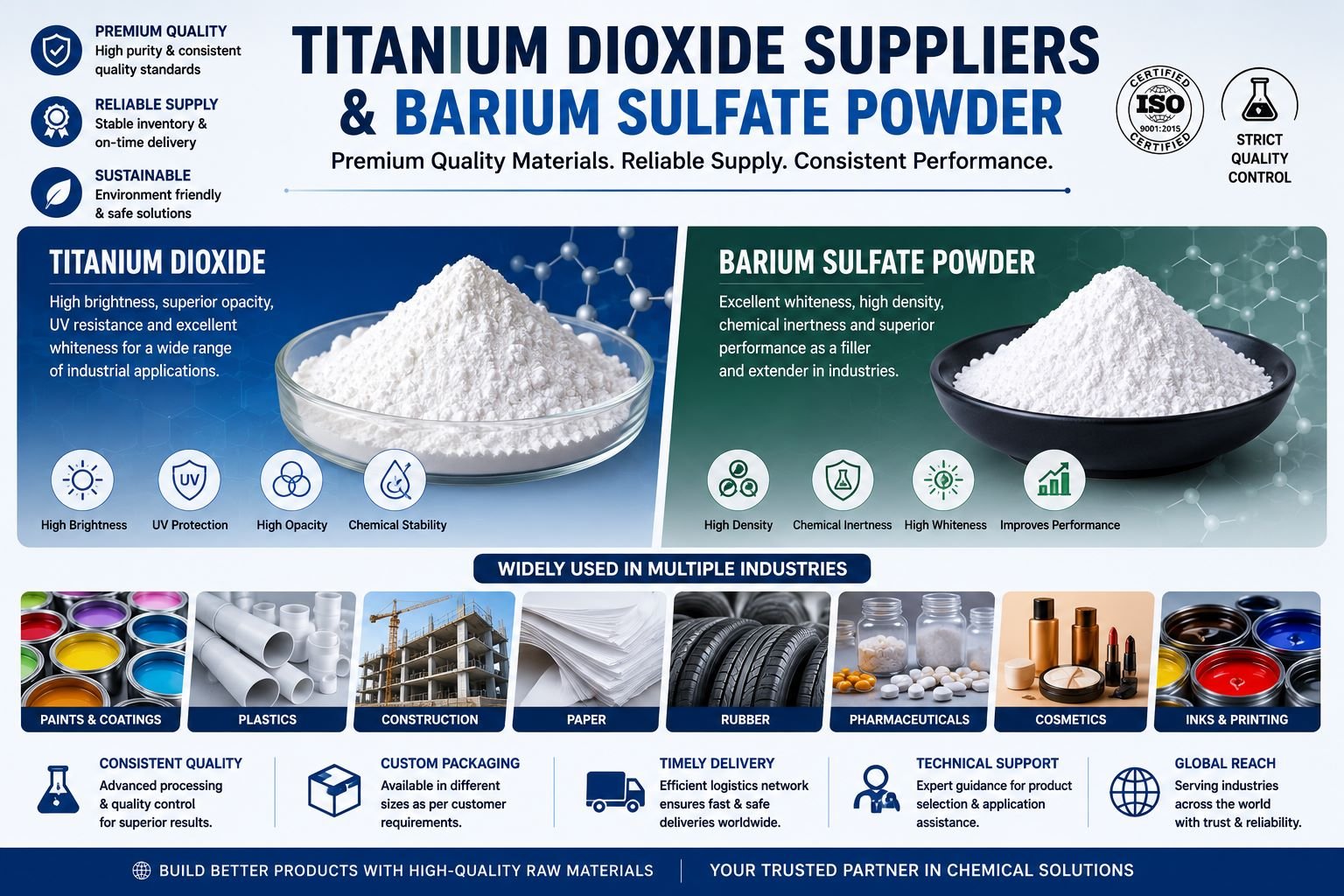
Industrial coatings, plastics, inks, rubber, construction compounds, and specialty products rely on mineral additives for appearance, durability, processing, and cost control. Two widely used materials are titanium dioxide and barium sulfate. Choosing dependable Titanium Dioxide Suppliers and the right Barium Sulfate Powder can influence opacity, whiteness, surface finish, chemical stability, and production consistency. Careful sourcing also supports smoother processing, fewer quality deviations, predictable inventory planning, and stronger control over finished-product specifications across repeated manufacturing cycles and customer orders alike.
Why Titanium Dioxide Is a Critical Industrial Pigment
Titanium dioxide, or TiO2, is one of the most important white pigments used in manufacturing. Its high refractive index, brightness, hiding power, and color stability make it useful in both decorative and functional products.
Established Titanium Dioxide Suppliers commonly provide rutile and anatase grades. Rutile titanium dioxide is frequently used in exterior coatings, plastics, masterbatches, and products requiring better weather resistance. Anatase grades are often selected where high whiteness and specific processing behavior are priorities.
Key Performance Characteristics
Manufacturers normally evaluate titanium dioxide for:
- TiO2 content and purity
- Whiteness and brightness
- Tinting strength
- Particle-size distribution
- Hiding power
- Oil absorption
- Surface treatment
- Dispersion performance
- UV and weather resistance
- Batch consistency
Why Batch Consistency Matters
Even a strong pigment can create problems if properties change from batch to batch. Consistency reduces reformulation, shade variation, dispersion problems, rejected production, and unnecessary quality-control costs.
Understanding Barium Sulfate Powder
Barium Sulfate Powder is a dense, chemically stable inorganic filler used in many industrial formulations. It offers good whiteness, low oil absorption, chemical inertness, and useful resistance under many processing conditions.
Natural barite and precipitated barium sulfate serve different requirements. Natural grades are commonly used where economical filling and density are important. Precipitated grades offer better purity, tighter particle control, and improved surface characteristics for demanding applications.
Common Industrial Applications
Barium Sulfate Powder is widely used in:
- Paints and coatings
- Powder coatings
- Plastics and masterbatches
- Rubber compounds
- Printing inks
- Adhesives and sealants
- Friction materials
- Specialty formulations
Titanium Dioxide and Barium Sulfate Compared
| Factor | Titanium Dioxide | Barium Sulfate Powder |
| Main role | White pigment | Functional filler |
| Opacity | Very high | Low to moderate |
| Whiteness | Excellent | High |
| Refractive index | High | Lower |
| Density | High | Very high |
| Cost level | Higher | Usually lower |
| Typical purpose | Hiding and brightness | Filling and cost balance |
These materials are not direct substitutes. In many formulations, they are used together to balance opacity, surface properties, processing, and formulation cost.
How to Select Reliable Titanium Dioxide Suppliers
Choosing Titanium Dioxide Suppliers requires both technical and commercial evaluation. The supplier should understand the intended application rather than recommend the same grade for every product.
Check these points before purchasing:
- Confirm whether rutile or anatase is suitable.
- Review specifications and certificates.
- Request samples for testing.
- Compare hiding and dispersion in the actual formulation.
- Check packaging and storage guidance.
- Confirm supply capacity and lead times.
- Ask about technical support.
- Verify regulatory documentation.
- Compare total formulation cost, not only unit price.
Choosing the Right Barium Sulfate Grade
The ideal Barium Sulfate Powder depends on particle size, purity, brightness, density, dispersibility, and the required finish.
Natural vs. Precipitated Barium Sulfate
Natural barite is often suitable for general industrial filling applications. Precipitated barium sulfate is better suited to formulations requiring high purity, fine particles, uniform morphology, and cleaner surface appearance.
Questions to Ask a Supplier
Request information about BaSO4 content, particle-size distribution, moisture, whiteness, residue, oil absorption, bulk density, packaging, and recommended applications. A representative sample should always be tested before large-volume purchasing.
Improving Formulation Value
Experienced formulators look beyond raw-material price. A higher-performing titanium dioxide grade may provide better opacity at lower dosage, while optimized Barium Sulfate Powder can improve filling efficiency and formulation economics.
The correct balance depends on the application. Architectural paint, automotive coating, PVC compounds, powder coatings, rubber products, and printing inks all require different properties. Trials should evaluate hiding, viscosity, gloss, dispersion, mechanical performance, and final appearance before commercial adoption.
Quality Control and Storage
Store both materials in a dry, clean area away from moisture and contamination. Keep bags sealed until use.
Incoming quality checks may include whiteness, particle size, moisture, residue, density, oil absorption, dispersion, or application-specific tests. Recording results by batch makes long-term supplier comparison more reliable.
Frequently Asked Questions
1. What should I check when selecting Titanium Dioxide Suppliers?
Check grade, purity, tinting strength, particle size, surface treatment, consistency, documentation, technical support, and delivery reliability.
2. Which TiO2 type is commonly used outdoors?
Rutile titanium dioxide is generally preferred where stronger weather resistance is required.
3. What is Barium Sulfate Powder mainly used for?
It is used as a functional filler, extender, density modifier, and processing aid in many industrial products.
4. Can barium sulfate replace titanium dioxide?
No. Their optical properties are different, although they can work together in optimized formulations.
5. What is precipitated barium sulfate?
It is a manufactured, high-purity grade with controlled particle characteristics.
6. Why is particle size important?
It affects dispersion, gloss, surface finish, rheology, and mechanical behavior.
7. Should buyers test samples first?
Yes. Laboratory and production trials reduce sourcing risk.
8. Is lower-priced TiO2 always cheaper to use?
No. Poor hiding strength may require more pigment and increase total cost.
9. What documents should buyers request?
Technical data sheets, safety data sheets, certificates of analysis, and relevant compliance documents.
10. Can both materials be used in one formulation?
Yes. Many products combine pigments and fillers to balance performance, finish, and cost.