
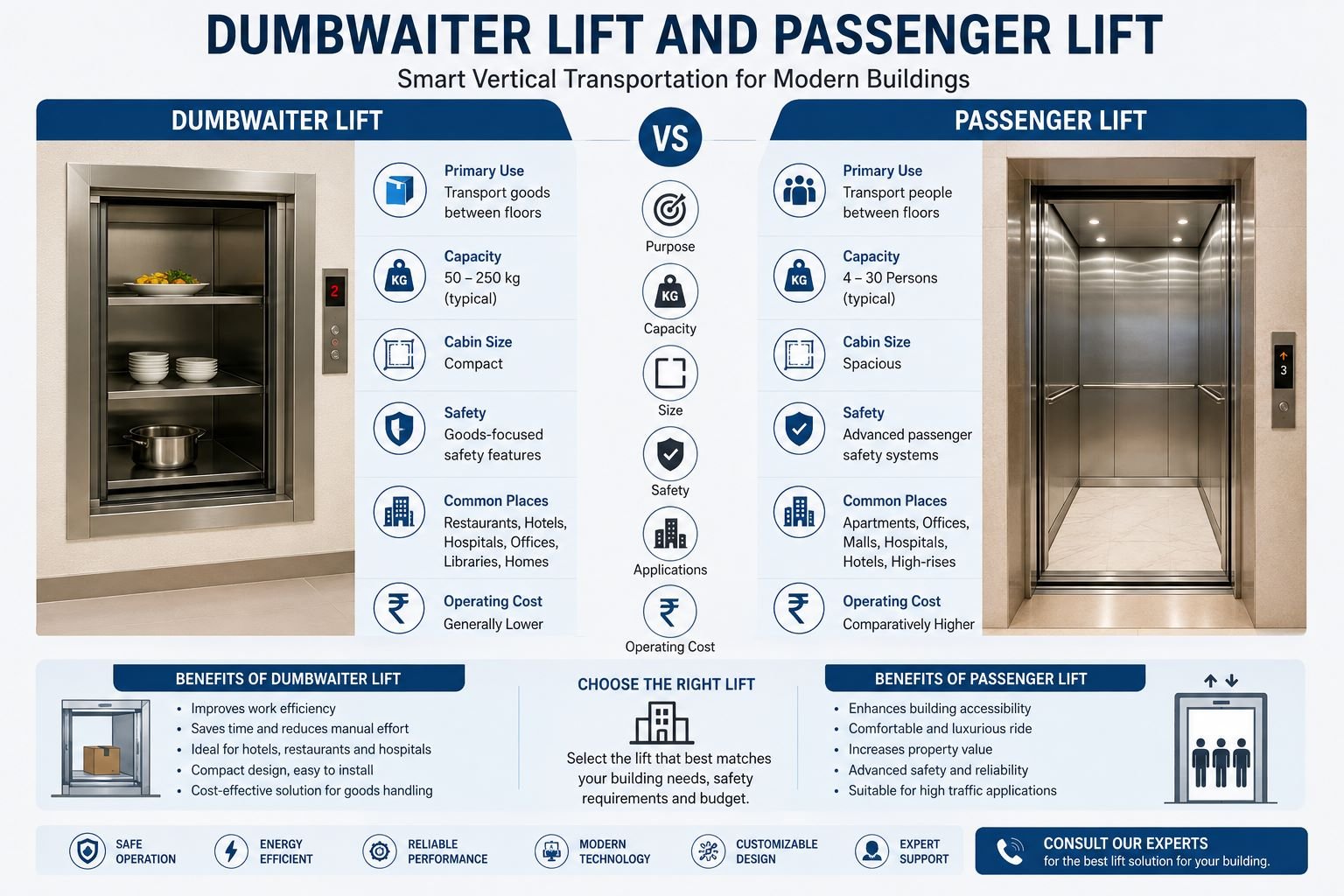
Whether it is a hotel transferring meals between floors, a hospital transporting supplies, or a commercial building moving employees and visitors, the right elevator system can improve productivity, safety, and convenience. Two widely used solutions are the dumbwaiter lift and passenger lift.
Although both systems provide vertical transportation, their purposes, capacities, designs, and safety requirements are different. Understanding these differences helps architects, property owners, developers, and facility managers select the most suitable lift system for their buildings.
What Is a Dumbwaiter Lift?
A dumbwaiter lift is a compact vertical transportation system designed specifically for moving goods rather than passengers. It usually operates between two or more floors and is commonly installed in restaurants, hotels, hospitals, warehouses, libraries, offices, and private residences.
Unlike conventional elevators, dumbwaiters have relatively small cabins. They can transport food, documents, medicines, kitchen supplies, laundry, tools, cartons, and other lightweight or medium-weight materials.
Modern dumbwaiters can include automatic doors, stainless-steel cabins, call buttons, interlocking systems, floor indicators, and advanced control panels.
Common Applications of Dumbwaiter Lifts
A dumbwaiter lift can improve workflow wherever goods need to move regularly between floors.
Popular applications include:
- Restaurants for transporting prepared food and utensils
- Hotels for moving meals, linen, and housekeeping supplies
- Hospitals for carrying medicines and medical materials
- Offices for documents and files
- Libraries for books and records
- Warehouses for lightweight goods
- Villas and homes for groceries or household items
- Retail stores for stock movement
By reducing manual transportation on staircases, dumbwaiters can save valuable employee time and minimize unnecessary physical effort.
What Is a Passenger Lift?
A passenger lift is designed specifically to transport people safely between different levels of a building. These lifts are commonly found in apartments, office towers, hotels, hospitals, shopping centres, schools, airports, and commercial complexes.
Passenger elevators are available in different sizes and capacities depending on building height, expected traffic, available space, and accessibility requirements.
Modern passenger elevators may incorporate intelligent controllers, automatic rescue systems, emergency communication devices, destination controls, energy-efficient drives, and smooth door mechanisms.
Important Features of Passenger Lifts
A professionally designed passenger lift normally focuses on safety, comfort, accessibility, and reliable operation.
Important features can include:
- Automatic opening and closing doors
- Emergency alarm systems
- Overload protection
- Floor position indicators
- Emergency lighting
- Automatic rescue devices
- Smooth acceleration and braking
- Accessible control panels
- Ventilation systems
- Backup power compatibility
These features make passenger elevators an essential part of modern multi-storey infrastructure.
Dumbwaiter Lift vs Passenger Lift
While their basic vertical movement principle may appear similar, these elevator types serve completely different purposes.
| Feature | Dumbwaiter Lift | Passenger Lift |
| Main purpose | Goods transportation | People transportation |
| Cabin size | Compact | Larger |
| Typical load | Food, documents, materials | Passengers |
| Installation space | Usually smaller | Usually larger |
| Safety system | Goods-focused protection | Comprehensive passenger safety |
| Common locations | Restaurants, hotels, hospitals | Offices, apartments, malls |
| Human transportation | Not permitted | Specifically designed for people |
| Cost | Generally lower | Usually higher |
Choosing between the two should always depend on the intended application rather than simply installation cost.
Benefits of Installing a Dumbwaiter Lift
Businesses that frequently transport materials between floors can achieve significant operational benefits from a dumbwaiter lift.
1. Improved Productivity
Employees no longer need to repeatedly carry products upstairs and downstairs. This allows them to focus on higher-value tasks.
2. Better Workplace Safety
Reducing manual movement of heavy or awkward materials can lower the possibility of accidents associated with carrying goods on stairs.
3. Efficient Space Utilization
Because dumbwaiters are relatively compact, they can often be installed where a full-sized elevator would be impractical.
4. Faster Material Movement
Food, documents, supplies, and products can reach their destination quickly, improving overall service efficiency.
Long-Term Operational Advantage
For hotels, restaurants, hospitals, and commercial establishments, regular time savings can make the dumbwaiter lift particularly valuable over its operational life.
Benefits of Installing a Passenger Lift
A professionally planned passenger lift improves accessibility while adding functionality and convenience to multi-storey properties.
Major advantages include:
- Comfortable movement between floors
- Improved accessibility for elderly and mobility-impaired users
- Faster movement in high-traffic buildings
- Better building usability
- Increased convenience for visitors and occupants
- Modern appearance and user experience
Passenger elevators can also be customized with different cabin finishes, lighting systems, control panels, doors, flooring, and interior designs.
How to Choose the Right Lift
Before purchasing either type of elevator, building owners should carefully assess operational requirements.
Consider:
- Number of floors
- Required load capacity
- Available shaft dimensions
- Expected daily usage
- Building type
- Power requirements
- Installation environment
- Maintenance accessibility
- Safety regulations
- Future usage requirements
Working with an experienced lift manufacturer or installation specialist is important because elevator requirements vary significantly between projects.
Safety and Maintenance Considerations
Routine maintenance is essential for both elevator categories.
A passenger lift requires particularly strict safety inspections because it carries people. Important components such as doors, brakes, control systems, emergency devices, ropes or belts, electrical equipment, and sensors should be inspected according to applicable regulations and manufacturer recommendations.
A dumbwaiter lift also requires periodic servicing. Door interlocks, control switches, guide systems, motors, cables, and safety components must remain in reliable operating condition.
Preventive maintenance can detect wear before it develops into expensive breakdowns.
Energy Efficiency in Modern Lift Systems
Modern elevators increasingly use energy-efficient motors, intelligent control systems, LED lighting, standby modes, and optimized drive technology.
For buildings experiencing frequent elevator movement, selecting an efficient system can reduce electricity consumption throughout the equipment’s operating life.
Energy efficiency should therefore be considered alongside price, capacity, safety, and maintenance requirements.
Frequently Asked Questions
1. What is a dumbwaiter lift used for?
A dumbwaiter lift transports goods such as food, documents, medicines, laundry, and supplies between floors.
2. Can people travel inside a dumbwaiter?
No. Dumbwaiters are designed for goods, not passenger transportation.
3. What is a passenger lift?
A passenger lift is an elevator engineered specifically to transport people safely between building floors.
4. Where are dumbwaiters commonly installed?
They are frequently installed in restaurants, hotels, hospitals, offices, libraries, warehouses, and residences.
5. Are passenger lifts suitable for residential buildings?
Yes. They are widely used in apartments, villas, residential towers, and multi-storey homes.
6. How much space does a dumbwaiter require?
Space requirements depend on capacity, cabin dimensions, travel height, and equipment design.
7. How many people can a passenger lift carry?
Capacity varies significantly. The appropriate model should be selected according to expected traffic and building requirements.
8. Do lifts require regular maintenance?
Yes. Preventive servicing is essential for safe, reliable, and efficient operation.
9. Can elevator cabins be customized?
Many manufacturers offer customizable cabin materials, finishes, lighting, doors, and control panels.
10. Which lift should a restaurant choose?
Restaurants typically use a dumbwaiter lift for transporting food and utensils. A separate passenger elevator may be required for customers and staff.