
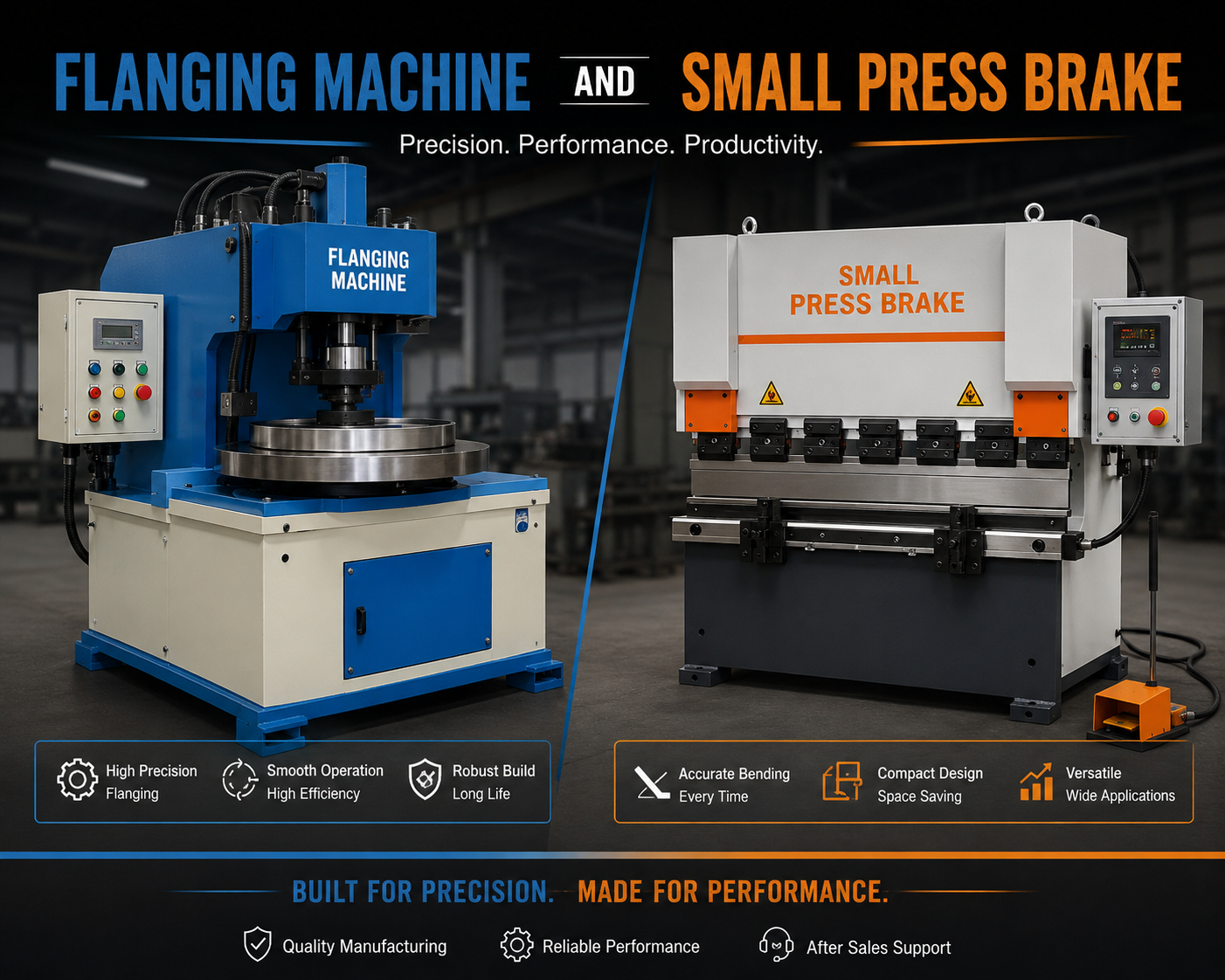
Although both machines are associated with metal forming, they solve very different production challenges. A flanging machine concentrates on shaping and strengthening the edges of metal components, while a small press brake creates controlled bends, folds, and profiles.
For fabrication workshops, HVAC manufacturers, electrical enclosure producers, automotive suppliers, and general engineering companies, understanding how these machines work can make equipment selection much easier.
Why Sheet Metal Forming Needs Specialized Machines
Every fabricated component has a specific shape, thickness, radius, and strength requirement. Trying to perform all forming operations manually can create variations from one part to another.
Modern machinery allows manufacturers to control force, positioning, and tool movement more accurately.
This provides several benefits:
- Improved dimensional consistency
- Faster production
- Reduced manual effort
- Cleaner component edges
- Lower material rejection
- Better assembly accuracy
- Higher repeatability
A workshop that regularly manufactures bent or flanged components can therefore achieve much better productivity by using purpose-built equipment.
What Exactly Does a Flanging Machine Do?
A flanging machine forms the edge of a sheet metal component into a raised or angled section known as a flange.
This flange may be designed for structural reinforcement, connection, welding, sealing, or mounting.
Instead of changing the entire shape of the sheet, the machine mainly concentrates on its edge.
For example, imagine a circular metal plate used as the end of a storage tank. The outer edge may need to be turned upward so that it can be welded securely to the cylindrical tank body. A flanging machine can create this edge more consistently than manual forming.
Why Manufacturers Use Flanged Edges
A flange may look like a small design detail, but it can perform several important functions.
It may:
- Strengthen a thin metal edge
- Provide an area for welding
- Create a bolting surface
- Improve sealing
- Help two components align
- Reduce sharp exposed edges
- Improve structural stability
This is why flanging machines are used in many industrial sectors rather than only in specialized metal shops.
Typical Products Made with Flanging Machines
Flanging equipment is especially useful for round or curved products.
Common applications include:
- Industrial tanks
- Metal drums
- Ventilation ducts
- Vessel ends
- Circular covers
- Exhaust components
- Food processing equipment
- Pipe fittings
- Air-handling components
- Metal containers
The exact application depends on the machine’s tooling, forming method, diameter capacity, and metal thickness range.
What Is a Small Press Brake?
A small press brake is a compact version of an industrial bending machine.
It bends sheet metal by positioning the material between a punch and die. As pressure is applied, the sheet follows the profile created by the tooling.
The biggest advantage of a compact press brake is flexibility. Instead of being dedicated to one product, it can produce many different component shapes by changing the tool setup and bend position.
This makes it particularly useful for smaller fabrication companies and workshops producing custom work.
Where a Small Press Brake Fits Best
A small press brake can be used for manufacturing:
- Mounting brackets
- Electrical boxes
- Control cabinets
- Metal channels
- Machine guards
- Small panels
- Shelves
- Equipment covers
- Furniture components
- Prototype metal parts
A workshop may produce several unrelated products using the same press brake, making it valuable for businesses handling mixed production.
Why Compact Press Brakes Are Becoming Popular
Not every manufacturer needs a massive hydraulic press brake.
A compact machine can be a better choice when components are smaller and production quantities vary frequently.
The main advantages include:
- Smaller installation footprint
- Lower space requirement
- Easier handling of short components
- Quick tooling changes
- Suitable for prototype work
- Flexible production
- Reduced setup complexity
Modern compact models may also include CNC controls, programmable backgauges, digital displays, or automatic positioning features.
Flanging Machine vs Small Press Brake
Both machines reshape metal, but their roles are different.
| Feature | Flanging Machine | Small Press Brake |
| Main operation | Edge forming | Straight bending |
| Common product | Tank and duct parts | Brackets and panels |
| Primary tooling | Rollers or forming tools | Punch and die |
| Circular component ability | High | Limited |
| Multi-angle bending | Limited | High |
| General fabrication | Specialized | Very flexible |
| Repeat production | Excellent | Excellent |
| Custom job work | Moderate | Excellent |
For many manufacturers, the question is not which machine is better. The real question is which operation the component requires.
Important Factors Before Buying a Flanging Machine
Machine specifications should always match actual production requirements.
Before selecting a flanging machine, consider:
- Metal thickness
- Material type
- Minimum component diameter
- Maximum component diameter
- Required flange height
- Flange radius
- Production quantity
- Tool adjustment range
A machine suitable for thin aluminum components may not provide enough force for thicker stainless steel parts.
What to Check Before Choosing a Small Press Brake
For a small press brake, buyers should focus on more than machine dimensions.
Important specifications include:
- Maximum bending length
- Available tonnage
- Material thickness capacity
- Backgauge accuracy
- Tooling compatibility
- Stroke length
- Control system
- Frame rigidity
It is also important to consider future work. Purchasing a machine that operates constantly near its maximum capacity may limit production expansion.
Why Tonnage Matters in Press Brake Operations
Tonnage represents the amount of force available during bending.
The required force depends on several factors:
- Sheet thickness
- Bend length
- Material strength
- Die opening
- Bending technique
Thicker or stronger materials generally need more force.
Using incorrect tonnage may affect bend accuracy and could place unnecessary stress on machinery or tooling.
Material Behavior Can Change the Result
Manufacturers should remember that different metals respond differently during forming.
Mild steel is generally predictable and widely used.
Stainless steel typically requires greater forming force and may experience more springback.
Aluminum is easier to form in many applications, although certain grades may crack if the bend radius is too tight.
Understanding material characteristics is therefore just as important as selecting the machine itself.
Simple Ways to Improve Forming Quality
Good equipment cannot compensate for poor setup.
Better results can be achieved by:
- Checking material thickness before forming.
- Using correctly matched tooling.
- Inspecting tools for wear.
- Performing sample bends.
- Measuring the first completed part.
- Recording successful machine settings.
- Keeping forming surfaces clean.
- Following recommended maintenance schedules.
Small improvements in setup practices can significantly reduce scrap and rework.
Maintenance Should Never Be Ignored
Both a flanging machine and small press brake work under considerable mechanical pressure.
Routine maintenance may include checking:
- Hydraulic oil
- Lubrication points
- Forming rollers
- Punches and dies
- Electrical components
- Fasteners
- Alignment
- Safety systems
Preventive maintenance helps preserve accuracy and reduces unexpected production stoppages.
Frequently Asked Questions
1. What is the main use of a flanging machine?
It creates shaped edges or flanges on sheet metal components for strength, joining, sealing, or assembly.
2. Can flanging machines make circular flanges?
Yes. Many models are specifically designed for round and cylindrical workpieces.
3. What is the purpose of a small press brake?
A small press brake bends sheet metal into controlled angles, channels, brackets, and profiles.
4. Can a small press brake be used for production work?
Yes. It is suitable for prototypes, small batches, and repeated production depending on machine capacity.
5. What metals can be processed?
Common materials include mild steel, stainless steel, aluminum, copper, and brass when machine capacity allows.
6. Why does metal spring back after bending?
The material retains some elastic properties and attempts to return partially toward its original shape.
7. What causes flange cracking?
Incorrect radius, unsuitable material, excessive forming pressure, or poor tooling may cause cracking.
8. Can a press brake make different bend angles?
Yes. Tooling and machine settings can be adjusted to create a wide range of angles.
9. What does a backgauge do?
It positions sheet metal accurately before bending and helps maintain consistent dimensions.
10. Are compact press brakes suitable for small factories?
Yes. Their smaller footprint makes them practical where workshop space is limited.