
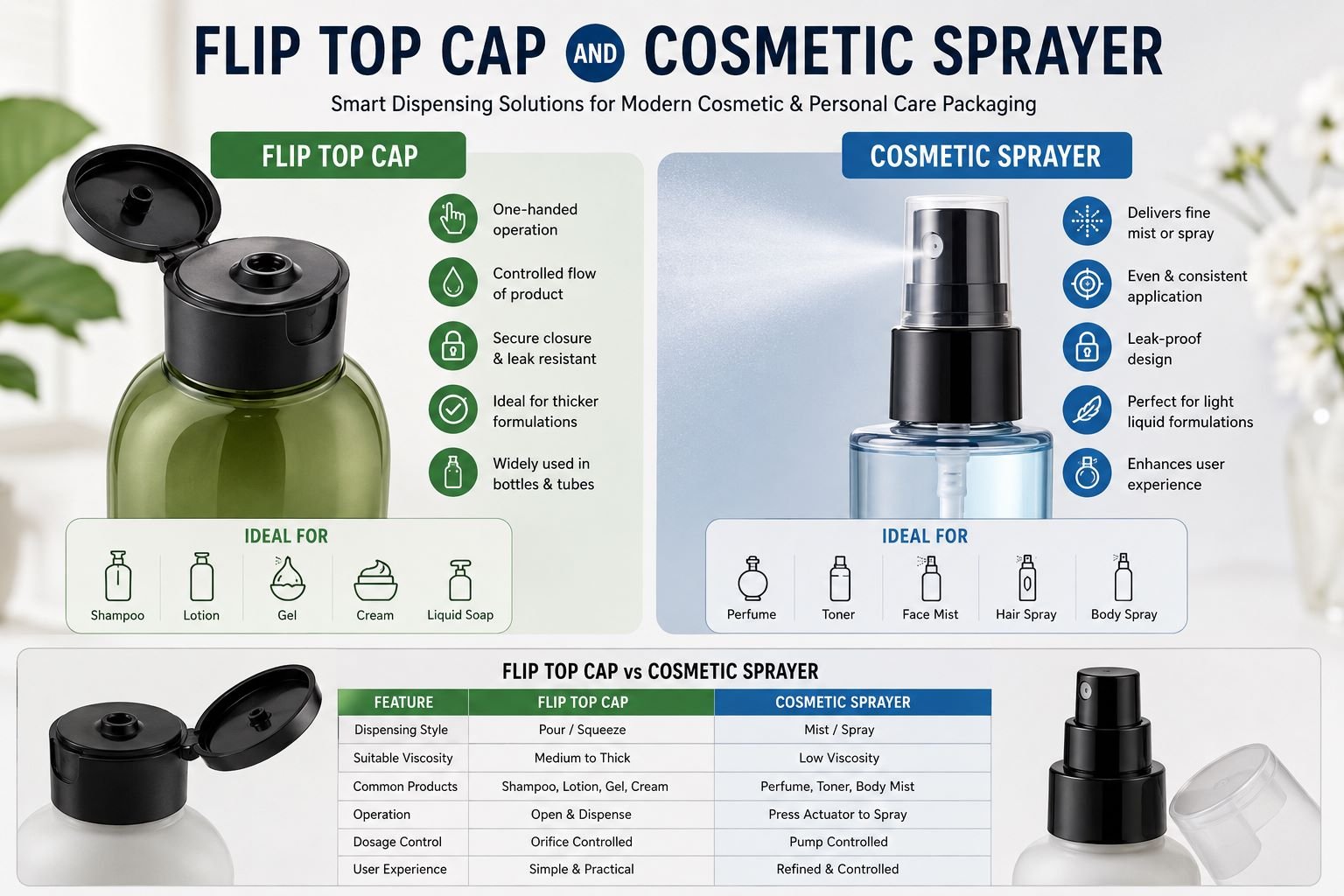
The right closure or dispensing system can influence convenience, product protection, dosage control, shelf appeal, and the overall customer experience. Among the most widely used packaging components today are the flip top cap and cosmetic sprayer.
Although both serve different dispensing requirements, they share one important objective: helping consumers use cosmetic and personal care formulations conveniently, hygienically, and efficiently. Understanding their features, applications, materials, and selection criteria can help cosmetic manufacturers develop packaging that complements both their formulation and brand positioning.
Why Packaging Closures Matter in Cosmetics
Consumers interact with the packaging before they experience the formulation itself. A poorly designed closure may leak, dispense excessive product, become difficult to operate, or negatively affect customer perception.
Manufacturers therefore need dispensing solutions designed around viscosity, dosage requirements, bottle compatibility, transportation conditions, and consumer habits.
An effective cosmetic closure should provide:
- Convenient dispensing
- Reliable sealing
- Controlled product flow
- Compatibility with the formulation
- Comfortable one-handed operation
- Attractive visual presentation
- Protection during storage and transportation
Both the flip top cap and cosmetic sprayer address these requirements in different product categories.
Understanding the Flip Top Cap
A flip top cap is a dispensing closure containing a hinged lid that users can open and close without completely removing the cap from the bottle. This simple mechanism makes it particularly practical for frequently used products.
It is commonly seen on shampoo, conditioner, body lotion, face wash, hand sanitiser, shower gel, hair treatment products, and other personal care packaging.
Key Features of Flip Top Closures
A properly engineered flip top closure combines convenience with functional sealing.
Important features may include:
- Strong hinge performance for repeated opening.
- Secure snap closure to reduce accidental opening.
- Controlled dispensing orifice.
- Smooth edges for comfortable handling.
- Reliable bottle-neck compatibility.
- Customisable shapes, finishes, and colours.
Because the lid remains connected to the closure, customers do not need to handle or store a separate cap while using the product.
Materials Commonly Used
Polypropylene is frequently used to manufacture flip top closures because it offers useful flexibility, durability, and hinge performance.
Depending on the application, manufacturers may also consider polyethylene or other suitable packaging polymers.
Material selection should consider chemical compatibility, closure design, recycling objectives, manufacturing requirements, and the intended cosmetic formulation.
Understanding the Cosmetic Sprayer
A cosmetic sprayer transforms liquid formulations into a controlled spray or fine mist. It is typically used when the product needs to cover a larger surface area evenly rather than being poured or squeezed directly from the bottle.
Common applications include facial mist, body spray, hair mist, toner, fragrance, setting spray, skincare liquids, and refreshing sprays.
How a Cosmetic Sprayer Works
Most sprayers contain several coordinated components, including an actuator, pump mechanism, dip tube, housing, closure, and nozzle.
When the actuator is pressed, the pump draws liquid through the dip tube and pushes it through the nozzle.
Spray Performance Matters
The nozzle and pump design determine characteristics such as:
- Mist fineness
- Spray angle
- Product output per stroke
- Coverage area
- Droplet consistency
These characteristics can significantly influence how luxurious or practical a cosmetic product feels during application.
Flip Top Cap vs Cosmetic Sprayer
Selecting between these dispensing systems depends largely on formulation type and intended application.
| Feature | Flip Top Cap | Cosmetic Sprayer |
| Best suited for | Creamy or viscous products | Liquid formulations |
| Dispensing method | Pour or squeeze | Spray or mist |
| Dosage control | Moderate to high | Controlled per stroke |
| Typical products | Shampoo, lotion, cleanser | Mist, toner, fragrance |
| Operation | Flip lid open | Press actuator |
| Application area | Targeted | Wider coverage |
| Main advantage | Simple convenience | Even distribution |
Neither option is universally better. The appropriate dispensing system depends on how consumers are expected to apply the formulation.
Applications Across Beauty and Personal Care
The versatility of these packaging components allows manufacturers to use them across many categories.
A flip top cap works particularly well for:
- Shampoo and conditioner
- Body lotion
- Face cleanser
- Shower gel
- Sunscreen
- Hair gel
- Hand wash
- Massage products
A cosmetic sprayer is commonly selected for:
- Facial mist
- Hair spray
- Body mist
- Toner
- Makeup setting spray
- Lightweight skincare formulations
- Perfumed body products
Matching viscosity and dispensing technology is essential. Very thick formulations generally cannot travel efficiently through a fine-mist pump.
How to Choose the Right Flip Top Cap
Several technical and commercial factors should be evaluated before finalising a closure.
Check Bottle-Neck Compatibility
The closure must correspond correctly with the bottle-neck specification. An incorrect match can cause leakage, loose fitting, or sealing problems.
Evaluate the Orifice
The dispensing opening should complement the formulation’s viscosity. Thick lotion may require a larger opening than shampoo or facial cleanser.
Test the Hinge
The hinge should withstand repeated consumer use without cracking or losing functionality.
Consider Brand Appearance
Colour matching, surface finish, shape, embossing, and custom decoration can help the closure become part of the overall brand identity.
How to Choose a Cosmetic Sprayer
Spray packaging requires additional attention because dispensing performance directly affects application.
Test the Formula
Not every pump works equally well with every liquid. Oils, alcohol-containing formulations, water-based products, and specialised cosmetic ingredients can behave differently.
Determine Output Requirements
Some applications require a very fine mist, while others need greater liquid output per stroke.
Test Spray Pattern
An uneven spray can negatively affect product perception. Manufacturers should evaluate coverage, consistency, droplet size, and actuator comfort.
Conduct Leakage Testing
Packaging should be tested under storage, transportation, and orientation conditions before commercial production.
Quality Considerations for Cosmetic Packaging
Appearance alone should never determine closure selection. Manufacturers should perform appropriate compatibility and functionality tests before large-volume production.
Important assessments may include:
- Leakage testing
- Torque testing
- Drop testing
- Pump-output testing
- Hinge-cycle testing
- Transportation simulation
- Formulation compatibility testing
These checks help identify potential packaging problems before finished products reach customers.
Sustainable Packaging Considerations
Sustainability is increasingly influencing cosmetic packaging development. Brands are exploring lightweight designs, recyclable materials, simplified component construction, refill concepts, and reduced material usage.
For flip top closures, manufacturers can explore efficient mono-material designs where technically appropriate.
Sprayers can be more complicated because conventional pump assemblies may contain multiple materials. Packaging engineers should therefore evaluate recyclability together with actual performance rather than focusing on environmental claims alone.
Frequently Asked Questions
1. What is a flip top cap?
A flip top cap is a hinged bottle closure that opens by lifting or pressing the lid while remaining attached to the main closure.
2. Where are flip top closures commonly used?
They are frequently used for shampoos, lotions, conditioners, cleansers, gels, sunscreens, and other personal care products.
3. What is a cosmetic sprayer?
A cosmetic sprayer is a dispensing pump designed to release liquid cosmetic formulations as a spray or fine mist.
4. Which products are suitable for cosmetic sprayers?
Facial mist, toner, body mist, fragrance, hair mist, and makeup setting products are common applications.
5. Can thick lotion be used with a cosmetic sprayer?
Generally, highly viscous products require another dispensing system unless the sprayer is specifically engineered for that formulation.
6. Are flip top caps reusable?
They are designed for repeated opening and closing throughout the normal life of the packaged product.
7. Can flip top closures be customised?
Yes. Manufacturers may offer different colours, shapes, finishes, orifice sizes, and branding options.
8. What determines spray quality?
Pump construction, nozzle geometry, formulation viscosity, output rate, and actuator design can all affect spray performance.
9. How can brands prevent leakage?
Correct bottle-neck matching, appropriate sealing design, compatibility testing, torque control, and transportation testing are important.
10. Which option provides better dosage control?
A cosmetic sprayer can provide measured output per actuation, while a flip top closure provides controlled pouring or squeezing depending on its orifice.