
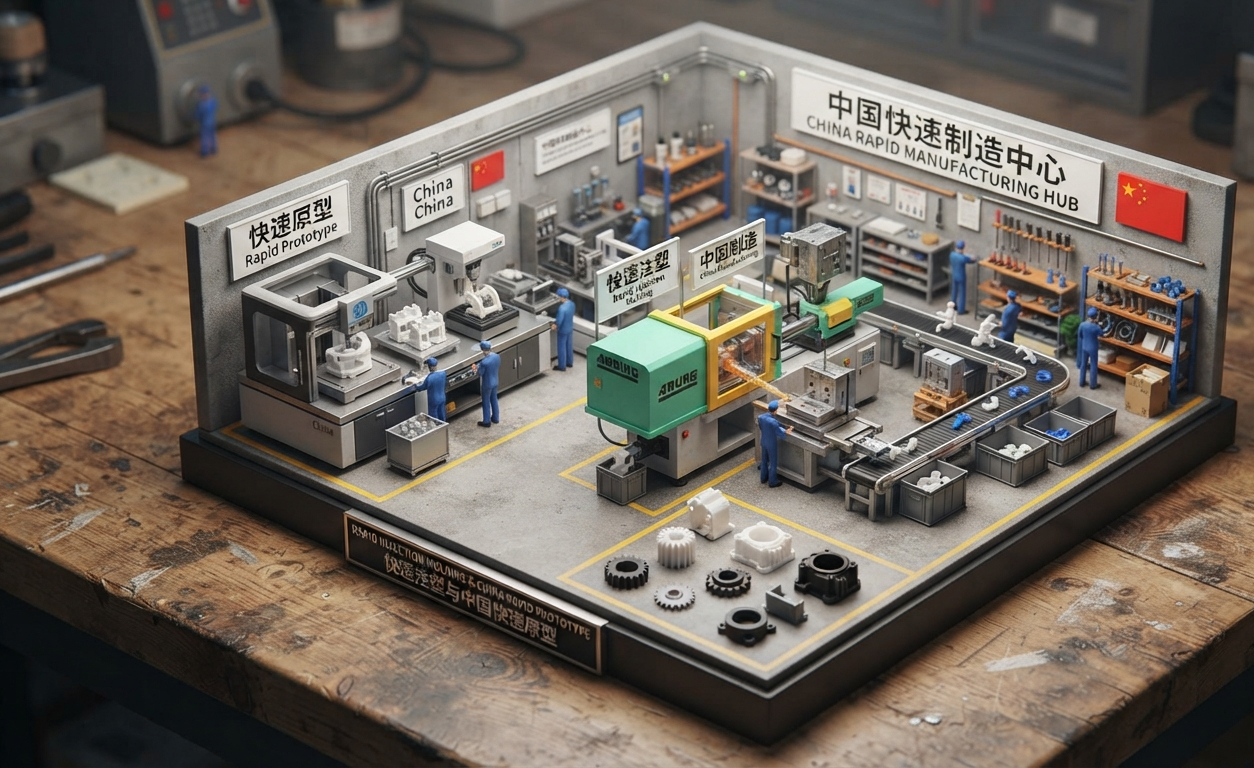
The distance between a promising product idea and a manufacturable product can be surprisingly large. A design may look excellent in CAD software but reveal unexpected problems once engineers hold the first physical part. A clip may be too rigid, two components may not align correctly, or a seemingly simple feature may require a complicated mould mechanism.
For this reason, manufacturers increasingly use rapid injection molding alongside china rapid prototype services to test important assumptions before moving towards mass production. The combination provides a practical way to create physical parts, learn from them and progressively improve a product.
Rather than treating prototyping as an optional expense, modern development teams increasingly see it as a source of valuable engineering information.
Why the First Prototype Should Not Be Expected to Be Perfect
Product development is naturally iterative. Even an experienced engineering team may discover opportunities for improvement after evaluating a physical prototype.
A first prototype may reveal issues related to ergonomics, component clearance, assembly or appearance. The second version may solve those problems but expose another issue related to material performance.
This is exactly what prototypes are supposed to do.
A china rapid prototype programme allows a company to manufacture physical versions of a design without immediately committing to expensive long-term production tooling.
Depending on what needs to be tested, manufacturers can use:
- 3D printing for quick concept models
- CNC machining for accurate functional parts
- Vacuum casting for small batches
- Sheet-metal fabrication for enclosures and brackets
- Rapid tooling for production-like components
- Rapid injection molding for moulded plastic parts
The important decision is not simply how quickly a prototype can be manufactured. It is whether the selected process can answer the engineering question behind the prototype.
When a Prototype Needs to Behave Like a Real Product
Early prototypes are often excellent for checking size, shape and basic assembly. However, they may not accurately reproduce the behaviour of the final injection-moulded product.
Imagine developing a snap-fit plastic enclosure.
A 3D-printed version may demonstrate that the two halves fit together, but its layer structure and material characteristics can differ from the final moulded thermoplastic.
If engineers need to test the actual snap behaviour repeatedly, rapid injection molding may provide more representative samples.
This is one of the major reasons rapid moulding becomes valuable during later product validation.
What Makes Rapid Injection Molding Different?
Traditional injection moulding is often associated with large production quantities and substantial tooling programmes. Rapid moulding changes the economics by focusing tooling around shorter development cycles or lower manufacturing quantities.
Depending on requirements, rapid moulds may be manufactured from aluminium or appropriate steel grades.
The process itself follows familiar injection-moulding principles:
- Plastic resin is prepared.
- The material is heated.
- Molten polymer enters the mould cavity.
- Pressure helps fill the required geometry.
- The material cools and solidifies.
- The mould opens.
- The finished component is ejected.
The real advantage is that companies can obtain moulded parts before committing to a long-term mass-production strategy.
Why China Rapid Prototype Manufacturing Attracts Global Product Developers
China has developed extensive supply chains around prototype machining, mould manufacturing, injection moulding, surface treatment and assembly.
A china rapid prototype company may therefore be able to support several stages of the same development project.
For example, a business developing a smart-home product might need a CNC-machined aluminium frame, a transparent prototype lens, a flexible button and an injection-moulded housing.
Working with a manufacturer capable of coordinating different processes can simplify the development programme.
However, sourcing from China should still involve careful supplier assessment. A low quotation is not evidence of engineering capability.
Technical communication, quality control and manufacturing experience remain essential.
Choosing the Right Manufacturing Process at the Right Time
One of the biggest product-development mistakes is selecting a manufacturing method simply because it is familiar.
Different technologies solve different problems.
| Development Need | Suitable Process | Key Benefit |
| Visual concept | 3D printing | Fast evaluation of shape |
| Accurate functional component | CNC machining | Precision and material choice |
| Small batch of similar parts | Vacuum casting | Useful for prototype quantities |
| Production-like plastic samples | Rapid injection molding | Realistic moulded characteristics |
| Initial production | Rapid tooling | Supports controlled scaling |
| Large established demand | Production moulding | Suitable for repeat manufacturing |
A well-managed china rapid prototype project may use several of these technologies before the design reaches production.
The Importance of DFM Before Cutting Metal
Once mould manufacturing begins, design changes become more complicated.
This is why Design for Manufacturing should happen before tooling is approved.
DFM examines the CAD model from the manufacturer’s perspective.
Are the Walls Designed Correctly?
Injection-moulded components generally benefit from appropriate and relatively consistent wall thickness. Heavy sections can affect cooling and contribute to visible sink.
Does the Component Have Enough Draft?
Draft helps moulded parts release from tooling. Insufficient draft can complicate ejection and affect surface quality.
Are There Unnecessary Undercuts?
An undercut may require sliders, lifters or another mechanical solution.
Removing an unnecessary undercut can simplify the mould and potentially reduce cost.
Are Ribs and Bosses Properly Designed?
These features can improve strength and provide assembly points, but poor proportions may create moulding or cosmetic issues.
What Will the Customer Actually See?
Gate marks, ejector locations and parting lines should be considered carefully when the component has important cosmetic surfaces.
Material Choice Should Follow the Application
Selecting a plastic because it is inexpensive can become costly if it fails during use.
Materials commonly considered for rapid injection molding include ABS, PP, PC, nylon, POM, polyethylene and TPE.
Each provides different characteristics.
ABS is widely considered for housings and general components. Polypropylene can be appropriate where chemical resistance or flexibility is important. Polycarbonate may be considered for certain impact-resistant applications, while nylon is frequently evaluated for mechanical components.
The final decision should account for:
- Mechanical loading
- Temperature
- Chemical contact
- UV exposure
- Moisture
- Required flexibility
- Surface appearance
- Applicable regulations
A competent china rapid prototype manufacturer should be able to process the specified material correctly, but final material selection should reflect engineering requirements.
When Does Rapid Molding Become Economically Attractive?
There is no universal number of parts at which injection moulding suddenly becomes the best choice.
The answer depends on component geometry, tooling cost, material and alternative manufacturing methods.
For example, producing ten components using CNC machining may be commercially sensible. Producing several thousand of the same plastic component through CNC machining may become inefficient compared with moulding.
This is why buyers should compare total project economics rather than only unit price.
Rapid injection molding becomes particularly attractive when businesses need:
- Multiple identical parts
- Production-like materials
- Pilot-production quantities
- Assembly-validation components
- Market-testing inventory
- Bridge production
The objective is to find the manufacturing point where tooling investment becomes justified by quantity and technical requirements.
Why the Cheapest Prototype Can Become the Most Expensive
Imagine receiving two quotations for the same prototype.
Supplier A offers a substantially lower price. Supplier B is more expensive but identifies an issue with the wall thickness and recommends changing an undercut before tooling.
Choosing Supplier A may initially save money. However, if the resulting mould requires modification, the total project could become more expensive.
A valuable china rapid prototype supplier should therefore contribute manufacturing knowledge rather than functioning only as a parts producer.
Engineering feedback can sometimes be more valuable than a small reduction in quotation price.
Quality Control Starts With Your Drawing
Manufacturers cannot reliably inspect requirements that were never clearly specified.
A strong prototype package should include the 3D CAD model alongside a 2D drawing where critical dimensions or tolerances need to be controlled.
The documentation should identify relevant requirements such as:
- Critical dimensions
- Tolerances
- Material grade
- Surface finish
- Colour
- Cosmetic surfaces
- Assembly requirements
Once parts are manufactured, dimensional inspection, visual checks, assembly testing and functional evaluation can be performed against these specifications.
Frequently Asked Questions
What is rapid injection molding?
It is an injection-moulding approach designed to produce prototype, validation or lower-volume plastic components using rapidly manufactured tooling.
What does china rapid prototype refer to?
It generally refers to Chinese manufacturing services providing prototypes through CNC machining, 3D printing, vacuum casting, tooling and related technologies.
When should injection molding replace 3D printing?
It should be considered when moulded material characteristics, repeatability or larger quantities become important.
Can rapid moulding be used for final products?
Yes, if the tool design, material and expected production quantity are appropriate.
What is the purpose of rapid tooling?
Rapid tooling creates moulds intended to shorten the transition between prototype development and injection-moulded components.
Which plastic is best for injection molding?
There is no single best plastic. Selection depends on mechanical, environmental, cosmetic and regulatory requirements.
What files should I provide for prototyping?
3D CAD files, 2D drawings, material requirements, quantities, tolerances and finishing specifications are commonly required.
Why is DFM important?
DFM can identify manufacturing difficulties before tooling begins, when design changes are usually easier to implement.
Can a China prototype supplier manufacture metal parts?
Many suppliers offer CNC machining and other processes for aluminium, stainless steel and additional metals.
How do I compare prototype quotations?
Compare materials, manufacturing methods, tolerances, inspection, finishing, tooling specifications and included services—not price alone.
How can prototype quality be improved?
Clear technical documentation, realistic tolerances, appropriate processes and agreed inspection standards can improve consistency.
Can prototypes reduce product-development risk?
Yes. Physical testing can identify design, assembly and manufacturing problems before larger production commitments are made.
https://newsgrow.blogspot.com/2026/08/rapid-injection-molding-and-china-rapid.html