
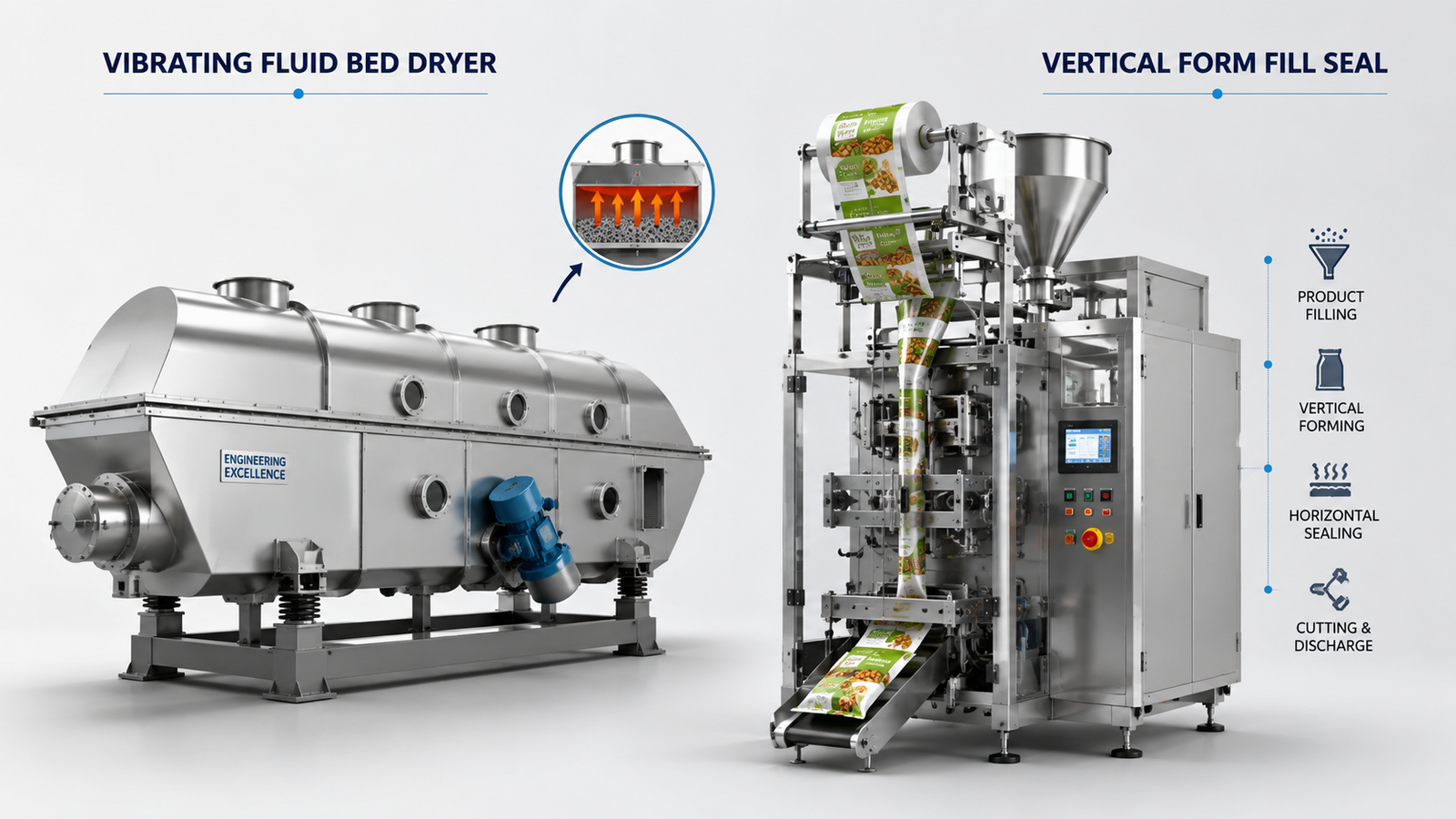
A vibrating fluid bed dryer is an industrial drying system designed to remove moisture from powders, granules and other free-flowing materials efficiently and consistently. By combining controlled hot-air flow with mechanical vibration, the equipment improves material movement and heat transfer while helping achieve uniform drying.
For manufacturers, selecting the right dryer is not simply a matter of choosing the highest-capacity machine. Material characteristics, required final moisture content, residence time, temperature sensitivity, production rate, hygiene requirements and downstream packaging all influence the right configuration.
This guide explains how a vibrating fluid bed dryer works, where it is used, what its advantages are, and which factors should be considered before investing in one.
What Is a Vibrating Fluid Bed Dryer?
A vibrating fluid bed dryer is a continuous or batch industrial dryer in which material is suspended or partially fluidised by a stream of heated air while the drying chamber vibrates.
The combination of fluidisation and vibration promotes movement of individual particles through the drying zone. Hot air comes into contact with a large surface area of the product, allowing moisture to evaporate and leave with the exhaust air.
Compared with conventional static drying arrangements, the vibrating action can improve product movement and reduce the likelihood of material remaining stationary in one area of the drying chamber.
The equipment is commonly considered for applications involving:
· Powders
· Granules
· Crystals
· Agglomerates
· Food ingredients
· Pharmaceutical intermediates
· Chemicals
· Fertilisers
· Minerals
· Agricultural and animal-feed products
The exact design depends heavily on the product being processed.
How Does a Vibrating Fluid Bed Dryer Work?
The operating principle is relatively straightforward:
1. Product feeding – Wet material enters the fluid bed dryer at a controlled rate.
2. Air heating – Process air is heated to the required temperature.
3. Fluidisation – Air passes through the perforated or porous bed, creating contact between the heated air and product particles.
4. Vibration – A controlled vibrating mechanism moves the material through the drying chamber.
5. Moisture evaporation – Heat transfers into the particles, causing moisture to evaporate.
6. Exhaust – Moist, used air is removed from the system.
7. Discharge – Dried material leaves the dryer at the desired moisture level.
The drying process can be controlled through parameters such as air temperature, airflow, vibration intensity, feed rate and residence time.
Why combine vibration with fluidisation?
Fluidisation provides efficient contact between air and particles, while vibration assists product movement through the dryer.
This combination can be particularly useful where controlled residence time and even exposure to drying air are important.
Vibrating Fluid Bed Dryer vs Conventional Fluid Bed Dryer
Both systems use heated air to dry material, but vibration introduces an additional method of controlling product movement.
A vibrating fluid bed dryer may be advantageous when the process requires:
· Controlled material conveyance
· Consistent residence time
· Continuous operation
· Improved particle distribution
· Gentle movement of suitable products
· Integration with upstream and downstream equipment
However, vibration is not automatically better for every application. The correct solution depends on particle size, density, moisture content, stickiness, temperature sensitivity and the desired production process.
A technical evaluation or product trial is therefore recommended before final equipment selection.
Key Benefits of a Vibrating Fluid Bed Dryer
1. Efficient heat and mass transfer
Fluidisation exposes a large product surface area to the drying air. This can support efficient evaporation and help achieve the required final moisture level.
2. More controlled product movement
The vibrating mechanism assists the movement of material through the drying chamber, making the equipment suitable for continuous drying applications where residence time needs to be controlled.
3. Continuous processing
Many vibrating fluid bed dryers are designed for continuous production. This can make them suitable for manufacturing environments where drying is integrated into a larger processing line.
4. Flexible process control
Drying conditions can be adjusted according to the product. Typical variables include:
· Inlet air temperature
· Air volume
· Product feed rate
· Vibration parameters
· Residence time
· Exhaust conditions
This flexibility is important when processing products with different moisture and temperature requirements.
5. Potential for process-line integration
A dryer can be engineered as part of a wider production system rather than operating as an isolated machine.
For example, a processing line might incorporate:
Feeding → Wet processing → Vibrating fluid bed drying → Cooling → Screening → Packaging
Depending on the product, additional equipment such as dust collection, sieving, weighing or metal detection may also be required.
Applications of Vibrating Fluid Bed Dryers
Vibrating fluid bed drying technology is used across several industrial sectors.
Food processing
Potential applications include drying food ingredients, grains, cereals, pulses, snacks and other granular products where controlled moisture removal is required.
Food applications generally require particular attention to hygiene, cleanability, product-contact materials and temperature control.
Pharmaceutical manufacturing
Pharmaceutical processing can require precise control of moisture, temperature and residence time. Dryer construction may therefore need to meet stringent hygiene and process requirements.
The exact equipment specification should be established according to the product, manufacturing process and applicable regulatory requirements.
Chemical processing
Chemicals, salts, crystals and other granular materials can be suitable for fluid bed drying where particle characteristics allow effective fluidisation.
Fertiliser and agricultural products
Granular fertilisers and agricultural materials may require drying after upstream processing. A vibrating system can provide controlled conveying and drying within a continuous process.
Minerals and industrial materials
Selected mineral and inorganic products can also be dried using fluidised-bed technology, provided their particle properties are suitable for the process.
Factors to Consider Before Buying a Vibrating Fluid Bed Dryer
Choosing a dryer based only on advertised capacity can lead to an unsuitable installation. A proper selection should begin with the product and process requirements.
Product characteristics
Important parameters include:
· Particle size distribution
· Bulk density
· Initial moisture content
· Target moisture content
· Particle shape
· Flowability
· Stickiness
· Heat sensitivity
· Product degradation characteristics
These characteristics influence airflow requirements, fluidisation behaviour and residence time.
Required production capacity
The dryer should be sized around the actual production requirement rather than a theoretical maximum.
Consider:
· Wet feed rate
· Hours of operation
· Moisture load
· Desired final moisture
· Product density
· Seasonal variations, where applicable
Drying temperature
Some products tolerate relatively high temperatures, while others may lose quality when exposed to excessive heat.
The objective is not simply to maximise temperature. It is to establish an appropriate combination of air temperature, airflow, residence time and product temperature.
Final moisture specification
A clear target moisture range is essential when selecting drying equipment.
For example, a process requiring a narrow final moisture specification may need more sophisticated control than an application where a broader moisture range is acceptable.
Hygiene and construction
For food, pharmaceutical and other hygiene-sensitive applications, construction details matter.
Depending on the process, considerations may include:
· Stainless-steel construction
· Product-contact surface finish
· Weld quality
· Cleanability
· Inspection access
· Drainability
· Dust control
· Hygienic design
Vibrating Fluid Bed Dryer and Packaging-Line Integration
Drying is often only one stage of the manufacturing process. Once the product reaches its required moisture level, it may need to be cooled, screened, weighed and packed.
This is where a vertical form fill seal machine can become relevant.
A vertical form fill seal machine, commonly abbreviated to VFFS, forms packaging film into a bag, fills the bag with product and seals it within an integrated packaging cycle.
A typical automated process might therefore look like:
Drying → Cooling → Screening → Product handling → Weighing → Vertical form fill seal packaging
The exact arrangement depends on the product and packaging format.
For manufacturers considering a complete processing solution, it can be useful to evaluate the dryer and packaging equipment together. Product temperature, residual moisture, particle flowability and discharge characteristics can all affect downstream packaging performance.
What Is the Difference Between a Fluid Bed Dryer and a Fluid Bed Cooler?
A fluid bed dryer primarily removes moisture from the product, whereas a fluid bed cooler is designed to reduce product temperature.
In some processing lines, drying and cooling may be carried out in separate zones or integrated into the same equipment arrangement.
Cooling can be particularly important before packaging. Packing a product while it is still too warm can affect packaging performance and, depending on the product, may contribute to condensation or quality issues.
Is a Vibrating Fluid Bed Dryer Suitable for Heat-Sensitive Products?
It can be, but suitability must be established through process evaluation.
Heat-sensitive products may require relatively low product temperatures and carefully controlled residence times. Because drying depends on several interacting variables, simply specifying a low inlet temperature does not guarantee product protection.
For temperature-sensitive materials, manufacturers should consider product trials and obtain drying data before committing to a full-scale system.
How Is a Vibrating Fluid Bed Dryer Sized?
Dryer sizing is normally based on the product’s moisture load and required production conditions rather than feed rate alone.
A simplified material balance can be useful as an initial assessment.
For example, if a process feeds wet material containing a known percentage of moisture and the finished product must meet a lower moisture specification, the amount of water that must be removed can be calculated. That evaporation duty then forms part of the basis for determining the dryer capacity.
Other factors include:
· Feed temperature
· Inlet-air conditions
· Product properties
· Required evaporation rate
· Residence time
· Airflow
· Heat-transfer conditions
· Desired final moisture
· Operating environment
A qualified equipment supplier should confirm final sizing using representative product data and, where necessary, trials.
What Information Should You Give a Dryer Manufacturer?
Providing accurate process information can significantly improve the quality of a technical proposal.
When requesting a quotation, consider supplying:
Product
· Product name and description
· Particle size
· Bulk density
· Heat sensitivity
· Flow characteristics
Moisture
· Initial moisture content
· Target final moisture
· Moisture basis, where relevant
Production
· Wet feed rate
· Desired operating hours
· Batch or continuous operation
Process
· Feed temperature
· Maximum permissible product temperature
· Available utilities
· Installation environment
Downstream requirements
· Cooling
· Screening
· Conveying
· Storage
· Weighing
· Packaging
The more complete the process information, the more meaningful the equipment recommendation is likely to be.
Common Questions About Vibrating Fluid Bed Dryers
What is the main purpose of a vibrating fluid bed dryer?
Its main purpose is to remove moisture from suitable powders, granules or particulate materials using heated air combined with controlled vibration and fluidisation.
What products can be dried in a vibrating fluid bed dryer?
Potential products include food ingredients, pharmaceutical materials, chemicals, fertilisers, minerals and other free-flowing particulate materials. Suitability depends on the product’s physical and thermal properties.
Is a vibrating fluid bed dryer suitable for continuous production?
Yes. Continuous vibrating fluid bed dryers are commonly designed to move material through the drying chamber while controlling drying conditions and residence time.
Can drying and cooling be combined?
In some system designs, drying and cooling can be incorporated into separate zones within an integrated fluid bed arrangement. The appropriate configuration depends on the product and process.
Can a vibrating fluid bed dryer be connected to a VFFS packaging machine?
Yes, where the product and process requirements are compatible. A typical line may connect drying and cooling equipment with conveying, weighing and a vertical form fill seal packaging machine.
How do I choose the right vibrating fluid bed dryer?
Start with the product characteristics, moisture removal requirement, production capacity, temperature limitations and downstream process. For critical applications, product testing and process trials can help validate the proposed dryer configuration.
Practical Example: From Wet Granules to Finished Packs
Consider a manufacturer producing a granular ingredient that needs its moisture reduced to a defined specification before packaging.
A possible process could be:
Wet granule feed → Vibrating fluid bed dryer → Fluid bed cooling → Screening → Weighing → VFFS packaging
The dryer removes the required moisture while moving the product continuously. Cooling then brings the product to a more suitable temperature for handling and packaging. Screening can remove oversized particles or agglomerates, while the weighing and packaging stages prepare the finished product for dispatch.
The important point is that the dryer should be selected as part of the complete process, rather than as a standalone piece of equipment.
Internal Linking Opportunities
If this article forms part of an industrial equipment website, useful internal links could include:
· Fluid Bed Dryer → Link to the main fluid bed dryer product/category page
· Industrial Drying Equipment → Link to the complete drying-equipment range
· Pharmaceutical Drying Solutions → Link to pharmaceutical processing equipment
· Food Processing Equipment → Link to food-industry equipment
· VFFS Packaging Machine → Link to the vertical form fill seal machine product page
· Industrial Packaging Machines → Link to the packaging equipment category
· Contact Our Technical Team → Link to the enquiry/contact page
These links should point to genuinely relevant pages rather than being added solely for SEO.
Choosing a Vibrating Fluid Bed Dryer Supplier
The machine itself is only part of the investment. Technical support, process understanding and after-sales service can be equally important.
Before choosing a supplier, ask:
· Can they assess your specific product?
· Can they provide process calculations?
· Is product testing available?
· What materials of construction are offered?
· How is airflow controlled?
· How is vibration controlled?
· What instrumentation is included?
· Can the dryer integrate with existing equipment?
· What commissioning and after-sales support is available?
· Can the supplier support future capacity or process changes?
A supplier that takes time to understand the complete process is generally better placed to recommend an appropriate configuration than one quoting from capacity alone.
Get the Right Dryer for Your Process
A vibrating fluid bed dryer can be an effective solution for controlled drying of suitable particulate materials, particularly where continuous conveying, fluidisation and controlled residence time are important.
The right specification, however, depends on the product. Moisture content, particle characteristics, thermal sensitivity, production rate and downstream requirements all need to be considered before equipment is selected.