
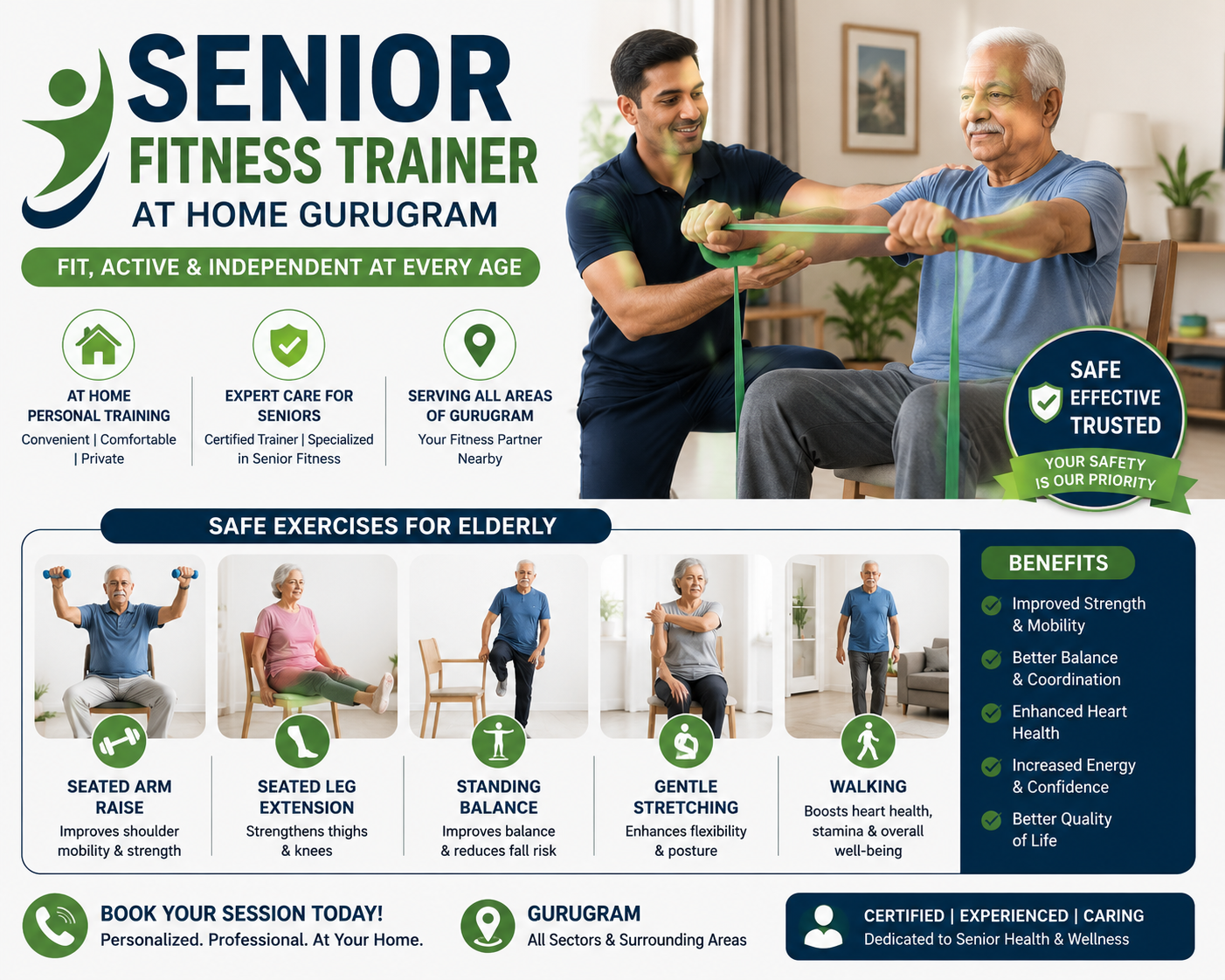
Growing older changes the way the body responds to physical activity, but it does not remove the need to stay active. Strength, balance, flexibility, coordination and endurance all influence how comfortably an older adult can perform everyday activities. This is why families are increasingly considering a Senior fitness trainer at home Gurugram to provide personalised exercise guidance without requiring elderly family members to visit a gym.
The right approach is not about intense workouts. It is about choosing Safe exercises for elderly adults that match their present abilities and gradually support better functional movement.
Why Regular Exercise Matters for Senior Citizens
Ageing is commonly associated with changes in muscle strength, joint mobility, balance and physical endurance. An inactive lifestyle can make everyday movements feel increasingly difficult.
Regular physical activity can support the movements seniors use every day, including:
- Standing up from a chair
- Walking around the house
- Using stairs
- Reaching for objects
- Maintaining posture
- Carrying light items
- Moving confidently outdoors
The emphasis should be on maintaining useful physical capabilities rather than achieving conventional gym targets.
Why Choose a Senior Fitness Trainer at Home Gurugram?
For some seniors, travelling to a gym can itself become an obstacle. Traffic, transportation, crowded environments and unfamiliar equipment may discourage consistent exercise.
Hiring a Senior fitness trainer at home Gurugram allows training to take place in familiar surroundings.
A trainer can observe the individual’s current movement patterns and select exercises according to strength, mobility, balance and fitness experience.
Home fitness can also provide one-to-one attention that may be difficult to achieve in group classes.
What Makes Senior Exercise Different?
Senior fitness should not simply involve reducing the repetitions of a standard adult workout.
An older person’s exercise plan needs to consider movement quality, stability, recovery and functional requirements.
A well-designed programme generally combines:
- Strength training
- Balance exercises
- Mobility work
- Cardiovascular activity
- Flexibility exercises
- Coordination training
The exact combination should vary from person to person.
Safe Exercises for Elderly Adults at Home
Many Safe exercises for elderly adults require little or no specialist equipment. A stable chair, clear floor space and wall support can be enough for several useful movements.
Chair Sit-to-Stand
Sit towards the front of a sturdy chair with both feet firmly on the floor.
Lean slightly forward and stand gradually. Pause before returning to the seated position in a controlled manner.
The movement targets muscles involved in standing, walking and climbing stairs.
Wall Push-Ups
Stand facing a wall and place both palms against it.
Slowly bend the elbows and move towards the wall. Push gently through the hands to return to the starting position.
Wall push-ups offer an accessible upper-body exercise without requiring the senior to exercise on the floor.
Supported Calf Raises
Stand behind a sturdy chair and hold it for support.
Slowly lift the heels from the floor, pause and return them to the ground.
This exercise works the calf muscles and can form part of a balance-focused routine.
Seated Knee Extensions
Sit upright in a chair.
Gradually straighten one leg, briefly hold the position and lower it. Repeat with the other leg.
The exercise is particularly useful when a standing activity is not appropriate.
Seated Marching
While seated comfortably, alternate lifting the knees.
Seated marching provides gentle movement for the hips and legs while also requiring coordination.
Gentle Walking
Walking is one of the most accessible physical activities for many seniors.
Duration and pace should match individual capability. Someone beginning after a long period of inactivity may need much shorter walks than an already active senior.
Balance Exercises Deserve Special Attention
Balance training can be an important part of Safe exercises for elderly adults.
Exercises may include supported single-leg standing, controlled weight shifting or heel-to-toe walking.
Support should remain readily available whenever required.
A Senior fitness trainer at home Gurugram can supervise these activities and determine when an exercise needs to be simplified or progressed.
Strength, Balance and Mobility Compared
| Exercise Category | Examples | Primary Focus |
| Strength | Sit-to-stand, wall push-up | Functional muscle strength |
| Balance | Weight shifting, supported standing | Stability |
| Mobility | Shoulder circles, ankle movements | Comfortable movement |
| Cardiovascular | Walking, gentle marching | Endurance |
| Flexibility | Gentle calf or upper-body stretches | Range of movement |
| Coordination | Seated alternating movements | Movement control |
A balanced programme normally incorporates several categories rather than relying on a single type of exercise.
How a Home Fitness Session Can Be Structured
A senior exercise session should have a logical progression.
Warm-Up
The session can begin with comfortable walking, ankle movements, shoulder circles and other gentle mobility exercises.
Functional Strength Training
The trainer may introduce sit-to-stands, supported leg exercises, wall presses or light resistance movements.
Balance Training
Simple balance drills can follow, with stable support available where appropriate.
Cardiovascular Movement
Walking or another suitable low-impact activity can be used according to endurance.
Cool-Down
Gentle movements and stretching can help bring the session to a gradual finish.
How Exercise Should Progress With Age
Progress does not always mean adding heavier weights.
For an older adult, meaningful improvement could involve completing a movement with better control, walking comfortably for longer or requiring less assistance during an appropriate exercise.
A professional Senior fitness trainer at home Gurugram should therefore measure progress according to functional ability as well as conventional exercise indicators.
Small Improvements Can Have Practical Value
Being able to complete an additional controlled sit-to-stand may appear like a small achievement, but it can represent meaningful progress when the same movement is required repeatedly during everyday life.
Common Exercise Mistakes Seniors Should Avoid
Exercise becomes less useful when intensity takes priority over appropriate technique.
Some common mistakes include:
- Starting too aggressively
- Exercising on slippery surfaces
- Using unstable furniture for support
- Moving too quickly
- Holding the breath during exercises
- Ignoring significant pain
- Copying advanced internet workouts
- Increasing resistance too quickly
- Skipping warm-ups
- Comparing progress with other people
The safest approach is individual and progressive.
How to Choose the Right Senior Fitness Trainer
Not every personal trainer specialises in working with elderly clients.
When selecting a Senior fitness trainer at home Gurugram, families should consider experience, qualifications and communication style.
Ask questions such as:
- Have you previously trained senior citizens?
- How do you assess mobility and balance?
- How do you modify difficult exercises?
- How is progress monitored?
- What happens if an exercise causes discomfort?
- How do you approach balance exercises?
- What equipment will be required?
A trainer should also recognise situations where medical or physiotherapy guidance may be appropriate.
Creating a Safe Exercise Environment at Home
The environment is an important part of senior fitness.
Before beginning Safe exercises for elderly, check whether the workout area has adequate space and stable support.
Remove unnecessary obstacles and loose objects from the exercise area. A lightweight chair that moves easily should not be used as balance support.
Appropriate footwear and adequate lighting are equally important.
How Often Should Seniors Exercise?
There is no single exercise schedule appropriate for every elderly adult.
Frequency depends on current fitness, exercise intensity, recovery and individual circumstances.
Rather than attempting long, exhausting workouts occasionally, many seniors may find shorter and more consistent activity easier to maintain.
A trainer can also provide simple exercises that may be performed independently between supervised sessions when appropriate.
When Professional Guidance Becomes Important
Older adults with existing medical conditions, recent surgery, significant balance difficulties or unexplained physical symptoms should obtain appropriate healthcare advice before starting or substantially changing an exercise programme.
Exercise should also be stopped when symptoms such as sudden significant pain, severe unusual breathlessness, chest discomfort or dizziness occur.
A fitness trainer should work within professional boundaries and should not attempt to diagnose or treat medical conditions.
Frequently Asked Questions
1. What are the best Safe exercises for elderly adults?
Walking, chair sit-to-stands, wall push-ups, seated leg exercises and appropriately supported balance activities are common options.
2. Why hire a Senior fitness trainer at home Gurugram?
Home trainers provide personalised supervision, exercise modification and convenient training without regular travel to a fitness centre.
3. Can seniors start exercising after 70?
Many people can begin appropriate physical activity later in life, although individual fitness and medical circumstances should be considered.
4. Are chair exercises useful for seniors?
Yes. Chair-based exercises can support strength, mobility and coordination while providing additional stability.
5. Is walking good exercise for elderly people?
Walking can support cardiovascular endurance and everyday mobility when performed at an appropriate pace and duration.
6. Can seniors perform strength training?
Appropriately selected resistance exercises can form part of senior fitness programmes.
7. What equipment is required for home workouts?
Many programmes use only a sturdy chair, wall, resistance bands or light weights.
8. How can seniors work on balance?
Supported standing, controlled weight shifting and appropriate walking drills can be included in balance training.
9. Should elderly people exercise every day?
The appropriate frequency depends on exercise type, intensity, recovery and individual ability.
10. How long should a senior fitness session last?
There is no fixed duration. Sessions should be adjusted according to endurance, ability and the activities being performed.
https://newsgrow.blogspot.com/2026/08/senior-fitness-trainer-at-home-gurugram.html