
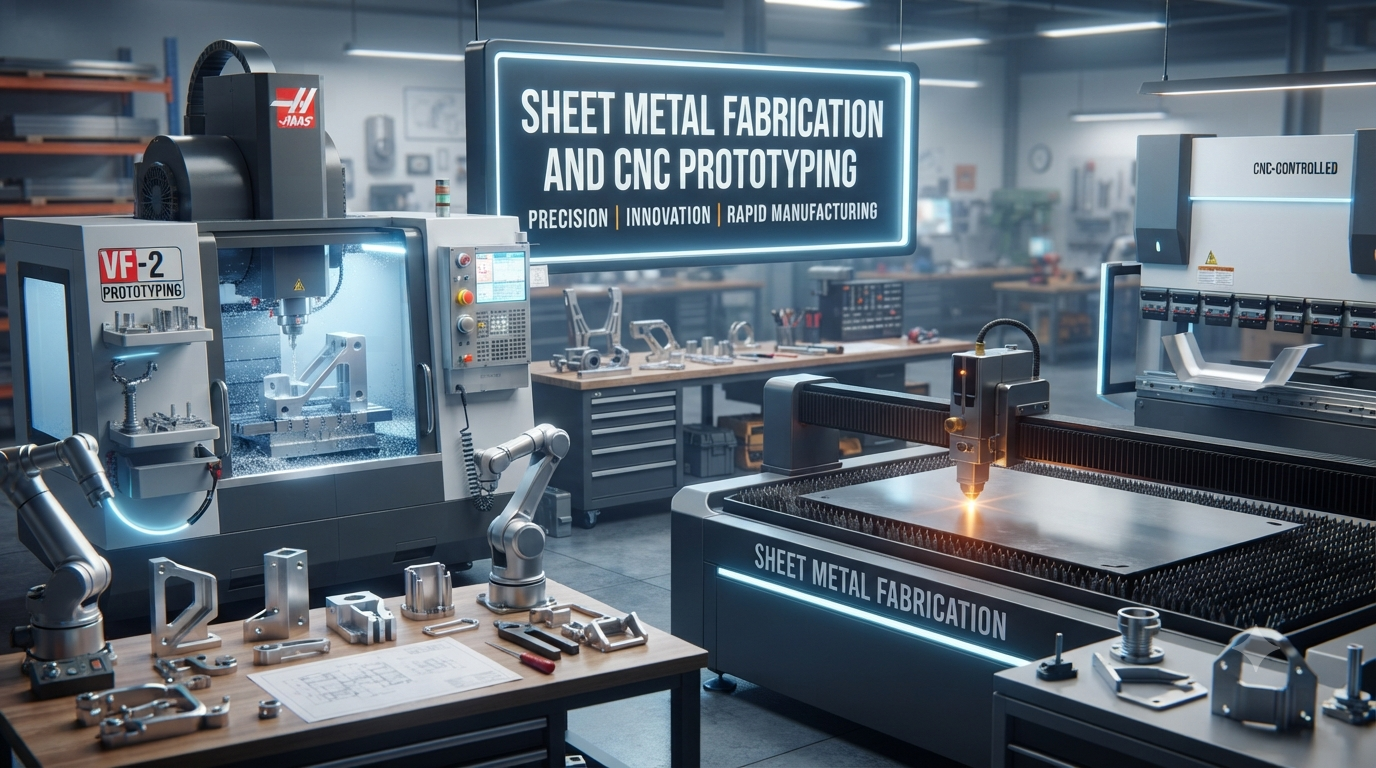
The manufacturing industry is entering a new era in which speed, precision, and flexibility are becoming essential to successful product development. As businesses seek to move from design concepts to market-ready products faster, sheet metal fabrication and CNC prototyping are emerging as two important manufacturing approaches for engineers, product designers, and manufacturers.
From industrial equipment and automotive components to electronics enclosures and consumer products, companies increasingly need prototypes that closely represent the final product. Modern fabrication and computer-controlled machining technologies help businesses test designs, identify potential problems, and make improvements before committing to full-scale production.
The growing demand for customized components is also encouraging manufacturers to combine digital design tools with advanced production processes. This approach can reduce development delays while supporting consistent quality and more efficient manufacturing workflows.
Why Sheet Metal Fabrication Remains Important
Sheet metal fabrication involves transforming flat metal sheets into functional components through processes such as cutting, bending, forming, punching, and joining. Depending on the application, manufacturers may work with materials including stainless steel, aluminum, mild steel, and galvanized steel.
The process is widely used because sheet metal offers a practical balance of strength, durability, weight, and cost. It is particularly valuable when manufacturers need lightweight structures or components that can withstand demanding operating conditions.
Common applications include:
- Electrical and electronic enclosures
- Industrial machine panels
- Automotive components
- HVAC systems
- Control cabinets
- Brackets and mounting parts
- Equipment housings
- Consumer product components
Modern fabrication equipment can deliver highly accurate cuts and bends, helping manufacturers maintain dimensional consistency across different production volumes.
Digital Manufacturing Improves Fabrication Accuracy
The integration of CAD software, CNC machinery, and automated production systems has significantly changed traditional fabrication workflows. Digital files can move directly from engineering design to manufacturing equipment, reducing manual intervention and improving repeatability.
Laser cutting, CNC punching, press braking, and robotic welding can be combined into a coordinated production process. This enables manufacturers to create complex components while maintaining tighter control over dimensions and material usage.
CNC Prototyping Speeds Up Product Development
CNC prototyping is another increasingly important method for creating functional product samples. CNC, or computer numerical control, machines use programmed instructions to remove material from a solid block and produce highly accurate components.
Unlike some additive manufacturing techniques, CNC machining can create prototypes from production-grade materials. This allows engineers to evaluate physical properties such as strength, durability, surface finish, and mechanical performance.
CNC prototypes are commonly produced for:
- Automotive engineering
- Aerospace applications
- Medical equipment
- Robotics
- Electronics
- Industrial machinery
- Consumer products
Because CNC machining can achieve excellent dimensional accuracy, it is particularly useful when prototypes must fit with existing assemblies or moving components.
From Digital Design to Physical Prototype
The CNC prototyping process generally begins with a 3D CAD model. Engineers review the design, select an appropriate material, and determine the machining strategy. The CNC machine then follows programmed toolpaths to produce the physical part.
This workflow allows product teams to identify issues early. A prototype may reveal problems involving tolerances, assembly, ergonomics, or functionality that are difficult to detect through digital models alone.
Sheet Metal Fabrication vs. CNC Prototyping
Although both processes support product development, they serve different manufacturing requirements.
| Feature | Sheet Metal Fabrication | CNC Prototyping |
| Primary material | Metal sheets | Solid metal or plastic blocks |
| Typical process | Cutting, bending, forming, joining | Milling, turning, drilling |
| Best suited for | Panels, enclosures, brackets | Complex precision components |
| Design flexibility | Excellent for formed sheet parts | Excellent for detailed geometries |
| Material testing | Strong production relevance | High material and functional accuracy |
| Typical applications | Cabinets, housings, structural parts | Mechanical prototypes and precision parts |
Choosing between these methods depends on the product’s design, material, geometry, performance requirements, and expected production volume.
How Both Technologies Support Faster Innovation
Modern product development is increasingly focused on shortening the time between concept and commercialization. Delays during prototyping can increase costs and give competitors opportunities to reach the market first.
Using sheet metal fabrication and CNC prototyping strategically can help manufacturers improve several stages of development.
Key advantages include:
- Faster design validation
- Better dimensional accuracy
- Early identification of manufacturing problems
- Improved product testing
- Greater material flexibility
- Reduced risk before mass production
- Easier design modifications
- More reliable assembly testing
The ability to quickly modify digital designs and produce revised prototypes creates a more responsive product development cycle.
Choosing the Right Manufacturing Partner
Selecting a capable manufacturing provider is essential for achieving consistent results. Businesses should evaluate technical expertise, equipment capabilities, quality-control systems, material options, and communication processes before starting a project.
Important considerations include:
- CAD and engineering support
- CNC machining capabilities
- Sheet metal cutting and bending equipment
- Material availability
- Prototype turnaround times
- Quality inspection procedures
- Finishing and assembly services
- Ability to support low-volume production
A manufacturer with integrated engineering and production capabilities can often help identify design improvements before manufacturing begins.
The Future of Digital Fabrication and Prototyping
The next phase of manufacturing is likely to be shaped by greater automation, smarter software, and increasingly connected production systems. Artificial intelligence, digital twins, automated inspection, and advanced CAD/CAM platforms are expected to play a larger role in manufacturing decision-making.
For manufacturers, the objective is no longer simply to produce a component. The focus is shifting toward building a streamlined digital-to-physical workflow that improves speed, quality, and cost efficiency.
As product designs become more sophisticated, sheet metal fabrication and CNC prototyping will remain valuable technologies for companies seeking practical ways to test and refine new ideas.
Frequently Asked Questions
1. What is sheet metal fabrication?
Sheet metal fabrication is the process of converting flat metal sheets into finished components through cutting, bending, forming, punching, and joining techniques.
2. What is CNC prototyping?
CNC prototyping uses computer-controlled machining equipment to manufacture accurate prototype components from materials such as metals and engineering plastics.
3. Which materials are used in sheet metal fabrication?
Common materials include aluminum, stainless steel, mild steel, galvanized steel, and other specialized alloys selected according to application requirements.
4. Which materials can CNC machines process?
CNC machines can work with various metals, plastics, and engineering materials. The best option depends on the required strength, durability, weight, and finish.
5. Is CNC prototyping suitable for functional testing?
Yes. CNC prototypes can often be produced using materials similar to those intended for final products, making them useful for functional and assembly testing.
6. What industries use sheet metal fabrication?
Automotive, electronics, aerospace, HVAC, industrial machinery, construction, and consumer products are among the industries that regularly use fabricated sheet metal components.
7. Why is CNC prototyping useful for engineers?
It allows engineers to evaluate physical designs, check dimensions, test assemblies, and identify potential issues before moving into larger-scale production.
8. Can sheet metal fabrication be customized?
Yes. Components can be customized according to specific dimensions, materials, shapes, finishes, and functional requirements.
9. How do manufacturers improve prototype accuracy?
They use precise CAD models, advanced CNC equipment, calibrated inspection tools, appropriate machining strategies, and systematic quality-control processes.
10. How should companies choose between the two processes?
The decision should consider component geometry, material, tolerance requirements, production volume, functionality, and intended application. Some projects may benefit from using both methods.
https://newsgrow.blogspot.com/2026/07/sheet-metal-fabrication-and-cnc.html
https://shopnets.com/sheet-metal-fabrication-and-cnc-prototyping-building-better-products-faster/