
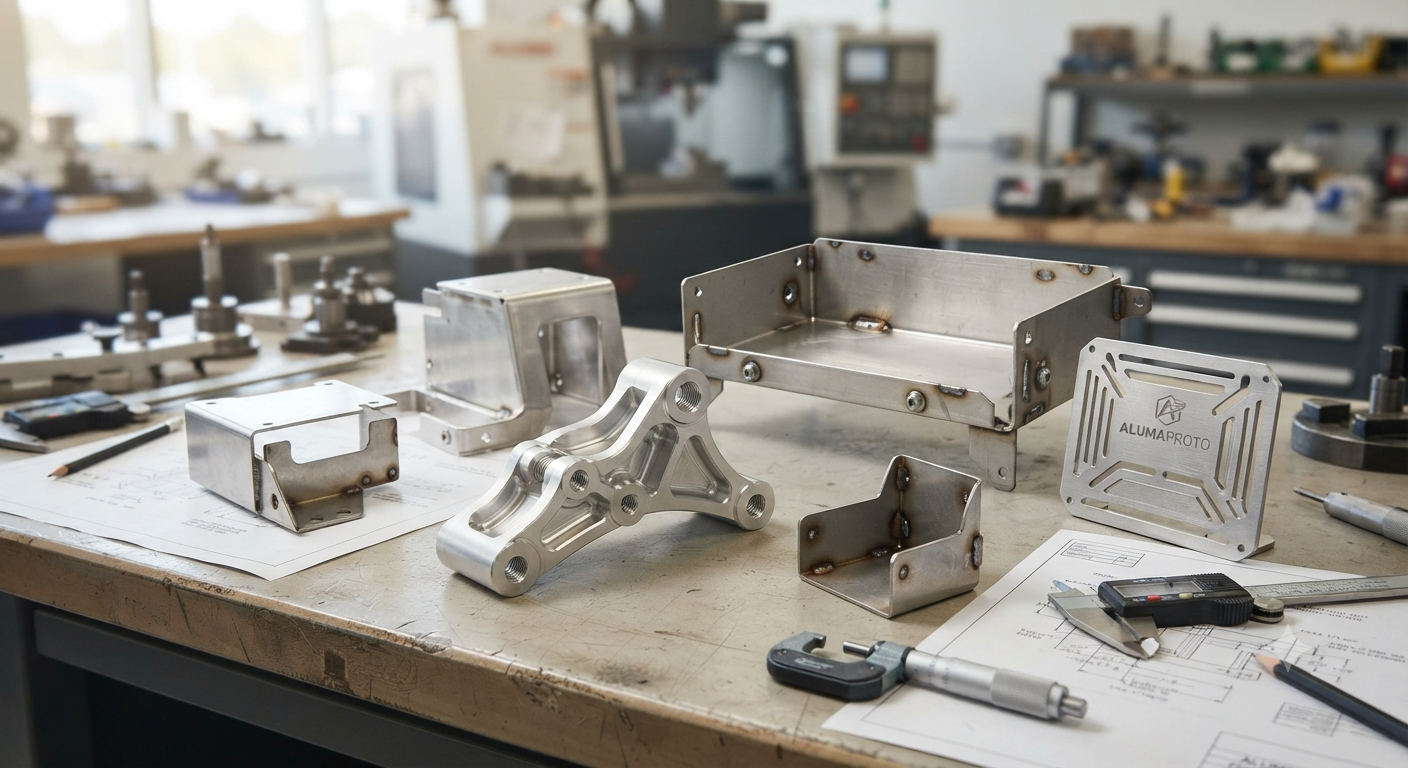
Modern product development is moving faster than ever. Businesses need to test new ideas, validate designs, and prepare products for manufacturing without spending excessive time or money on early-stage production. This is where aluminum prototype development and sheet metal prototyping become valuable.
From automotive components and aerospace parts to electronics enclosures and industrial machinery, prototypes help engineers identify design problems before mass production begins. Aluminum is particularly popular because it combines low weight, strength, corrosion resistance, and excellent machinability.
At the same time, sheet metal prototyping provides a practical way to evaluate brackets, housings, panels, frames, and other fabricated components. Together, these manufacturing approaches help companies turn digital concepts into functional products with greater confidence.
What Is an Aluminum Prototype?
An aluminum prototype is an early-stage product or component manufactured from aluminum to evaluate a design before full-scale production. Unlike a simple visual model, a functional aluminum prototype can often be tested under real operating conditions.
Aluminum is widely selected for prototypes because it offers a useful balance of performance and manufacturing flexibility. Depending on the project, manufacturers may use CNC machining, milling, turning, or other fabrication techniques to create accurate prototype parts.
Key advantages include:
- Lightweight construction
- High strength-to-weight ratio
- Good corrosion resistance
- Excellent machinability
- Attractive surface appearance
- Strong thermal conductivity
- Compatibility with several finishing processes
For engineers, these characteristics make aluminum prototypes suitable for testing both form and function.
Why Aluminum Is Popular for Prototyping
Choosing the right prototype material can significantly affect the quality of product testing. Aluminum often performs well when designers need a prototype that behaves similarly to a production-quality component.
For example, an aluminum prototype can help engineers assess:
- Dimensional accuracy and component fit
- Mechanical performance
- Heat management
- Assembly compatibility
- Surface finishing requirements
- Ergonomics and usability
Aluminum also works well for products that require lightweight structures without sacrificing durability. This makes it common in transportation, robotics, electronics, medical equipment, and industrial applications.
Understanding Sheet Metal Prototyping
Sheet metal prototyping involves producing early-stage components from flat sheets of metal. The material is typically cut, bent, punched, or formed into a desired shape.
This method is especially useful when a final product will eventually be manufactured using sheet metal fabrication. Instead of waiting for mass production, engineers can create a small number of prototype parts to verify the design.
Common sheet metal prototype applications include:
- Electrical and electronic enclosures
- Equipment cabinets
- Automotive brackets
- Machine guards
- Control panels
- Mounting plates
- Structural frames
- HVAC components
The process allows product teams to discover design limitations early and make improvements before committing to expensive production tooling.
Typical Sheet Metal Prototyping Process
A typical project may follow these stages:
1. Design development: Engineers create a 3D CAD model or technical drawing.
2. Material selection: The appropriate metal thickness and material are selected according to strength, weight, cost, and application requirements.
3. Cutting: Laser cutting, waterjet cutting, or other methods are used to produce the required flat pattern.
4. Forming: The sheet is bent or shaped using suitable fabrication equipment.
5. Assembly: Components may be welded, fastened, or joined together.
6. Finishing: Deburring, powder coating, anodizing, painting, or other treatments may be applied.
7. Inspection: The finished prototype is checked for dimensional accuracy and functional performance.
Aluminum Prototype vs. Sheet Metal Prototyping
Although both methods support product development, they serve different purposes. The best choice depends on the component’s geometry, performance requirements, and intended manufacturing process.
| Feature | Aluminum Prototype | Sheet Metal Prototyping |
| Typical process | CNC machining or fabrication | Cutting and bending |
| Best for | Complex solid components | Panels, brackets, enclosures |
| Material form | Aluminum blocks, plates, or profiles | Flat metal sheets |
| Geometric flexibility | High for machined parts | Best for formed designs |
| Tooling needs | Usually low for prototypes | Usually low for prototypes |
| Surface options | Anodizing, polishing, coating | Powder coating, painting, plating |
| Ideal application | Functional precision components | Fabricated structures and housings |
The two approaches can also be combined. For example, a product may use a machined aluminum component alongside a sheet metal enclosure during prototype development.
How Prototyping Improves Product Development
A strong prototyping strategy can reduce uncertainty throughout the engineering process. Instead of relying entirely on computer simulations or assumptions, teams can physically evaluate a component.
The major benefits include:
- Faster design validation: Physical parts reveal issues that may not be obvious in CAD models.
- Lower development risk: Problems can be corrected before expensive production begins.
- Improved functionality: Engineers can test fit, movement, strength, and usability.
- Better communication: A physical prototype makes it easier for teams and stakeholders to understand the proposed product.
- Reduced tooling investment: Low-volume prototypes can often be produced without committing to production molds or dies.
- More efficient iteration: Design changes can be tested through multiple prototype cycles.
This iterative approach is particularly valuable in industries where precision and reliability are critical.
Choosing the Right Prototyping Method
Before selecting an aluminum prototype or sheet metal prototyping process, product teams should evaluate several factors.
Consider the Part Geometry
Complex three-dimensional components may be better suited to CNC-machined aluminum. Flat or bent designs are often more appropriate for sheet metal fabrication.
Evaluate Performance Requirements
If the prototype must withstand mechanical loads, heat, or environmental exposure, material selection becomes especially important.
Consider Production Intent
A useful rule is to prototype using a process that closely represents the intended production method whenever practical. This can provide more realistic feedback about manufacturability.
Review Quantity and Budget
Prototype volume, deadlines, and budget all influence process selection. Low-volume production may favor flexible manufacturing methods that avoid costly tooling.
Check Finishing Requirements
If appearance or corrosion protection matters, consider the finishing process during the design stage rather than treating it as an afterthought.
Common Industries Using Aluminum and Sheet Metal Prototypes
These technologies support innovation across numerous sectors.
Automotive: Brackets, housings, structural components, and interior parts.
Aerospace: Lightweight components where weight reduction and precision are important.
Electronics: Enclosures, chassis, mounting systems, and protective covers.
Medical equipment: Housings and precision components used in specialized devices.
Robotics: Frames, brackets, mounts, and moving assemblies.
Industrial machinery: Guards, panels, fixtures, and custom machine components.
Frequently Asked Questions
1. What is an aluminum prototype?
It is a functional prototype manufactured from aluminum to test a product’s design, dimensions, performance, or assembly before production.
2. What is sheet metal prototyping?
It is the process of creating prototype components from metal sheets through cutting, bending, forming, and assembly.
3. Why is aluminum suitable for prototypes?
Aluminum is lightweight, machinable, corrosion-resistant, and available in several grades, making it useful for many functional applications.
4. Is aluminum prototyping expensive?
Cost depends on design complexity, material quantity, tolerances, finishing, and production volume. Prototype manufacturing is generally more economical when designs are optimized before production.
5. What industries use sheet metal prototypes?
Automotive, electronics, aerospace, robotics, medical technology, construction, and industrial equipment industries commonly use them.
6. Can sheet metal prototypes be customized?
Yes. Dimensions, bends, holes, cutouts, materials, finishes, and assembly methods can be customized according to project requirements.
7. Which is better: aluminum or sheet metal prototyping?
Neither is universally better. The right option depends on the component’s geometry, material requirements, function, quantity, and intended production method.
8. How does prototyping reduce manufacturing risk?
It allows engineers to identify design, fit, assembly, and performance problems before investing heavily in full-scale manufacturing.
9. Can prototypes receive surface finishing?
Yes. Depending on the material and application, options may include anodizing, powder coating, painting, polishing, and other treatments.
10. When should companies use rapid prototyping?
Rapid prototyping is valuable when teams need to test concepts quickly, accelerate design iterations, or validate a product before production tooling is developed.
https://newsgrow.blogspot.com/2026/07/aluminum-prototype-and-sheet-metal.html