Industrial manufacturers are rethinking how they purchase pigments and mineral fillers as product quality, raw material consistency, and supply chain reliability become increasingly important.
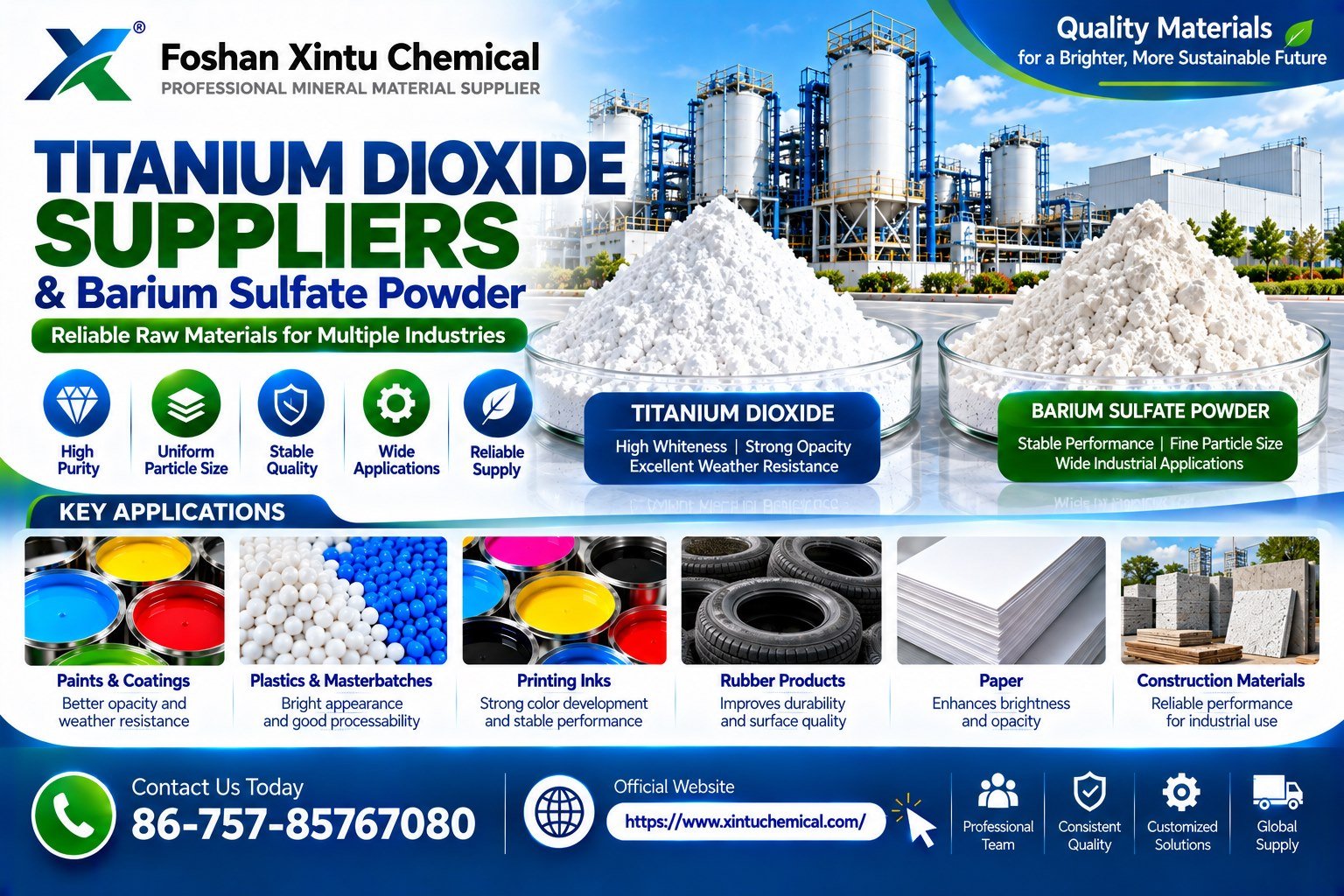
For businesses producing paints, coatings, plastics, and printing inks, working with dependable Titanium Dioxide Suppliers is essential for maintaining consistent product appearance and performance.
At the same time, Barium Sulfate Powder remains an important functional filler in selected industrial formulations, offering useful characteristics such as chemical stability, high density, and compatibility with suitable manufacturing systems.
Although these materials perform different functions, they are frequently considered together during formulation development and raw material procurement.
For manufacturers seeking greater purchasing efficiency, understanding their complementary roles can support better material decisions, more predictable production costs, and stronger supplier relationships.
Why Industrial Raw Material Sourcing Requires a New Approach
Purchasing industrial chemicals involves more than comparing quotations.
Raw material quality can influence finished-product appearance, manufacturing efficiency, customer satisfaction, and production reliability.
An inconsistent pigment may affect colour or hiding power, while an unsuitable mineral filler may influence viscosity, dispersion, or other formulation properties.
These differences can create manufacturing challenges that outweigh initial purchasing savings.
This perspective encourages manufacturers to assess suppliers according to both commercial and technical requirements.
Understanding the Role of Titanium Dioxide Suppliers
Titanium Dioxide Suppliers provide titanium dioxide pigments used in a wide range of industrial applications.
Titanium dioxide, represented by the chemical formula TiO₂, is valued for its high refractive index and ability to scatter visible light.
These characteristics make it useful for achieving whiteness, brightness, and opacity in suitable formulations.
Commercial titanium dioxide is available in different grades with varying particle properties and surface treatments.
Important Supplier Evaluation Factors
- Pigment Grade: Suitability for the intended manufacturing application.
- Optical Performance: Relevant whiteness, undertone, and hiding characteristics.
- Dispersibility: Compatibility with the selected formulation.
- Batch Consistency: Stability of agreed technical specifications.
- Documentation: Availability of technical and safety information.
Selecting an appropriate grade helps manufacturers align pigment performance with product requirements.
What Is Barium Sulfate Powder?
Barium Sulfate Powder is an inorganic material with the chemical formula BaSO₄.
It is available in naturally processed and synthetically precipitated grades.
The material is used as a functional filler in selected paints, coatings, plastics, inks, and other industrial products.
Its properties include high density, low water solubility, and chemical stability under many common application conditions.
Depending on the grade, particle characteristics may influence dispersion, surface appearance, and processing behaviour.
However, barium sulfate is not a universal replacement for titanium dioxide because the two materials have different optical properties.
How Titanium Dioxide and Barium Sulfate Work Together
Titanium dioxide and barium sulfate can perform complementary functions within certain industrial formulations.
Titanium dioxide primarily contributes light scattering and opacity, while barium sulfate may function as an extender or property-modifying filler.
Their combined use requires careful evaluation.
For example, changes in filler concentration may influence pigment spacing, viscosity, coating structure, and finished-product performance.
A formulation containing more mineral filler does not automatically deliver better results or lower total costs.
Laboratory testing remains essential when adjusting pigment and filler combinations.
Comparing Titanium Dioxide and Barium Sulfate Powder
| Material Property | Titanium Dioxide | Barium Sulfate Powder |
| Main Industrial Function | White pigment | Functional mineral filler |
| Chemical Formula | TiO₂ | BaSO₄ |
| Optical Characteristics | Strong visible-light scattering | Lower hiding contribution |
| Common Applications | Coatings, plastics, inks | Coatings, plastics, inks |
| Selection Priorities | Opacity, whiteness, dispersion | Particle size, purity, compatibility |
| Formulation Role | Primarily optical performance | Filling and property adjustment |
The appropriate material balance depends on the final product’s technical specifications.
Improving Supply Chain Reliability
Manufacturers depend on predictable raw material availability to maintain production schedules.
Disruptions in pigment or filler supply can affect manufacturing plans, inventory requirements, and customer deliveries.
Businesses should therefore consider supplier communication, material availability, packaging conditions, and documented product specifications.
Maintaining approved alternatives may provide additional flexibility, but substitution should follow appropriate testing.
A replacement grade can differ in particle distribution, surface treatment, or impurity characteristics even when its chemical composition appears similar.
Supply chain resilience depends on qualified material options rather than untested substitutions.
Why Total Formulation Cost Matters
Raw material prices are an important part of purchasing decisions, but they do not represent the complete cost of manufacturing.
A lower-priced ingredient may require changes in processing conditions or produce different finished-product characteristics.
Conversely, an appropriately selected pigment grade may support efficient formulation performance.
Manufacturers should examine factors such as material consumption, dispersion requirements, acceptable product yield, and relevant quality testing.
The objective is to achieve the required product performance at a commercially sustainable cost.
Formulation trials can provide stronger evidence than purchase-price comparisons alone.
Quality Assurance for Industrial Pigments and Fillers
Quality assurance helps manufacturers evaluate whether materials satisfy agreed requirements.
For titanium dioxide, relevant assessments may include optical properties, dispersibility, moisture content, and other grade-specific measurements.
For barium sulfate, manufacturers may assess chemical purity, particle size distribution, whiteness, and suitable physical characteristics.
Testing requirements should reflect the intended application.
A supplier’s certificate of analysis can support purchasing decisions, but manufacturers may still need independent testing and production trials.
Consistent inspection procedures help reduce uncertainty when materials are obtained from multiple sources.
Building Stronger Supplier Relationships
Long-term industrial procurement benefits from clear technical communication.
Manufacturers should provide suppliers with accurate application requirements, required specifications, and relevant purchasing expectations.
Suppliers should clarify product characteristics, available documentation, and any material limitations.
Commercial discussions should also address packaging, transportation, and procedures for handling quality concerns.
Businesses evaluating Titanium Dioxide Suppliers alongside mineral filler sources may benefit from coordinated purchasing arrangements, provided each material satisfies its individual performance requirements.
Responsible Storage and Material Handling
Powdered industrial materials require appropriate workplace handling practices.
Manufacturers should follow relevant safety data sheets and implement suitable dust-control measures.
Storage conditions should protect raw materials from contamination, moisture exposure where relevant, and physical packaging damage.
Industrial grades should not automatically be considered suitable for regulated applications such as food contact, pharmaceutical manufacturing, or cosmetics.
Such uses may require additional product specifications, testing, and regulatory assessment.
Frequently Asked Questions (FAQs)
1. What do Titanium Dioxide Suppliers provide?
They supply titanium dioxide materials, including pigment grades used in selected coatings, plastics, printing inks, and industrial formulations.
2. What is Barium Sulfate Powder used for?
It is commonly used as a functional mineral filler in suitable coatings, plastics, inks, and other industrial products.
3. Can barium sulfate replace titanium dioxide?
Not directly in every application. Titanium dioxide provides stronger hiding power, while barium sulfate serves different formulation functions.
4. Why should manufacturers evaluate raw material consistency?
Consistent specifications help reduce unwanted variations in appearance, processing behaviour, and finished-product quality.
5. How can businesses choose reliable chemical suppliers?
They should review material specifications, analytical documentation, application compatibility, supply reliability, and technical communication.
Media Contact
Department: Industrial Pigments and Mineral Fillers Enquiries
Contact: +86-757-85767080
Email: sales@xintuchemical.com
Official Website: https://www.xintuchemical.com/
Read More:-