
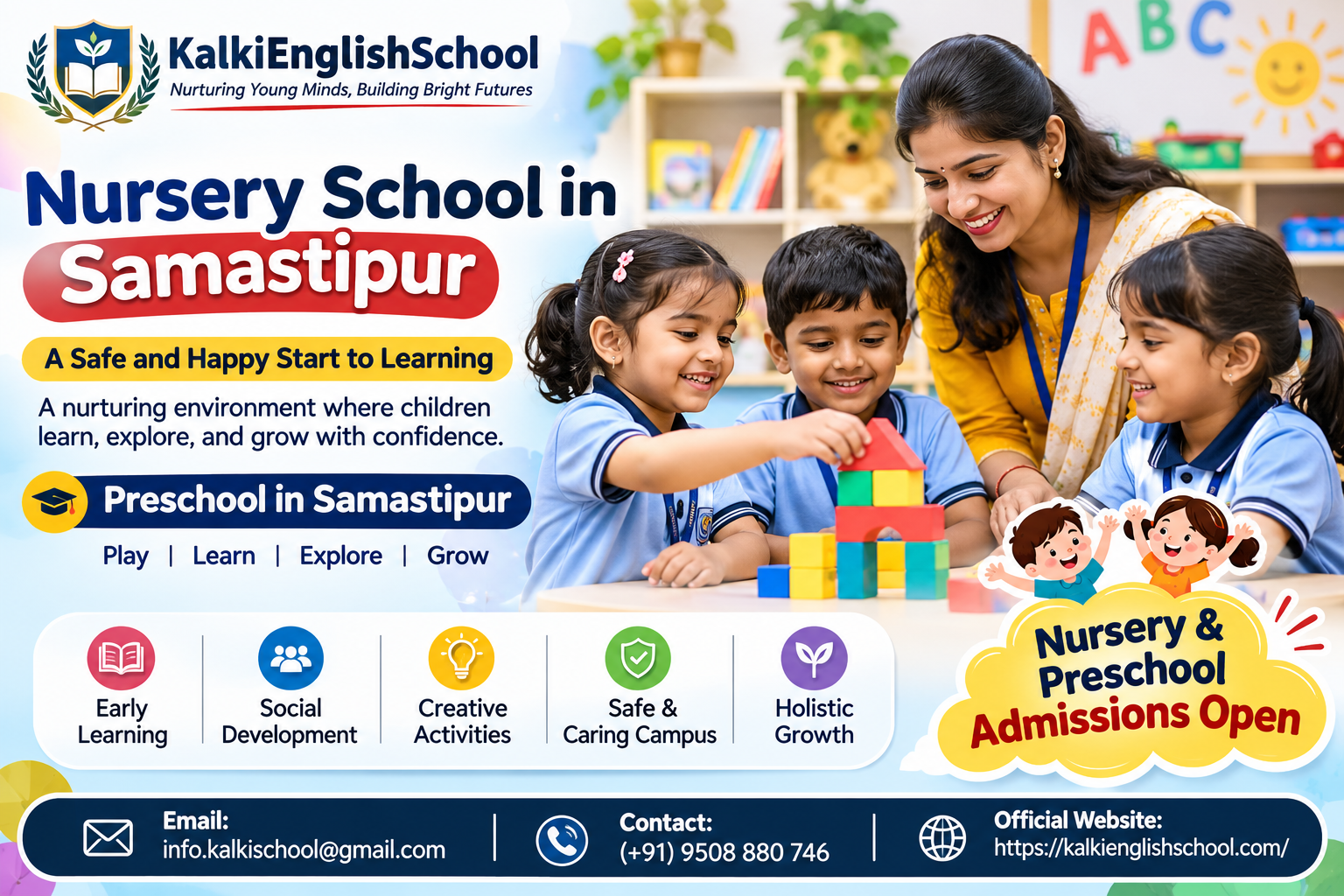
The transition from home to school represents an important milestone in a child’s educational journey. For families exploring a nursery school in samastipur, attention is increasingly directed toward classroom routines, communication between parents and teachers, and learning experiences that help children adjust to a structured environment.
Selecting a suitable preschool in samastipur involves understanding how educational institutions support early literacy, social interaction, healthy habits, and emotional security.
Beyond introducing letters and numbers, effective nursery education helps children develop the confidence to participate, communicate, and learn alongside others.
Why the Home-to-School Transition Matters
Starting nursery introduces children to unfamiliar surroundings, teachers, classmates, and daily activities.
Some children adjust comfortably, while others need additional encouragement and reassurance.
A supportive school environment recognizes these differences and provides appropriate guidance.
Parents should consider how schools manage separation concerns, classroom introductions, and individual adjustment requirements.
What Is a Nursery School?
A nursery school is an early childhood education institution that provides age-appropriate learning experiences before formal primary education.
A suitable nursery school in samastipur introduces foundational concepts through storytelling, creative activities, guided play, and simple classroom routines.
Nursery education generally focuses on:
- Language and communication development.
- Early recognition of numbers and shapes.
- Fine and gross motor coordination.
- Positive social interaction.
- Emotional awareness and confidence.
- Creative expression and curiosity.
The objective is balanced development rather than accelerated academic performance.
The Importance of Structured Daily Routines
Young children often benefit from predictable classroom experiences.
Consistent routines help them understand expectations and become familiar with the school environment.
A nursery classroom may incorporate welcoming activities, group conversations, storytelling, creative work, physical movement, and supervised play.
These experiences help children gradually develop attention, participation, and responsibility.
However, schedules should remain flexible enough to accommodate individual learning needs.
Building Early Literacy Through Everyday Experiences
Language development begins long before children start reading independently.
Nursery teachers can introduce literacy through picture books, rhymes, conversations, and storytelling.
Children may learn to recognize familiar sounds, identify objects, describe pictures, and express simple ideas.
A quality preschool in samastipur should provide regular opportunities for meaningful communication.
Effective Early Literacy Activities
Picture Reading: Encourages observation and vocabulary.
Rhymes: Develop listening and sound awareness.
Story Discussions: Strengthen comprehension and expression.
Drawing: Supports early writing-related motor skills.
Conversation Circles: Encourage children to communicate confidently.
Formal writing exercises should remain appropriate to each child’s developmental readiness.
Developing Mathematical Thinking Naturally
Early mathematics is not limited to memorizing numbers.
Children can develop mathematical understanding by comparing sizes, recognizing patterns, sorting objects, and exploring quantities.
For example, arranging building blocks by color introduces classification, while comparing two groups of objects develops basic quantity awareness.
These activities encourage reasoning and curiosity without unnecessary academic pressure.
Parent-Teacher Partnerships in Nursery Education
Communication between families and educators is an important part of early learning.
Parents understand their children’s interests, habits, and everyday behavior. Teachers observe how children participate in group activities and classroom interactions.
Sharing these observations can help both sides provide suitable support.
Important Communication Areas
- Classroom participation and comfort.
- Language and communication progress.
- Social interaction with classmates.
- Learning interests and preferences.
- Areas where additional encouragement may help.
Parents evaluating a nursery school in samastipur should ask how the institution communicates developmental observations.
Child Development: Observation Instead of Competition
Children develop abilities at different rates.
A nursery school should recognize individual progress rather than compare every child against identical expectations.
Teachers may use activity observations, portfolios, artwork, and informal conversations to understand children’s learning.
Such assessments help educators identify suitable activities and communicate progress with parents.
They should not create unnecessary pressure through excessive testing or rankings.
Health, Hygiene, and Classroom Safety
A child-friendly learning environment requires appropriate safety and hygiene arrangements.
Parents should review classroom supervision, safe play materials, washroom accessibility, and emergency communication procedures.
Clean learning spaces and suitable handwashing facilities support everyday hygiene practices.
Schools should also maintain clear procedures for authorized pickups, illness management, and communicating concerns to guardians.
These practical arrangements are important when selecting a preschool in samastipur.
Encouraging Positive Social Behavior
Nursery classrooms provide opportunities for children to interact with classmates from different backgrounds.
Through guided activities, children gradually learn to share materials, take turns, listen, and resolve simple disagreements.
Teachers should model respectful communication and help children recognize emotions.
Cooperative games and group projects can introduce teamwork without focusing excessively on competition.
Positive social experiences help establish a supportive classroom atmosphere.
How Parents Can Prepare Children for Nursery
Families can support school readiness through simple home activities.
Reading together, encouraging independent handwashing, practicing clear communication, and discussing school positively may help children feel prepared.
Parents can also encourage children to organize belongings and express their needs.
Preparation should remain reassuring rather than becoming another source of pressure.
The aim is to help children feel comfortable entering a new learning environment.
Choosing a Suitable Nursery Institution
Before admission, parents should evaluate the school’s educational approach and practical arrangements.
| Evaluation Area | Questions to Consider |
| Teaching approach | Are activities appropriate for young children? |
| Classroom environment | Is the space welcoming and organized? |
| Teacher interaction | Are children treated patiently? |
| Developmental assessment | Is individual progress observed? |
| Safety | Are supervision procedures explained? |
| Parent communication | Are progress updates available? |
School visits and direct discussions with educators can provide useful insights beyond promotional descriptions.
Frequently Asked Questions (FAQs)
1. What is a nursery school in Samastipur?
It is an early education institution that introduces young children to foundational learning through suitable classroom activities.
2. What is a preschool in Samastipur?
A preschool provides early childhood learning experiences designed to support development before primary schooling.
3. What is the difference between nursery and preschool?
Preschool is a broad category of early childhood education, while nursery commonly refers to a particular early learning stage.
4. Why are classroom routines important?
Predictable routines help children understand expectations and become comfortable in the learning environment.
Media Contact
Department: Nursery Education and School Admission Enquiries
Email: info.kalkischool@gmail.com
Contact: (+91) 9508 880 746
Official Website: https://kalkienglishschool.com/