
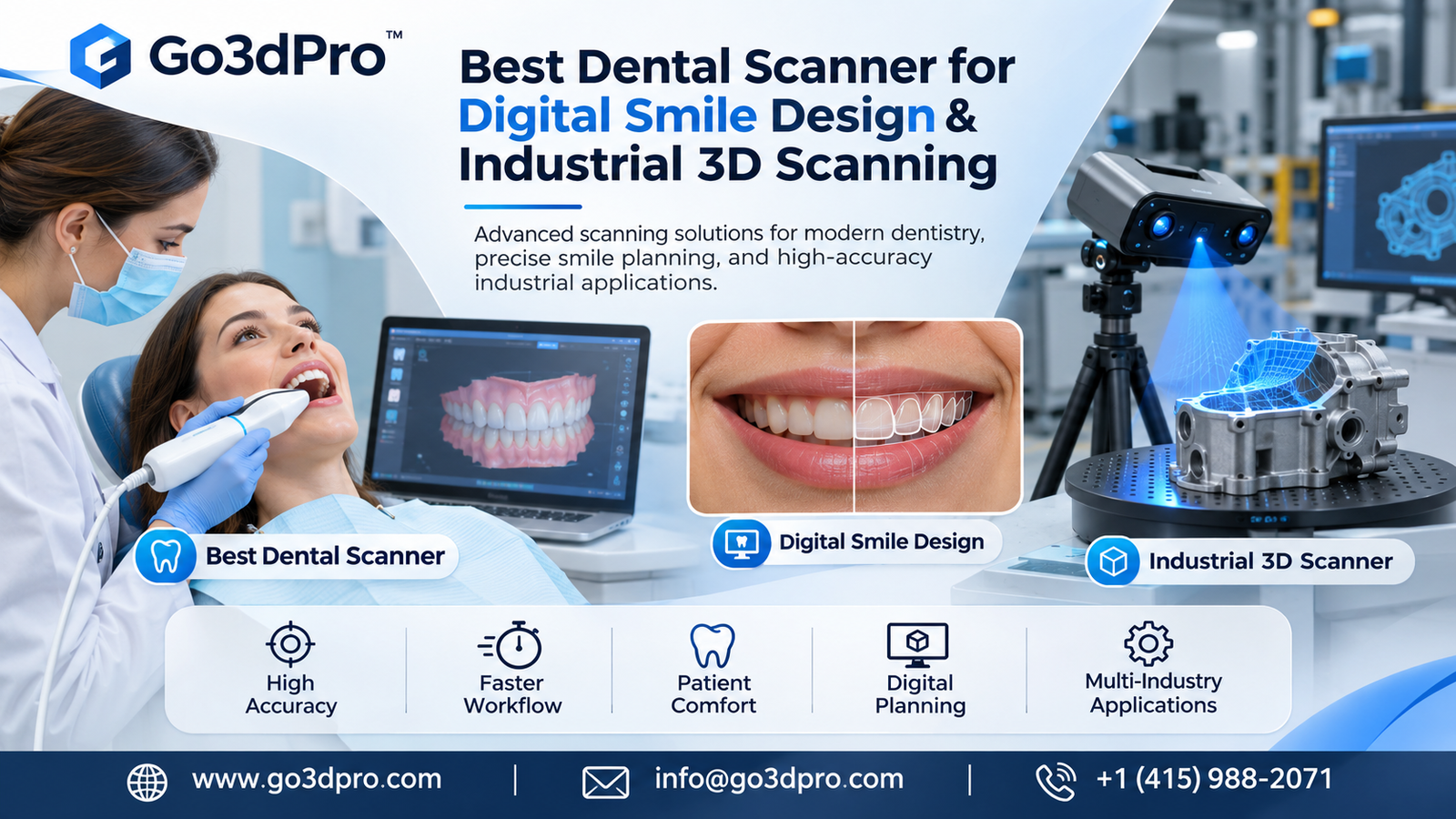
Advanced scanning equipment is also supporting greater precision in industrial design, manufacturing inspection, and quality control.For dental clinics and laboratories, selecting the Best Dental Scanner involves evaluating clinical accuracy, software compatibility, patient comfort, and treatment-planning capabilities. Meanwhile, digital smile design combines digital imaging and clinical expertise to visualize potential aesthetic improvements before treatment.
Beyond dentistry, the industrial 3d scanner demonstrates how accurate surface measurement and digital modeling can support complex professional workflows.
These developments highlight the importance of choosing scanning technology according to its intended application rather than relying exclusively on technical specifications.
How Digital Scanning Is Transforming Modern Dentistry
Dental scanning technology allows professionals to capture detailed three-dimensional representations of teeth and surrounding oral structures.
Instead of relying entirely on conventional impression materials, suitable intraoral scanners provide digital information that can support restorative dentistry, orthodontics, and laboratory communication.
Key Benefits of Dental Scanning
- Digital Impressions: Capture dental surfaces for suitable clinical procedures.
- Patient Convenience: Reduce reliance on conventional impression materials.
- Immediate Visualization: Allow clinicians to review digital models.
- Laboratory Integration: Support communication with compatible dental CAD/CAM systems.
- Treatment Planning: Provide geometric information for restoration design.
- Digital Records: Support organized documentation under appropriate privacy controls.
What Makes the Best Dental Scanner?
The Best Dental Scanner is not necessarily the equipment with the highest price or most advanced promotional specifications.
The ideal device should meet the clinical requirements of the dental practice while supporting efficient daily operations.
Important Selection Criteria
Scanning Accuracy: The equipment must provide clinically suitable impressions for its intended procedures.
Capture Speed: Efficient scanning can improve workflow convenience.
Ergonomic Design: A manageable handpiece supports comfortable clinical operation.
Software Compatibility: Integration with dental CAD/CAM software simplifies digital restoration workflows.
Data Export: Suitable file formats support communication with dental laboratories.
Technical Support: Training, software updates, and service availability influence long-term usability.
Dental professionals should request practical demonstrations before selecting equipment.
Understanding Digital Smile Design
Digital smile design is a treatment-planning approach that uses digital photographs, clinical information, and suitable imaging or scanning data to visualize potential changes to a patient’s smile.
The process helps dentists communicate aesthetic objectives and evaluate proposed restorative changes.
It may support planning for veneers, crowns, orthodontic treatment, and selected cosmetic dental procedures.
How the Process Works
Patient Assessment: The dentist examines oral health, function, and aesthetic concerns.
Digital Photography: Appropriate photographs document facial proportions and smile characteristics.
Dental Scanning: Suitable scanning equipment captures tooth geometry.
Digital Planning: Software assists in visualizing possible tooth shapes and arrangements.
Patient Consultation: The clinician explains realistic treatment options and limitations.
Treatment Execution: Appropriate procedures are performed according to the agreed clinical plan.
Digital previews are planning aids, not guarantees of treatment outcomes.
How Dental Scanners Support Personalized Smile Planning
A suitable dental scanner provides geometric information that can complement photographs and other clinical records.
For example, digital tooth models can assist dentists in assessing existing tooth dimensions and communicating proposed restorative changes to laboratories.
When compatible software is available, digital models may also support virtual diagnostic wax-ups and suitable physical mock-ups.
The accuracy of the overall workflow depends on scanning technique, data alignment, software processing, and professional judgment.
What Is an Industrial 3D Scanner?
An industrial 3d scanner is a measurement device designed to capture the geometry of physical objects for engineering, inspection, product development, and other technical applications.
Depending on the system, it may use structured light, laser-based technology, or other optical measurement methods.
Common Industrial Applications
- Reverse Engineering: Digitizing existing components for further design work.
- Quality Inspection: Comparing manufactured parts against design specifications.
- Product Development: Capturing prototype geometry.
- Automotive Engineering: Supporting component evaluation.
- Manufacturing Documentation: Creating digital records of physical parts.
Industrial scanning and dental scanning share fundamental geometric measurement concepts but have different operating requirements.
Dental Scanner vs. Industrial 3D Scanner
| Feature | Dental Scanner | Industrial 3D Scanner |
| Primary application | Digital dental impressions | Engineering and measurement |
| Scanning subject | Teeth and oral structures | Manufactured parts and objects |
| Software | Dental CAD/CAM | Engineering CAD and inspection |
| Main priority | Clinical suitability | Dimensional accuracy |
| Environment | Dental clinic or laboratory | Factory or technical laboratory |
| Important consideration | Hygiene and patient safety | Measurement conditions and calibration |
An industrial scanner must not be used inside a patient’s mouth unless it is specifically designed and appropriately authorized for clinical intraoral use.
The Importance of Accuracy and Digital Workflow Integration
Accuracy is essential in both dental and industrial scanning, but it must be evaluated according to the specific task.
In dentistry, incomplete surface capture or inaccurate data can affect the fit of a restoration.
In manufacturing, measurement errors may influence inspection results or component compatibility.
Professionals should distinguish measurement accuracy from scanning resolution.
High-resolution data does not automatically guarantee high dimensional accuracy.
For digital smile design, the alignment of facial photographs and dental models is also important for meaningful visualization.
Patient Experience and Responsible Treatment Planning
Digital scanning may make some dental procedures more comfortable by reducing the need for traditional impression materials.
However, patient comfort is only one consideration.
Dentists must also evaluate oral health, bite relationships, periodontal conditions, and the clinical suitability of proposed treatments.
Digital simulations should be presented as potential outcomes rather than promises.
Patient information must be protected through suitable data management and privacy practices.
Choosing a Reliable Scanning Technology Provider
Clinics, laboratories, and engineering companies should evaluate suppliers through application-specific demonstrations.
Important purchasing considerations include:
- Verified technical specifications.
- Intended application compatibility.
- Software integration and licensing.
- Operator training requirements.
- Demonstrated scanning performance.
- Warranty and maintenance support.
- Data security and storage arrangements.
- Long-term operational costs.
A suitable supplier should communicate equipment limitations clearly and provide appropriate technical documentation.
Frequently Asked Questions (FAQs)
1. What is the Best Dental Scanner for a dental clinic?
The best option depends on clinical requirements, scanning accuracy, software integration, ergonomics, and budget.
2. What is digital smile design?
It is a digital planning approach used to visualize and communicate possible aesthetic dental treatment outcomes.
3. What is an industrial 3d scanner?
It is equipment used to capture three-dimensional geometry for engineering, manufacturing, inspection, and product development.
4. Can a dental scanner support smile design?
Yes. Suitable digital scans can provide tooth geometry for compatible smile-planning workflows.
5. Are digital dental impressions accurate?
Appropriate systems can produce clinically suitable impressions, depending on the procedure and scanning technique.
6. Can digital smile design guarantee treatment results?
No. Digital previews are planning tools, and actual outcomes depend on clinical circumstances.
7. Can industrial scanners replace dental scanners?
Not for clinical intraoral applications. Dental equipment must meet its intended clinical requirements.
8. What software is used for digital smile planning?
Dental professionals use compatible imaging, smile-planning, and dental CAD software according to their workflows.
9. What influences dental scanner costs?
Hardware capabilities, software subscriptions, accessories, training, warranty, and maintenance affect total costs.
10. How should professionals choose a scanning equipment supplier?
They should assess technical performance, application compatibility, demonstrations, training, service support, and warranty conditions.
Media Contact
Department: Dental and Industrial 3D Scanning Technology Communications
Email: info@go3dpro.com
Contact: +1 (415) 988-2071
Official Website: https://www.go3dpro.com/