
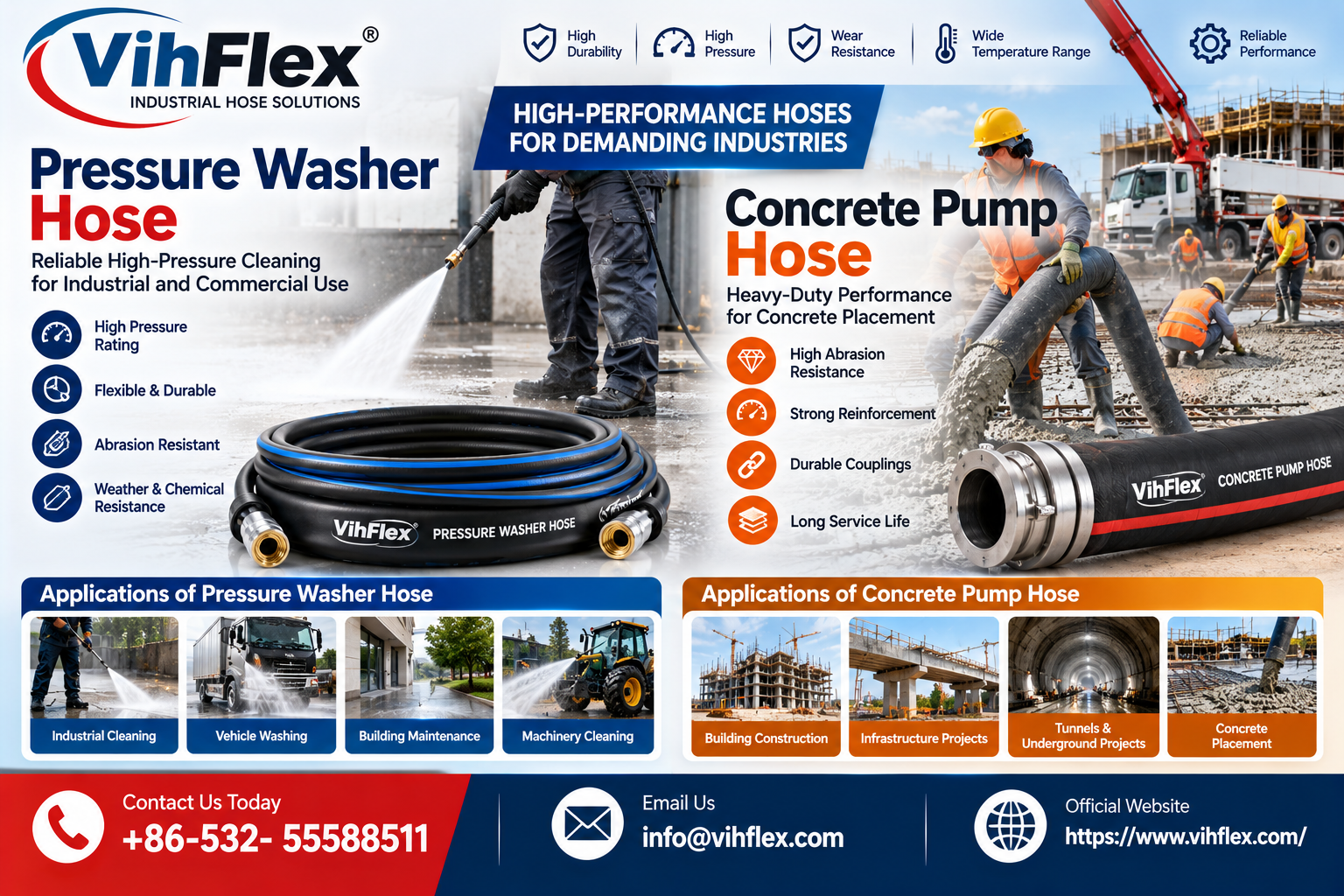
As construction companies, industrial cleaning contractors, equipment manufacturers, and infrastructure developers focus on operational efficiency and workplace safety, high-performance industrial hoses continue to play an important role in demanding applications.
A Pressure Washer Hose is designed to deliver pressurized water for cleaning equipment and surfaces, while a Concrete Pump Hose transports wet concrete through specialized pumping systems.
Although both products operate under pressure, their materials, reinforcement structures, operating conditions, and applications differ significantly. Understanding these differences helps businesses select suitable hoses that deliver consistent performance, durability, and safe operation.
Understanding Pressure Washer Hose Technology
A Pressure Washer Hose is a flexible hose engineered to carry pressurized water between a pressure washer and its spray equipment.
It is commonly used in commercial cleaning, industrial maintenance, automotive washing, and selected construction cleaning activities.
Unlike ordinary garden hoses, pressure washer hoses incorporate reinforcement layers designed for the specified working pressure.
Key Features of Pressure Washer Hoses
- High-Pressure Resistance: Designed for specified water-pressure requirements.
- Flexible Construction: Supports movement during cleaning operations.
- Reinforced Layers: Helps withstand internal pressure.
- Abrasion Resistance: Suitable outer covers protect against ordinary handling wear.
- Temperature Compatibility: Selected hoses support specified hot-water applications.
- Connection Compatibility: Appropriate fittings support secure equipment connections.
Common Applications of Pressure Washer Hoses
Pressure washer hoses support numerous professional cleaning operations.
Industrial Equipment Cleaning
Manufacturing facilities use compatible pressure washing systems to remove dirt, grease, and other surface contamination.
Automotive Cleaning
Commercial washing operations require flexible hoses that support convenient equipment movement.
Construction Site Maintenance
Pressure washing equipment helps clean suitable tools, machinery, and hard surfaces.
Agricultural Equipment Cleaning
Cleaning systems may be used to maintain tractors, equipment, and selected agricultural machinery.
Commercial Property Maintenance
Professional cleaning contractors use pressure washers for suitable exterior surfaces and maintenance tasks.
Equipment operators must select pressures and nozzles appropriate to the surface and application.
What Is a Concrete Pump Hose?
A Concrete Pump Hose is a specialized industrial hose designed to transport wet concrete through compatible concrete pumping equipment.
It is commonly used in building construction, infrastructure development, and commercial concreting operations.
Unlike water-cleaning hoses, concrete pump hoses must resist abrasive concrete mixtures while accommodating the pressure and movement associated with pumping.
Important Features of Concrete Pump Hoses
Abrasion-Resistant Inner Tube: Helps withstand contact with concrete aggregates and cementitious materials.
Heavy-Duty Reinforcement: Supports the pressure requirements of the specified pumping system.
Suitable Outer Cover: Protects the reinforcement against environmental wear.
Controlled Flexibility: Allows placement while maintaining the manufacturer’s minimum bend radius.
Compatible End Fittings: Supports connection to approved concrete pumping equipment.
Application-Specific Construction: Designed for the characteristics of wet concrete transportation.
Pressure Washer Hose vs. Concrete Pump Hose
Although both products are industrial hoses, they serve different purposes.
| Feature | Pressure Washer Hose | Concrete Pump Hose |
| Main application | High-pressure water cleaning | Wet concrete transportation |
| Transported material | Water or compatible cleaning fluid | Concrete mixtures |
| Inner lining | Suitable water-resistant material | Abrasion-resistant rubber |
| Reinforcement | Designed for cleaning-system pressure | Designed for concrete pumping loads |
| Main performance concern | Pressure and temperature compatibility | Abrasion, pressure, and material flow |
| Typical industries | Cleaning, automotive, maintenance | Construction and infrastructure |
These hoses are not interchangeable. Each must be selected according to its intended service and manufacturer’s specifications.
Materials Used in Industrial Hose Manufacturing
Industrial hose performance depends on the combination of materials and construction methods.
Synthetic Rubber
Suitable rubber compounds provide flexibility and resistance to specific working conditions.
Steel Wire Reinforcement
Steel wire braid or spiral reinforcement may be used in hoses requiring elevated pressure resistance.
Textile Reinforcement
Certain hose designs incorporate textile reinforcement where appropriate for their intended duty.
Abrasion-Resistant Compounds
Concrete delivery hoses require suitable internal materials to withstand repeated contact with abrasive aggregates.
Protective Outer Covers
Outer covers help protect reinforcement from mechanical damage, environmental exposure, and handling wear.
Material suitability should always be confirmed against the complete hose specification.
Importance of Pressure Rating and Hose Selection
Working pressure is among the most important considerations in industrial hose selection.
A hose must have an appropriate rated working pressure for its equipment and intended operating conditions.
Pressure surges, temperature, fitting compatibility, and handling requirements must also be considered.
A high burst-pressure figure should never be treated as the permissible operating pressure.
Essential Selection Factors
- Working pressure and potential pressure fluctuations.
- Hose internal diameter and required flow.
- Fluid or material compatibility.
- Operating temperature.
- Minimum bend radius.
- Abrasion and environmental exposure.
- End-fitting specifications.
- Manufacturer inspection and replacement recommendations.
Selecting hoses solely by appearance or diameter can create serious operational hazards.
Safety and Maintenance of Industrial Hoses
Industrial hoses require regular inspection and appropriate handling.
A damaged Pressure Washer Hose can release a hazardous high-pressure jet capable of causing serious injection injuries.
Concrete pumping systems present additional hazards, including uncontrolled hose movement, fitting failure, and pressure release from blocked lines.
Operators should never attempt to clear blockages or disconnect pressurized components without following approved depressurization procedures.
Routine inspections should identify cuts, exposed reinforcement, excessive wear, bulging, damaged fittings, and unusual leakage.
Questionable hoses should be removed from service until appropriately assessed.
Choosing a Reliable Industrial Hose Supplier
Businesses purchasing a Concrete Pump Hose or pressure cleaning hose should review manufacturing quality, technical documentation, and application suitability.
A dependable supplier should provide clear information about pressure ratings, materials, dimensions, fitting options, and recommended operating conditions.
Buyers should also examine quality-control practices, product traceability, packaging, and delivery arrangements.
For construction contractors and equipment distributors, consistent specifications can help reduce procurement errors and operational interruptions.
Frequently Asked Questions (FAQs)
1. What is a Pressure Washer Hose?
It is a reinforced hose designed to transport pressurized water between a pressure washer and its cleaning equipment.
2. What is a Concrete Pump Hose?
It is a specialized hose used to transport wet concrete through compatible concrete pumping systems.
3. Are pressure washer hoses suitable for hot water?
Only hoses specifically rated for the intended water temperature should be used.
4. Can a pressure washer hose transport concrete?
No. Pressure washer hoses are not designed for abrasive concrete pumping applications.
5. What materials are used in concrete pump hoses?
They commonly use abrasion-resistant rubber compounds and heavy-duty reinforcement layers.
6. Why is hose reinforcement important?
Reinforcement helps the hose withstand specified internal pressures and operating conditions.
7. How do I select the correct hose diameter?
Diameter selection depends on equipment specifications, flow requirements, and operating conditions.
8. How often should industrial hoses be inspected?
Inspection frequency depends on usage, operating conditions, manufacturer guidance, and applicable safety procedures.
9. What affects industrial hose prices?
Materials, reinforcement, dimensions, pressure rating, fittings, and manufacturing specifications influence costs.
10. How can buyers select a reliable industrial hose manufacturer?
Evaluate technical specifications, manufacturing quality, inspection practices, product documentation, and supply reliability.
Media Contact
Department: Industrial Hose Products and Business Communications
Email: info@vihflex.com
Contact: +86-532- 55588511
Official Website: https://www.vihflex.com/