
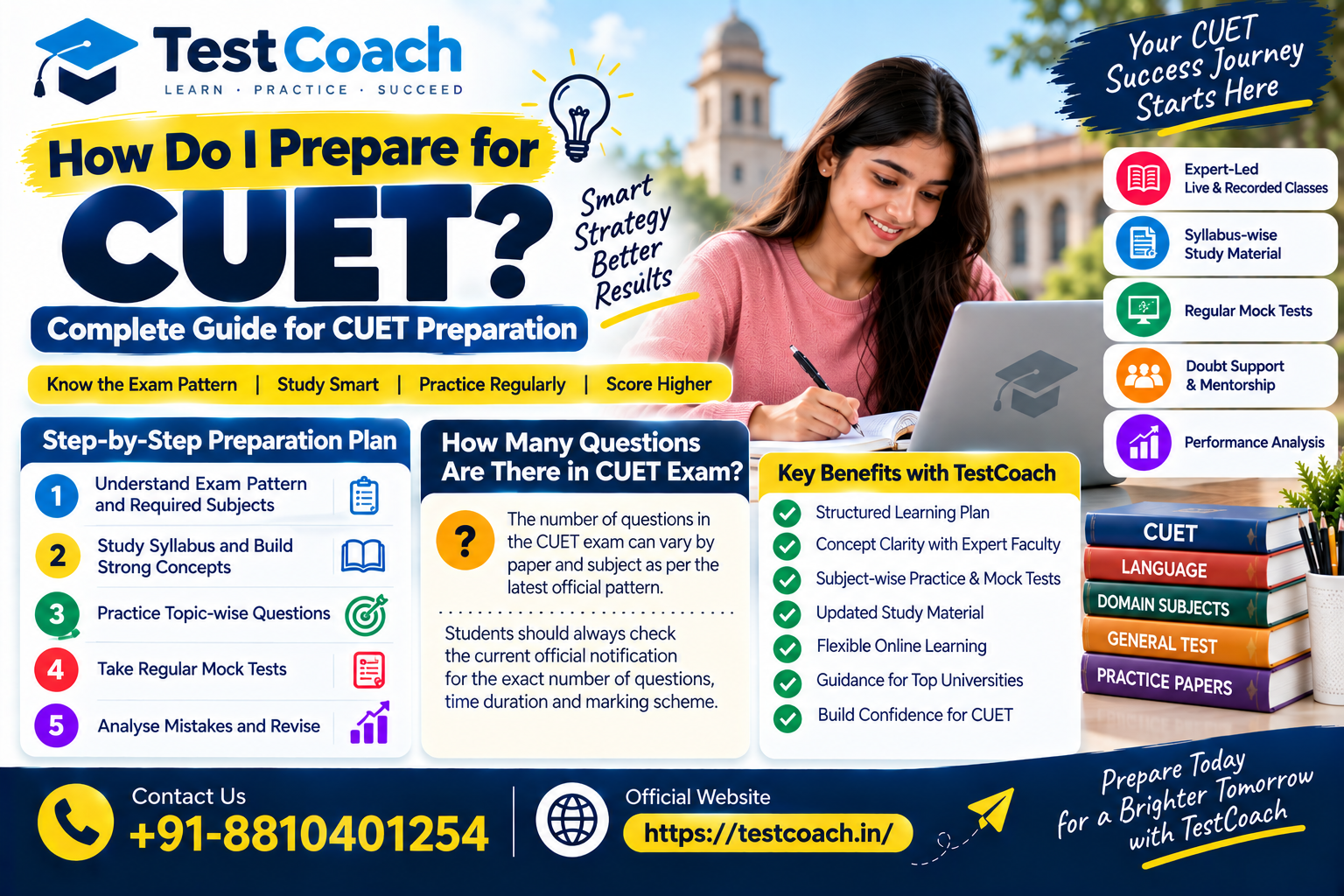
As students across India plan their undergraduate admissions, one question continues to influence their academic preparation: how do i prepare for cuet effectively? Alongside preparation strategies, aspirants frequently ask, how many questions are there in cuet exam, highlighting the importance of understanding the examination structure before developing a study schedule.
The Common University Entrance Test (CUET-UG) provides an admission pathway to various undergraduate programs at participating universities. Preparing for this examination requires syllabus awareness, conceptual understanding, consistent practice, and effective time management.
Students who begin preparation with clear academic goals and realistic study plans can develop stronger examination readiness while managing their school responsibilities.
How Do I Prepare for CUET? Understanding the First Steps
Students wondering how do i prepare for cuet should begin by reviewing the official examination syllabus and identifying the subjects required for their preferred university programs.
CUET preparation is not identical for every applicant. Examination subjects depend on course eligibility and institutional admission requirements.
A structured preparation strategy should include:
- Understanding the official CUET examination pattern
- Selecting appropriate examination subjects
- Reviewing relevant syllabus topics
- Preparing a realistic daily study schedule
- Strengthening fundamental academic concepts
- Practicing subject-wise questions regularly
- Attempting mock examinations
- Analyzing performance and revising weak topics
Rather than depending on excessive study hours, aspirants should concentrate on consistent learning and meaningful revision.
How Many Questions Are There in CUET Exam?
Understanding how many questions are there in cuet exam is important for effective examination planning.
Under the CUET-UG 2025 examination pattern, each subject paper contained 50 compulsory multiple-choice questions, with 60 minutes allotted per paper.
The total number of questions depended on how many examination papers a student selected.
For example:
- One subject paper: 50 questions
- Two subject papers: 100 questions
- Three subject papers: 150 questions
- Four subject papers: 200 questions
- Five subject papers: 250 questions
These figures describe the 2025 pattern and should not be treated as a permanent examination rule. Students preparing for a later admission cycle must verify the applicable question count, duration, marking scheme, and subject limits through the official examination information bulletin.
Understanding these details helps aspirants develop practical question-solving strategies.
Understanding the CUET Syllabus and Subject Selection
CUET preparation may involve language papers, domain-specific subjects, and general aptitude, depending on the university and program requirements.
Language preparation generally emphasizes reading comprehension, vocabulary, and verbal ability.
Domain-specific subjects can include academic disciplines such as Mathematics, Biology, Physics, Chemistry, Economics, History, and Accountancy.
General aptitude preparation may involve logical reasoning, numerical ability, current affairs, and general knowledge.
Students should avoid preparing for subjects that are unnecessary for their intended admission pathway.
Choosing relevant subjects allows aspirants to concentrate on academic requirements that directly support their higher education goals.
Creating an Effective Daily Study Schedule
A productive study plan should balance conceptual learning, revision, and examination practice.
Students asking how do i prepare for cuet often focus on the number of study hours required. However, preparation quality matters more than simply increasing daily study time.
A practical routine may include:
- Conceptual Learning: Dedicate time to understanding important syllabus topics.
- Question Practice: Solve subject-specific questions after completing each topic.
- Revision: Review previously studied concepts to improve retention.
- Mock Assessments: Attempt examination-style questions under timed conditions.
- Performance Analysis: Identify mistakes and prioritize weaker areas.
Students should adjust their schedules according to school examinations, individual learning speed, and preparation progress.
Importance of Mock Tests and Previous Question Papers
Mock tests are valuable resources for evaluating examination readiness.
They help students understand examination-style questions, practice time management, and identify areas requiring additional attention.
Previous-year question papers can also provide insights into earlier examination formats and commonly assessed skills.
Students should ensure their preparation materials remain consistent with the applicable syllabus.
After completing a mock examination, aspirants should review incorrect answers and understand the reasons behind their mistakes.
This process supports continuous improvement and helps students avoid repeating similar errors.
Common Mistakes Students Should Avoid
Students sometimes begin CUET preparation without checking admission requirements or understanding the examination structure.
Other common mistakes include ignoring weaker subjects, postponing revision, using outdated study materials, and attempting numerous mock tests without reviewing results.
Students should also avoid comparing their daily progress excessively with other aspirants.
A balanced preparation approach should prioritize individual improvement, academic understanding, and consistent revision.
Frequently Asked Questions (FAQs)
1. How do I prepare for CUET from the beginning?
Begin by reviewing the official syllabus, selecting subjects according to university requirements, studying fundamental concepts, practicing questions, and attempting regular mock tests.
2. How many questions are there in CUET exam?
Under the CUET-UG 2025 pattern, each subject paper contained 50 compulsory questions. Students should confirm the question count for their examination year through official notifications.
3. Can I prepare for CUET without coaching?
Yes. Students can prepare through self-study using suitable textbooks, syllabus-aligned resources, practice questions, and regular assessments.
4. How many hours should I study daily for CUET?
There is no universal requirement. Students should develop a realistic study schedule based on their academic preparation, subject requirements, and available time.
5. Are NCERT books useful for CUET preparation?
Yes. NCERT textbooks can support preparation for relevant domain subjects, provided students follow the applicable official syllabus.
6. Are mock tests necessary for CUET preparation?
Mock tests are not compulsory, but they help students evaluate preparation, improve accuracy, and develop confidence under timed conditions.
7. What is the best strategy for CUET revision?
Regularly revisit important concepts, practice weaker topics, review previous mistakes, and attempt periodic assessments.
8. Is the CUET General Aptitude Test compulsory?
No. The required examination subjects depend on the admission eligibility conditions established by the selected university and program.
9. How can students improve their CUET scores?
Students can improve through conceptual understanding, consistent practice, targeted revision, and careful analysis of mock test performance.
10. Where can students check the latest CUET exam pattern?
Students should consult the official examination information bulletin and notifications issued for their admission year.
Media Contact
Department: Education and Academic Guidance
Location: India
Email: support@testcoach.in
Contact: +91-8810401254
Official Website: https://testcoach.in/