
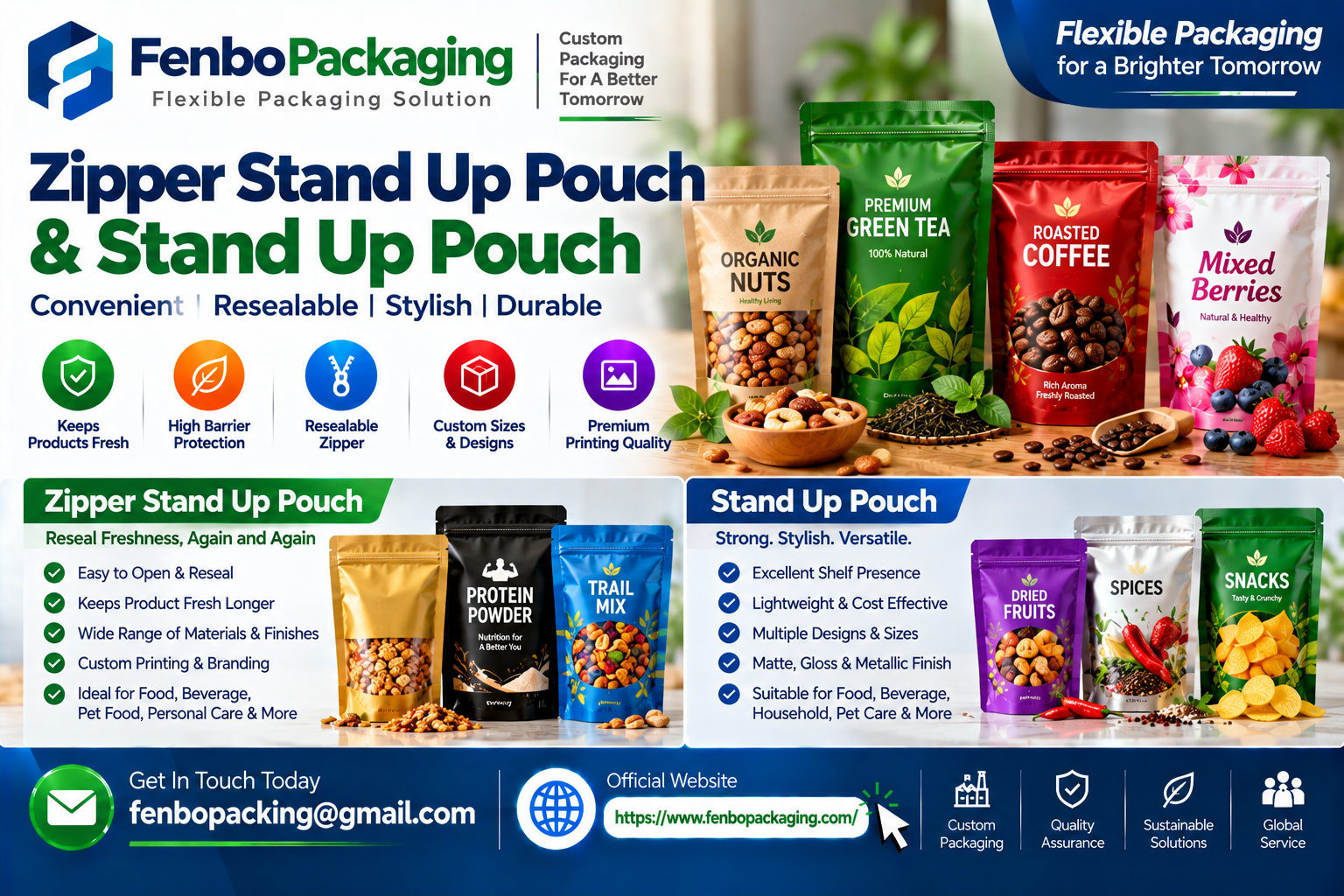
Convenience, product protection, and attractive shelf presentation are increasingly important considerations in flexible packaging design. Businesses across food, personal care, pet food, and household product industries are exploring packaging formats that simplify storage while supporting brand visibility.
Among these solutions, the zipper stand up pouch offers a practical combination of flexible packaging and resealable functionality. Designed with an integrated zipper closure and a supporting bottom gusset, this format allows consumers to open and close compatible packages during repeated use.
The Stand Up Pouch has become a versatile packaging option for brands seeking customizable shapes, printed designs, and material structures suited to different products.
Understanding zipper configurations, barrier materials, packaging performance, and manufacturing requirements helps businesses make informed purchasing decisions.
What Is a Zipper Stand Up Pouch?
A zipper stand up pouch is a flexible packaging container featuring a bottom gusset and a resealable zipper near its opening.
The gusset supports upright positioning when the pouch is appropriately filled, while the zipper allows consumers to reclose the package after opening.
Depending on the product, these pouches may be manufactured using polyethylene, polypropylene, or specialized laminated films.
Common applications include:
- Coffee beans and ground coffee.
- Nuts, dried fruits, and snacks.
- Pet treats and dry pet food.
- Tea leaves and powdered beverages.
- Spices and food ingredients.
- Nutritional powders.
- Selected cosmetics and household products.
Zipper closures support repeated access, but they should not automatically be considered airtight or equivalent to an unopened factory seal.
Why Are Resealable Stand-Up Pouches Popular?
Modern consumers often prefer packaging that is easy to handle and store.
A resealable Stand Up Pouch can provide several practical advantages.
Convenient Repeated Opening
The zipper allows consumers to access products without cutting or permanently opening the entire package.
Better Storage Organization
The standing design can help products remain upright on suitable shelves.
Attractive Product Presentation
Flexible pouch surfaces offer space for branding, product descriptions, nutritional information, and graphics.
Flexible Sizes and Shapes
Manufacturers may provide different pouch capacities, dimensions, and closure configurations.
Reduced Spillage
A properly closed zipper may help limit accidental product loss during normal handling.
These benefits depend on zipper quality, pouch construction, and consumer use.
Types of Zipper Closures for Stand-Up Pouches
Different products require different closure designs.
Press-to-Close Zippers: Commonly used for snacks, coffee, and other dry consumer products.
Slider Zippers: Include a sliding mechanism that can make opening and closing convenient.
Child-Resistant Closures: Specialized systems may be available for products requiring restricted access, subject to testing and applicable regulations.
Wide-Mouth Zippers: Suitable designs may provide easier access to larger products or repeated dispensing.
Selecting the correct zipper depends on packaging dimensions, product characteristics, and intended use.
Stand Up Pouch with Zipper vs Standard Pouch
Both packaging formats offer benefits, but resealability distinguishes their everyday use.
| Feature | Zipper Stand-Up Pouch | Standard Stand-Up Pouch |
| Closure | Resealable zipper | Usually heat-sealed |
| Repeated access | Designed for reopening | May require separate storage after opening |
| Shelf presentation | Upright design | Upright design |
| Manufacturing complexity | Additional zipper integration | Generally simpler construction |
| Suitable products | Frequently accessed goods | Single-use or portioned products |
| Custom printing | Available | Available |
The preferred format depends on customer usage patterns, filling requirements, and packaging costs.
Important Materials Used in Zipper Pouch Packaging
Material selection directly affects durability and product protection.
Polyethylene-Based Structures
Polyethylene is commonly used in flexible packaging, including heat-seal layers and certain mono-material designs.
Polypropylene Films
Polypropylene can provide useful moisture-resistance and mechanical characteristics in suitable packaging structures.
High-Barrier Laminates
Multilayer combinations may provide additional protection against oxygen, moisture, or light.
Transparent Packaging Films
Clear windows may allow customers to inspect the contents before purchasing.
Not every film offers equal protection. Businesses should determine material suitability through testing and application-specific specifications.
How Are Zipper Stand-Up Pouches Manufactured?
Production typically involves several controlled stages.
- Material Selection: Appropriate films and barrier structures are chosen.
- Artwork Preparation: Printing files and packaging dimensions are finalized.
- Printing and Lamination: Graphics and multilayer structures are prepared where required.
- Pouch Conversion: Film is formed into pouches with the required gussets and seams.
- Zipper Integration: Compatible zipper profiles are incorporated into the packaging.
- Quality Inspection: Finished pouches are checked for appearance, dimensions, seals, and zipper functionality.
The production sequence varies according to equipment and pouch design.
Quality Testing for Zipper Stand-Up Pouches
Quality control is essential when selecting a zipper stand up pouch for commercial packaging.
Manufacturers may evaluate:
- Zipper opening and closing performance.
- Heat-seal strength.
- Package leakage.
- Film puncture resistance.
- Bottom gusset stability.
- Dimensional accuracy.
- Moisture and oxygen barrier characteristics.
- Printed artwork consistency.
For food products, packaging materials should meet applicable food-contact requirements.
Businesses should test samples using their actual filling equipment and intended storage conditions.
How to Choose the Right Stand Up Pouch Supplier
Selecting suitable packaging requires more than comparing prices.
Buyers should first identify the product’s weight, composition, expected shelf life, and filling conditions.
They should then confirm pouch capacity, material thickness, zipper design, printing specifications, and any necessary barrier properties.
Before ordering, request appropriate samples and discuss minimum order quantities, production schedules, quality specifications, and shipping arrangements.
A suitable supplier should communicate clearly about manufacturing capabilities and technical limitations.
Sustainability Considerations for Resealable Packaging
Sustainability is an important consideration in flexible packaging development.
Some Stand Up Pouch designs may use less material by weight than certain rigid containers. However, environmental performance depends on the complete package and its lifecycle.
Multilayer films and zipper combinations can create recycling challenges.
Businesses should evaluate available mono-material structures, packaging performance, and local recycling capabilities before making environmental claims.
Frequently Asked Questions (FAQs)
1. What is a zipper stand up pouch?
It is a flexible pouch with a bottom gusset and a resealable zipper designed for repeated opening and closing.
2. What is the difference between a zipper pouch and a standard Stand Up Pouch?
A zipper pouch includes a resealable closure, while a standard pouch may rely entirely on heat sealing.
3. Are zipper stand-up pouches suitable for food packaging?
Yes, when the materials and manufacturing processes meet applicable food-contact and product requirements.
4. Can zipper pouches be customized?
Yes. Size, materials, printing, zipper configurations, and selected packaging features may be customized.
5. Are zipper stand-up pouches airtight?
Not necessarily. Airtightness depends on closure design, manufacturing quality, and correct consumer use.
6. What products commonly use resealable pouches?
Coffee, snacks, tea, nuts, dried foods, pet treats, and powdered products are common applications.
7. Can zipper pouches protect products from moisture?
Suitable barrier films and intact seals can help reduce moisture exposure, depending on the packaging structure.
8. Are zipper pouches recyclable?
Recyclability depends on film composition, zipper materials, and the availability of suitable recycling systems.
9. What determines zipper pouch manufacturing costs?
Material selection, dimensions, printing, zipper type, order volume, and technical requirements influence pricing.
10. How should businesses select a zipper pouch supplier?
Evaluate manufacturing capabilities, sample performance, available materials, quality control procedures, and commercial terms.
Media Contact
Industry: Flexible Packaging Manufacturing & Customized Packaging Solutions
Service Enquiries: Zipper Stand-Up Pouches, Resealable Packaging, Custom Printed Pouches & Flexible Packaging Materials
Email: fenbopacking@gmail.com
Official Website: https://www.fenbopackaging.com/