As personal-care and cosmetic manufacturers continue to develop cleaner-feeling, consumer-friendly formulations, demand for multifunctional ingredients such as Ethylhexylglycerin is increasing across skincare, haircare, hygiene, and beauty applications. At the same time, brands are paying greater attention to choosing a reliable Ethylhexylglycerin Supplier capable of providing consistent quality, technical documentation, dependable delivery, and formulation support.
Ethylhexylglycerin is widely used as a multifunctional cosmetic ingredient and is commonly incorporated into preservation systems, deodorant products, creams, lotions, cleansers, and related formulations. Its role is often linked with preservative boosting, skin-conditioning benefits, and improved formulation performance.
What Is Ethylhexylglycerin?
Ethylhexylglycerin is a glycerin-derived ingredient commonly used in cosmetic and personal-care formulations.
It is valued because it can perform more than one role within a formula.
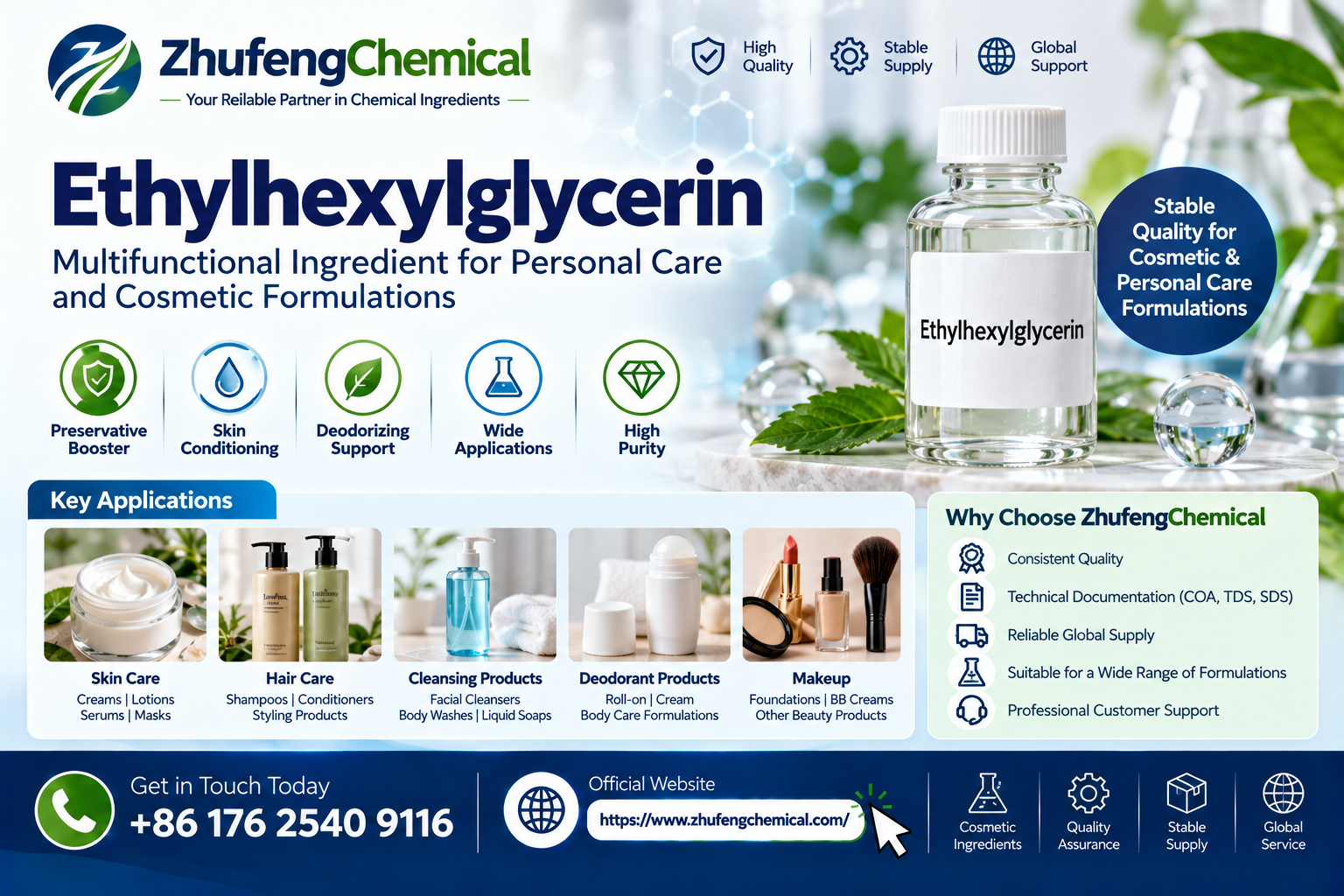
Typical functions may include:
- Preservative boosting
- Skin conditioning
- Deodorizing support
- Formulation stabilization
- Improving sensory performance
It is often used alongside established preservative systems rather than being treated as a complete preservative solution on its own.
Why Ethylhexylglycerin Is Important in Cosmetic Formulation
Cosmetic products containing water can be vulnerable to microbial contamination.
Manufacturers therefore use preservation systems designed to help maintain product integrity during storage and consumer use.
Ethylhexylglycerin is often selected because it can enhance the effectiveness of certain preservation systems.
This can help formulators create balanced systems while also contributing to skin feel.
Its multifunctionality makes it relevant in a wide variety of formulations.
Common Applications of Ethylhexylglycerin
The ingredient can be found in many cosmetic and personal-care product categories.
These may include:
Skin Care
Creams, lotions, serums, moisturizers, masks, and related products may use the ingredient as part of the overall formulation.
Hair Care
Shampoos, conditioners, styling products, and scalp-care products may also incorporate it.
Cleansing Products
Facial cleansers, body washes, liquid soaps, and similar products can use Ethylhexylglycerin as part of their preservation strategy.
Deodorant Products
The ingredient is also known for its use in deodorant and odor-control formulations.
Makeup
Selected cosmetic formulations may use it for preservation support and conditioning properties.
Ethylhexylglycerin as a Preservative Booster
One of the best-known uses of Ethylhexylglycerin is as a preservative booster.
A booster helps improve the effectiveness of a preservation system but does not necessarily replace the need for a validated preservative system.
This distinction is important.
Formulators should evaluate:
- Product pH
- Water content
- Packaging
- Intended shelf life
- Manufacturing process
- Target market
- Other preservatives used
Microbiological testing remains important before a formulation is commercially released.
Skin-Conditioning Properties
Another reason the ingredient is used in personal care is its conditioning effect.
It may contribute to a smoother and more comfortable skin feel in certain formulations.
This makes it attractive in products where both protection and sensory quality matter.
Modern consumers increasingly expect skincare products to feel lightweight, smooth, and pleasant during application.
Multifunctional ingredients can help formulators achieve those objectives efficiently.
Deodorizing Applications
Ethylhexylglycerin is also used in some deodorant and personal-hygiene formulations.
Its use in these products is associated with helping create an environment less favorable to odor-related microorganisms.
This makes it a useful component in formulations such as:
- Roll-on deodorants
- Cream deodorants
- Body-care products
- Personal-hygiene formulas
However, performance should always be verified in the final product rather than assumed based on the ingredient alone.
Why Supplier Quality Matters
Choosing the right Ethylhexylglycerin Supplier is an important part of manufacturing.
Cosmetic manufacturers generally need more than a raw ingredient.
They may also require:
- Certificate of Analysis
- Technical Data Sheet
- Safety Data Sheet
- Batch consistency
- Purity information
- Storage recommendations
- Regulatory documentation
- Packaging specifications
A professional supplier should be able to provide clear product information and support traceability.
Consistency Is Essential for Formulation Performance
A formulation that performs well in the laboratory needs to behave consistently during commercial production.
Variation in raw-material quality can affect:
- Appearance
- Odor
- Viscosity
- Stability
- Preservation
- Product feel
For this reason, buyers should evaluate an Ethylhexylglycerin Supplier based on quality systems and batch consistency rather than price alone.
Technical Documentation Supports Regulatory Review
Cosmetic companies often sell products across multiple markets.
Regulatory requirements can differ by region, so complete ingredient documentation can simplify product review and compliance work.
Buyers may need information related to:
- Ingredient identity
- Purity
- Manufacturing specifications
- Safety data
- Recommended storage
- Shelf life
Suppliers with organized documentation can help reduce delays during product development and regulatory evaluation.
Storage and Handling Considerations
Like other cosmetic raw materials, Ethylhexylglycerin should be stored according to the supplier’s recommendations.
Good practices typically include:
- Keeping containers properly closed
- Avoiding unnecessary contamination
- Storing under recommended temperature conditions
- Protecting from unsuitable environmental exposure
- Following batch and expiry controls
Manufacturers should use appropriate personal protective equipment and follow the applicable Safety Data Sheet during handling.
Formulation Testing Should Not Be Skipped
Even when an ingredient is widely used, the final cosmetic formula must still be tested.
Useful evaluations may include:
- Stability testing
- Compatibility testing
- Preservative efficacy testing
- Packaging compatibility
- Sensory evaluation
A preservative system that works well in one formula may not behave identically in another.
This is why formulation validation is a critical step before commercial production.
What to Look for in an Ethylhexylglycerin Supplier
When comparing suppliers, buyers should consider several practical factors:
- Raw-material consistency
- Technical documentation
- Quality-control procedures
- Packaging options
- Minimum order quantities
- Delivery reliability
- Export capability
- Technical communication
- Product traceability
- After-sales support
A strong supplier relationship can help cosmetic manufacturers maintain more predictable production.
Frequently Asked Questions
What is Ethylhexylglycerin?
Ethylhexylglycerin is a multifunctional cosmetic ingredient used for preservative boosting, skin conditioning, and selected deodorizing applications.
Is Ethylhexylglycerin a preservative?
It is commonly used as a preservative booster, usually as part of a broader preservation system rather than as the sole preservative.
Where is Ethylhexylglycerin used?
It may be used in skincare, haircare, cleansing products, deodorants, makeup, and other personal-care formulations.
Can Ethylhexylglycerin improve skin feel?
Yes. It is used as a skin-conditioning ingredient in various cosmetic formulations.
Is Ethylhexylglycerin used in deodorants?
Yes. It is often incorporated into deodorant and personal-hygiene formulations.
Why is an Ethylhexylglycerin Supplier important?
A reliable Ethylhexylglycerin Supplier can provide consistent material quality, technical documentation, traceability, and dependable supply.
What documents should a supplier provide?
Common documents include a Certificate of Analysis, Technical Data Sheet, and Safety Data Sheet.
Does every formulation need testing?
Yes. Stability, compatibility, and preservative performance should be verified in the finished formulation.
How should Ethylhexylglycerin be stored?
Storage should follow the manufacturer’s or supplier’s specific recommendations and safety documentation.
Can Ethylhexylglycerin be used in both rinse-off and leave-on products?
It may be used in different formulation types, but suitability and use level should be determined according to the finished product and applicable requirements.
Media Contact
Chemical Ingredients & Business Enquiries
Contact: +86 176 2540 9116
Email: sales@zhufengchemical.com
Official Website: https://www.zhufengchemical.com/