
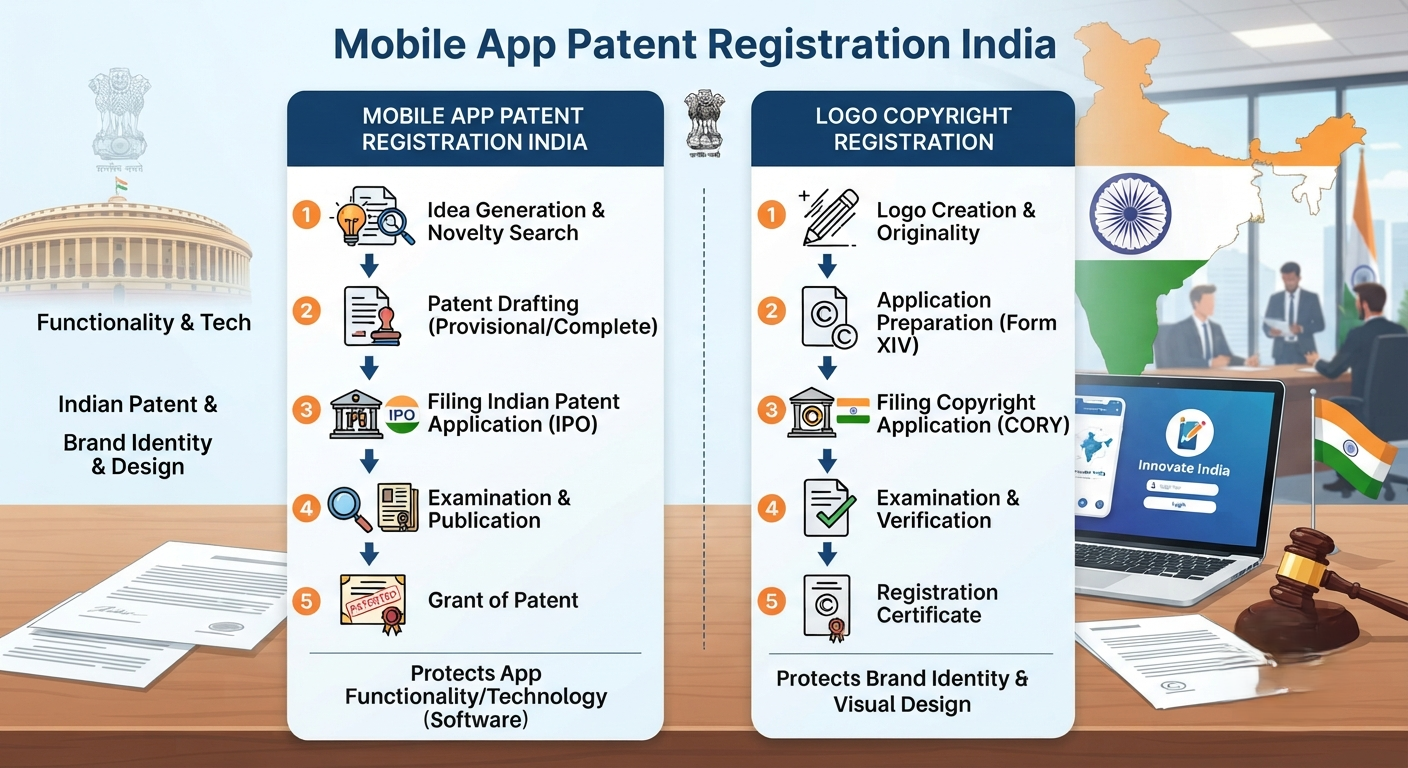
This is where Mobile App Patent Registration India And Logo Copyright Registration become relevant. However, the two forms of intellectual property protection serve different purposes. A patent may protect an eligible technical invention behind an application, while copyright can protect original creative expression such as software code or artistic logo artwork. Understanding these differences before filing can help businesses avoid confusion and build a more practical IP protection strategy.
Understanding Mobile App Patent Registration in India
A common misconception is that every newly developed mobile app can automatically be patented.
That is not how the Indian patent system works.
A mobile application may contain several different intellectual property elements, including software code, technical processes, algorithms, interfaces, databases, branding, graphics, and business methods. These elements may not all qualify for the same type of protection.
The Indian Patent Office examines computer-related inventions under the applicable provisions of the Patents Act and its Computer Related Inventions guidelines. The current official CRI guidance addresses patentability and exclusions relating to computer-related inventions, particularly Section 3(k).
Therefore, when people refer to Mobile App Patent Registration India, the real question should usually be:
Does the technology implemented through the mobile app contain a patentable technical invention?
Simply developing another shopping app, booking application, calculator, social networking platform, or conventional business-management app does not necessarily create a patentable invention.
A stronger patent application generally needs to explain the technical problem being addressed, the technical architecture involved, how the invention operates, and what distinguishes the proposed invention from existing technology.
What Parts of a Mobile App May Need IP Protection?
Instead of looking at an app as one single asset, businesses should divide it into individual intellectual property components.
1. Technical Invention
If the app implements an eligible new technical solution, patent protection may be considered.
Examples could involve innovations concerning device communication, cybersecurity mechanisms, network architecture, hardware-software interaction, data processing techniques, or other technically implemented solutions.
Patent eligibility must be assessed on the particular invention rather than simply describing something as a mobile application.
2. Source Code
Software code may receive copyright protection as a computer program.
The Copyright Office states that an app can be registered as a computer program under literary works. Its guidance also explains the source-code material required for registration.
This means that copyright and patent protection should not be treated as interchangeable.
3. App Name and Brand Identity
The business name or app name may require trademark protection where applicable.
This is different from patent protection.
4. Logo and Graphic Artwork
Original artwork forming a logo may fall under copyright protection as an artistic work, subject to applicable requirements.
This is where Logo Copyright Registration becomes relevant.
What Is Logo Copyright Registration?
A logo can be one of the most valuable visual assets of a growing business.
Customers may forget a long company description, but they can immediately recognize a strong symbol, icon, illustration, or visual identity.
Copyright law protects original artistic expression, and artistic works can be entered in the Register of Copyrights through the prescribed registration process. Section 45 of the Copyright Act allows an author, publisher, copyright owner, or other interested person to apply for registration of a work.
For a logo that qualifies as an artistic work and is used or capable of being used in relation to goods or services, additional trademark-search-related documentation may be required.
The Copyright Office’s guidance specifically identifies brand logos, labels, packaging, and similar business artwork among works that can require a Search Certificate from the Trade Marks Registry when submitted as artistic works used in connection with goods or services.
Therefore, businesses should not assume that uploading a logo file alone completes the registration process.
Copyright Registration and Trademark Registration Are Not the Same
This distinction is extremely important.
Copyright primarily concerns the original artistic expression contained in a logo.
Trademark law focuses on marks used to distinguish the goods or services of one business from those of others.
A company may therefore consider different forms of protection for the same broader brand identity depending on its commercial use and circumstances.
For example, a uniquely drawn symbol could potentially involve copyright issues as artwork while also functioning commercially as a trademark.
A professional IP assessment can help determine which rights are appropriate.
Mobile App Patent Registration India: A Practical Filing Approach
Businesses considering patent protection should begin before publicly revealing too much about the technical concept.
A practical approach usually involves the following stages.
Step 1: Identify the Real Invention
Do not begin with:
“We have created a mobile app.”
Instead, identify exactly what is technically new.
Questions may include:
- What technical problem does the invention solve?
- How does it solve that problem?
- What technical components interact?
- What is different from known technology?
- What technical result is achieved?
Step 2: Conduct a Prior-Art Search
Patent databases contain enormous numbers of previously published inventions.
Searching relevant prior art helps identify whether similar technical concepts already exist.
This can improve both decision-making and drafting quality.
Step 3: Prepare a Strong Patent Specification
Patent drafting is not simply writing a general app description.
The specification should clearly communicate the invention, technical implementation, embodiments, relevant diagrams, and claims.
The claims are particularly significant because they define the scope of patent protection being sought.
Step 4: File the Appropriate Patent Application
Depending on the development stage and circumstances, an applicant may consider a provisional or complete specification.
The correct strategy depends on factors such as invention readiness, disclosure, development timelines, and filing plans.
Step 5: Examination and Response
After filing and the applicable procedural steps, a patent application may undergo examination by the Indian Patent Office.
Questions or objections may arise regarding novelty, inventive step, patentable subject matter, clarity, or other legal and technical requirements.
Computer-related inventions can require especially careful explanation because the Indian Patent Office applies specific examination guidance to CRIs.
How Does Logo Copyright Registration Work?
For businesses seeking Logo Copyright Registration, the procedure generally begins by identifying ownership and authorship correctly.
The Copyright Rules provide for registration through the prescribed form and require one application for one work. They also contain additional requirements for artistic works used or capable of being used in connection with goods or services.
The official Copyright Office portal provides an online filing process involving Form XIV, the Statement of Particulars, supporting documents, work upload, further particulars where applicable, and online fee payment.
Applicants should carefully verify matters such as:
- Who originally created the logo?
- Who currently owns the copyright?
- Was the logo created by an employee, freelancer, designer, or agency?
- Has ownership been properly assigned?
- Is a No Objection Certificate required?
- Is the logo being used in connection with goods or services?
- Is the required trademark-related search certificate available where applicable?
Incorrect ownership documentation can create unnecessary complications later.
Advantages and Disadvantages of Mobile App Patent and Logo Copyright Protection
| Protection Area | Advantages | Possible Disadvantages / Challenges |
| Mobile App Patent | Can protect an eligible technical invention | Not every software or app idea qualifies for a patent |
| Competitive Position | May help establish rights around proprietary technical innovation | Prior art may limit the available claim scope |
| Business Value | Patent assets may support licensing, investment, or technology transactions | Patent drafting, prosecution, and maintenance can involve cost |
| Technical Disclosure | Creates a structured legal description of the invention | Patent applications require sufficient disclosure of the invention |
| Logo Copyright | Helps document rights relating to original logo artwork | Copyright does not automatically replace trademark protection |
| Ownership Record | Registration can provide useful documentation regarding copyright ownership | Incorrect author or ownership details can create objections |
| Enforcement Support | Registration records can be useful in disputes concerning copying | Registration does not guarantee that disputes will never arise |
| Brand Protection Strategy | Can complement other forms of intellectual property protection | Different IP rights may require separate filing strategies |
Why Startups Should Think About IP Early
Young companies often focus almost entirely on development and sales.
That is understandable.
However, intellectual property decisions can become harder once developers change, designers leave, investors enter the company, branding is redesigned, or the product becomes publicly available.
Imagine that three founders hire a freelance programmer and an independent graphic designer.
The programmer develops the app.
The designer creates the logo.
Months later, the founders decide to raise investment.
An investor may ask:
Who owns the code? Who owns the logo? Has the technology been protected?
If contracts, assignments, or filings are unclear, the company may need to reconstruct its ownership history.
Early IP planning can reduce these problems.
Common Mistakes Businesses Should Avoid
One frequent mistake is assuming that an “app idea” alone can always be patented.
Another is believing that copyright registration for a logo automatically gives every possible brand right.
Businesses also sometimes wait until after a dispute begins before investigating ownership.
Other mistakes include filing incomplete information, using an incorrect applicant name, overlooking previous technology during patent planning, misunderstanding the difference between patent and copyright rights, and failing to document assignments from freelancers or agencies.
Professional guidance can be particularly valuable when technology and branding rights overlap.
At ansipms, businesses can seek structured assistance for understanding intellectual property filing requirements and preparing an appropriate protection strategy according to the nature of their innovation and creative assets.
Why Mobile App Patent Registration India And Logo Copyright Registration Should Be Planned Together
For a technology startup, the application and the brand usually grow at the same time.
Your technical solution may differentiate the product functionally.
Your logo may differentiate the business visually.
Your app name may differentiate it commercially.
Your code represents the software implementation.
Because these assets are different, relying on only one form of intellectual property protection may leave important areas unaddressed.
A more structured IP strategy looks at the complete business:
Technology + Software + Brand + Creative Assets + Ownership Documentation
This broader perspective helps businesses understand what they actually own and what forms of registration may be relevant.
Frequently Asked Questions
1. Can a mobile app be patented in India?
A mobile app is not patentable merely because it is an app. An eligible underlying technical invention may potentially qualify for patent protection if it satisfies Indian patentability requirements and is not excluded under applicable provisions.
2. Can I patent only an app idea?
Generally, an abstract idea by itself is not enough. A patent application needs to describe an eligible invention with sufficient technical detail.
3. Is software protected by copyright in India?
Yes. Computer programs can qualify for copyright protection as literary works, subject to the Copyright Act and applicable requirements. The Copyright Office also provides a registration procedure for computer programs.
4. Can a logo be registered under copyright?
Original logo artwork may be registered as an artistic work where the applicable copyright requirements are satisfied.
5. Is Logo Copyright Registration the same as trademark registration?
No. Copyright protects eligible creative expression, while trademark protection concerns marks that identify or distinguish goods or services in commerce.
6. Do I need a trademark search certificate for logo copyright registration?
Where an artistic work is used or capable of being used in relation to goods or services, Indian copyright law and rules require the applicable certificate from the Trade Marks Registrar.
7. Can a startup apply for both patent and copyright protection?
Yes, depending on the assets involved. A business may consider patent protection for eligible technical inventions and copyright protection for qualifying software or artistic works.
8. Who should own the copyright if a freelancer designed my logo?
Ownership depends on the legal relationship and applicable agreements. Businesses should maintain clear written documentation regarding authorship, assignment, and ownership rights.
9. Should patent protection be considered before launching an app?
It is generally sensible to review patent strategy before making unrestricted public disclosures of a potentially patentable invention. The appropriate filing strategy depends on the individual circumstances.
10. How can ansipms assist with IP protection?
ansipms can help businesses understand filing requirements, organize intellectual property documentation, evaluate the appropriate registration route, and coordinate patent, copyright, and related IP filing strategies according to the nature of the asset.