Choosing an experienced vacuum casting and injection molding supplier can help manufacturers determine which process fits their product, production volume, material requirements, and budget. The right manufacturing partner can also support design optimization, tooling, prototyping, finishing, inspection, and production scaling.
What Is Vacuum Casting?
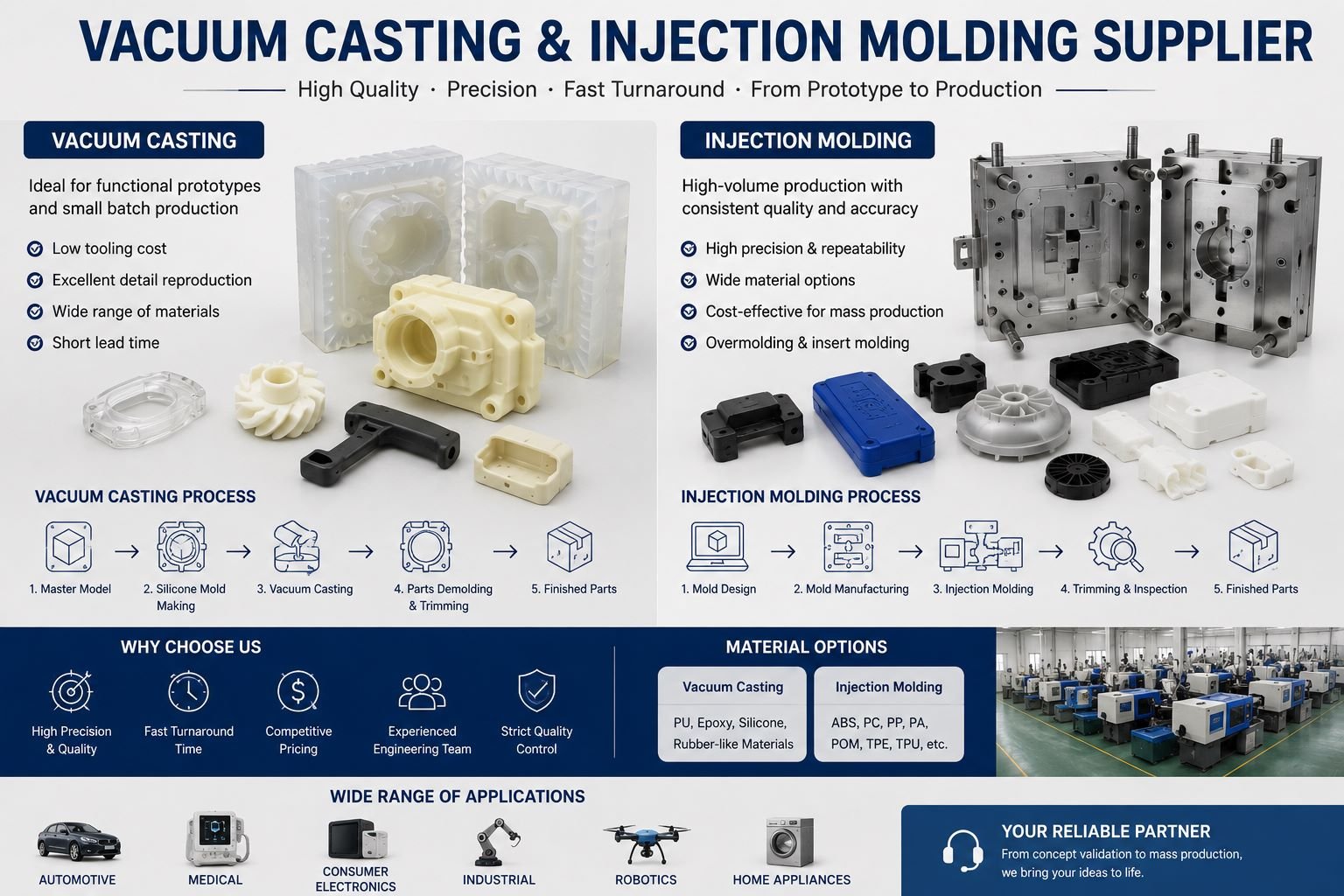
Vacuum casting is a manufacturing technique commonly used to create detailed prototypes and small quantities of functional components. A master pattern is normally produced from a digital CAD design. A flexible silicone mold is then created around the master pattern.
Once the silicone mold has cured, polyurethane or another suitable casting resin is introduced under controlled vacuum conditions. Vacuum pressure helps minimize air bubbles and improves the reproduction of fine details.
This method is particularly useful when manufacturers need physical products before investing in permanent production tooling.
Why Manufacturers Use Vacuum Casting
Vacuum casting provides several advantages during product development. It allows businesses to evaluate a physical design without immediately committing to expensive production molds.
Common applications include:
- Product appearance models
- Engineering prototypes
- Functional testing parts
- Small production batches
- Consumer product samples
- Marketing and demonstration units
- Pre-production validation
Another advantage is design flexibility. If a prototype reveals a dimensional or ergonomic problem, modifications can generally be made before permanent tooling is manufactured.
How Injection Molding Works
Injection molding follows a different manufacturing principle. Plastic pellets are heated until they become molten and are then injected into a specially manufactured mold. The material cools inside the cavity before the finished component is ejected.
The mold may contain one or multiple cavities depending on production requirements. For larger manufacturing programs, automated equipment can repeatedly produce components with consistent dimensions.
Injection molding is therefore widely used when production quantities justify the investment in dedicated tooling.
Major Differences Between the Two Processes
| Manufacturing Factor | Vacuum Casting | Injection Molding |
| Primary purpose | Prototypes and small batches | Repeated production |
| Tooling | Silicone mold | Metal production mold |
| Initial tooling investment | Usually lower | Usually higher |
| Production volume | Low to moderate | Moderate to very high |
| Design flexibility | High during development | Lower after tooling |
| Material options | Mainly casting resins | Extensive thermoplastic options |
| Production repeatability | Suitable for limited runs | Excellent for established production |
| Scaling | Limited by mold life | Highly scalable |
Neither technology is universally suitable for every project. The correct selection depends on the product’s development stage and commercial requirements.
Selecting the Manufacturing Process According to Production Stage
Early Product Development
During early development, product specifications may change frequently. Vacuum casting can provide physical components without requiring permanent production tooling.
It allows designers to inspect:
- Product dimensions
- Surface appearance
- Assembly compatibility
- Ergonomics
- Functional performance
Product Validation
When a design becomes more mature, manufacturers may need multiple samples for testing and customer evaluation. Vacuum casting can bridge the gap between a single prototype and full-scale manufacturing.
Established Production
Once the design has been finalized and production quantities increase, injection molding may become more appropriate. Production tooling can support repeated manufacturing cycles and consistent output.
What Should a Supplier Provide?
A reliable vacuum casting and injection molding supplier should offer more than manufacturing equipment. Engineering support can make a significant difference to project success.
A capable supplier should be able to assist with:
- CAD and drawing evaluation
- Design for manufacturability analysis
- Material recommendations
- Mold design
- Prototype production
- Tool manufacturing
- Surface finishing
- Dimensional inspection
- Production management
- Packaging and delivery
Early technical communication can identify manufacturing problems before they become expensive tooling or production issues.
Important Factors Before Ordering
Before requesting a quotation, manufacturers should prepare complete project information. Important details include CAD models, technical drawings, expected quantities, material preferences, surface requirements, colors, tolerances, and delivery targets.
Design Considerations
A supplier may review wall thickness, draft angles, ribs, bosses, undercuts, parting lines, and ejection requirements. These factors can affect tooling complexity and final product quality.
Material Requirements
Material selection should match the intended application. A prototype resin may reproduce selected properties of a production material, but it should not automatically be assumed to behave identically in every application.
For injection molding, engineers can select from numerous thermoplastic materials based on mechanical, thermal, chemical, electrical, and appearance requirements.
Industries Using These Manufacturing Methods
Vacuum casting and injection molding are used across numerous industries. Typical applications include:
- Automotive components
- Electronic enclosures
- Consumer products
- Industrial equipment
- Medical device development
- Appliances
- Robotics
- Telecommunications products
The required manufacturing method can vary significantly even within the same industry.
How to Compare Potential Suppliers
Price is important, but it should not be the only selection criterion. A low initial quotation may not represent the lowest overall project cost if tooling revisions, quality problems, or communication delays occur later.
Consider these factors when evaluating suppliers:
- Manufacturing capabilities
- Engineering expertise
- Quality inspection procedures
- Material knowledge
- Tooling experience
- Production capacity
- Communication practices
- Lead-time management
- Finishing capabilities
- Previous project experience
A supplier capable of supporting both prototype and production requirements can also make project transitions easier.
Frequently Asked Questions
What is the main purpose of vacuum casting?
Vacuum casting is commonly used for detailed prototypes, functional samples, appearance models, and limited production quantities.
How is injection molding different?
Injection molding uses permanent metal tooling and is generally intended for repeatable production.
Is vacuum casting suitable for small businesses?
It can be useful when a company needs limited quantities without investing immediately in production tooling.
When should a company move to injection molding?
The transition generally makes sense when the product design is finalized and production volume can justify tooling investment.
Can vacuum casting reproduce detailed features?
Yes. Flexible silicone molds can reproduce many fine surface and geometric details.
What information should I provide for a quotation?
CAD files, drawings, quantity, material, tolerances, finish, color, and delivery requirements are useful starting information.
Does injection molding support multiple materials?
Yes. Many thermoplastic materials can be processed through injection molding, depending on equipment and tooling requirements.
Why is DFM important?
Design for manufacturability can identify geometry or tooling problems before production begins.
Can one supplier handle prototyping and production?
Some manufacturers provide both vacuum casting and injection molding, allowing customers to manage different development stages through one supplier.
What determines the final manufacturing cost?
Part geometry, tooling complexity, material, quantity, tolerances, finishing, inspection, and production requirements all influence cost.