
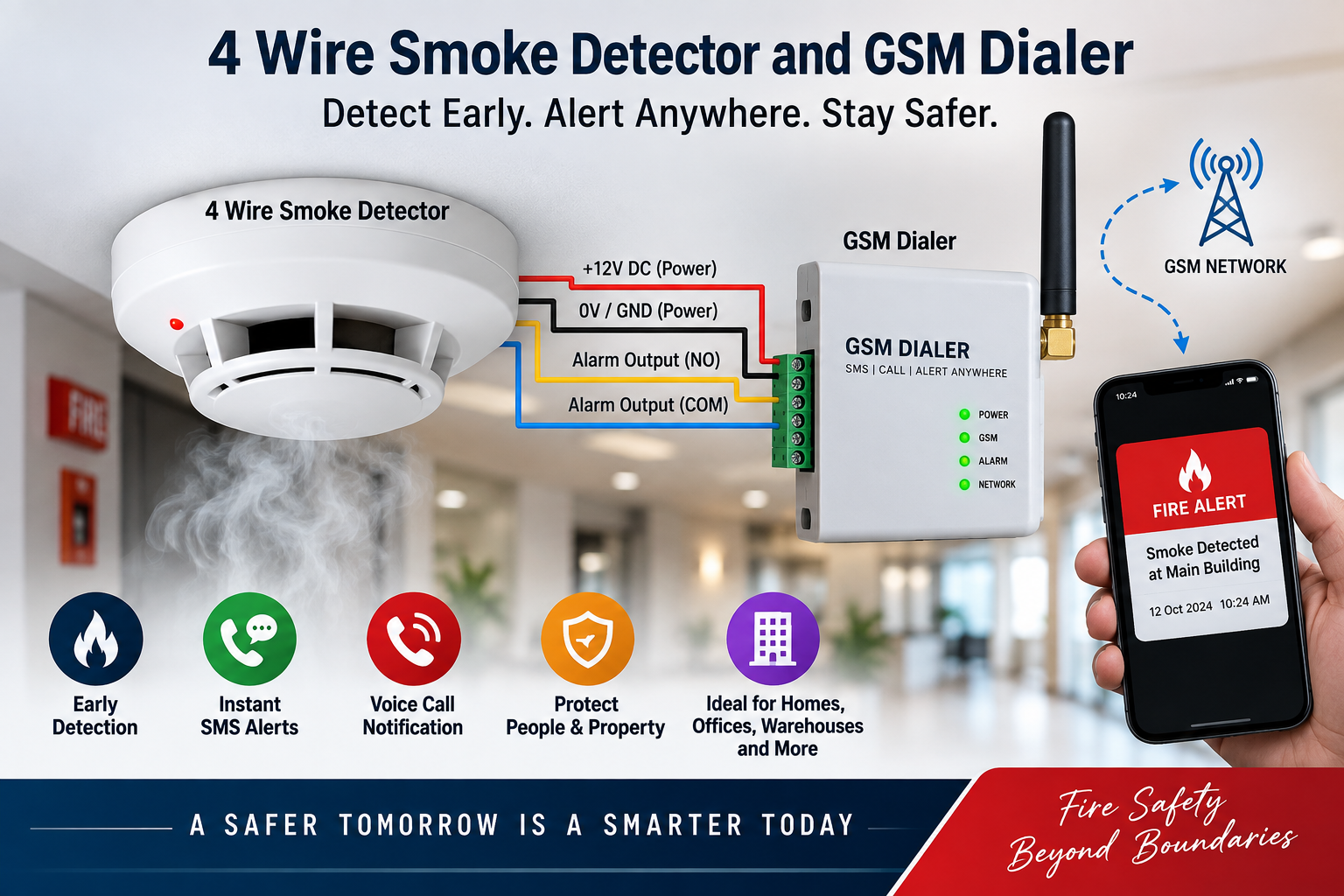
Fire safety is no longer limited to detecting smoke and sounding a local alarm. Modern buildings need reliable detection combined with fast communication so responsible people can be informed even when they are away from the property. A 4 wire smoke detector combined with a GSM dialer provides a practical solution for creating this type of connected fire and security alert system.
A 4 wire smoke detector typically uses separate connections for power and alarm signaling, giving installers greater flexibility when integrating detectors with compatible fire alarm or security control panels. A GSM dialer adds another communication layer by using a cellular network to send alerts or initiate calls when a programmed alarm condition occurs.
Together, these devices can help improve response awareness in offices, shops, warehouses, residential properties, institutions, and other premises where dependable fire notification is important.
What Is a 4 Wire Smoke Detector?
A 4 wire smoke detector is a smoke detection device that generally uses two wires for electrical power and another two wires for the alarm circuit. Unlike some two-wire detectors, its power circuit and alarm signaling circuit are separated.
When smoke particles reach the detector’s sensing chamber and meet the configured alarm threshold, the detector changes its alarm output. A compatible fire alarm or security panel interprets this condition and activates the programmed notification devices.
Common benefits include:
- Separate power and alarm connections
- Compatibility with many conventional alarm applications
- Straightforward integration with suitable control panels
- Reliable alarm signaling when correctly installed
- Flexibility for commercial and residential applications
Compatibility should always be verified before installation because voltage requirements, relay characteristics, reset methods, wiring arrangements, and panel specifications can differ between manufacturers.
How Does a 4 Wire Smoke Detector Work?
A typical detector continuously monitors its sensing area for indications of smoke. Depending on its technology, it may use photoelectric or another approved sensing method.
The detector receives continuous operating power through one pair of wires. The remaining connections are associated with the alarm signaling circuit.
When smoke is detected, the device changes the state of its alarm output. The control panel receives this signal and can activate sirens, sounders, strobes, relays, or other configured outputs.
Some installations also require appropriate end-of-line supervision and a suitable method for resetting detector power after an alarm. The exact arrangement should follow the detector and control-panel manufacturer’s documentation.
What Is a GSM Dialer?
A GSM dialer is a cellular communication device designed to transmit notifications when it receives a predefined trigger from an alarm system.
Depending on the model and network support, a GSM dialer may communicate through voice calls, SMS messages, or other cellular services. It can be connected to compatible fire alarm panels, security panels, control systems, and monitoring equipment.
For example, when a fire alarm panel enters an alarm condition, an output from the panel can trigger the GSM dialer. The dialer can then contact predefined recipients according to its programming.
This makes a GSM dialer particularly useful where immediate remote awareness is required.
Why Combine a 4 Wire Smoke Detector With a GSM Dialer?
Smoke detection is most effective when an alarm can quickly reach people capable of responding. A local sounder warns occupants, while remote communication can inform designated personnel who are elsewhere.
A 4 wire smoke detector and GSM dialer arrangement can therefore provide two important functions: detection and communication.
Potential advantages include:
- Rapid smoke detection within the protected area.
- Local alarm activation through the control system.
- Remote notification to predefined contacts.
- Cellular communication without depending entirely on a fixed telephone line.
- Improved awareness when a building is unattended.
A GSM dialer should complement properly designed fire-warning equipment rather than replace required alarms, monitoring services, evacuation procedures, or emergency communication systems.
4 Wire Smoke Detector vs GSM Dialer
| Feature | 4 Wire Smoke Detector | GSM Dialer |
| Primary purpose | Detect smoke | Communicate alarm events |
| Main role | Fire detection | Remote notification |
| Connection | Power and alarm circuit | Panel/output trigger |
| Communication | Local electrical signal | Cellular network |
| Typical location | Protected rooms or areas | Near control equipment |
| Main benefit | Early detection | Remote awareness |
These products perform different functions. The smoke detector identifies a possible fire condition, while the GSM dialer helps communicate a programmed alarm event.
Applications of 4 Wire Smoke Detectors
A 4 wire smoke detector can be suitable for many applications when the detector is approved and compatible with the selected alarm system.
Typical applications may include:
- Offices and corporate buildings
- Retail shops and showrooms
- Warehouses
- Schools and educational facilities
- Hotels and hospitality properties
- Apartment buildings
- Industrial facilities
- Clinics and healthcare premises
- Server and equipment rooms
- Residential properties
Detector selection and positioning should always reflect the building layout, occupancy, environmental conditions, applicable standards, and fire-risk assessment.
Benefits of Using a GSM Dialer
One major advantage of a GSM dialer is its ability to provide remote alerts through a cellular connection. This can be valuable for buildings that remain unattended during nights, weekends, or holidays.
Another advantage is flexibility. Depending on the equipment, multiple telephone numbers may be programmed so that several responsible people can receive notifications.
Modern units may also provide configurable inputs and outputs, event messages, backup-power compatibility, and network-status monitoring. Features vary significantly, so buyers should verify the exact specification rather than assuming every GSM dialer provides the same capabilities.
Important Installation Considerations
Correct installation is essential for dependable operation. A smoke detector should not simply be connected to any available GSM input without checking electrical and system compatibility.
Important considerations include detector voltage, current requirements, panel compatibility, alarm contacts, circuit supervision, reset requirements, cellular coverage, backup power, and applicable fire-safety regulations.
Professional installers should also perform functional testing after installation. Testing should confirm that smoke detection produces the expected panel response, local notification operates correctly, and the GSM communication pathway successfully delivers its programmed notification.
Regular inspection and maintenance are equally important.
Choosing the Right 4 Wire Smoke Detector and GSM Dialer
Before purchasing equipment, consider the complete system rather than evaluating individual components independently.
Check whether the 4 wire smoke detector is compatible with your control panel and operating voltage. Review its sensing technology, certification, environmental rating, alarm output, reset requirements, and recommended applications.
For a GSM dialer, consider supported cellular networks, number of inputs, notification methods, programmable contacts, backup-power options, signal-strength indication, and compatibility with the alarm panel.
Products intended for life-safety applications should meet the standards and regulations applicable to the installation location.
FAQ About 4 Wire Smoke Detector and GSM Dialer
1. What is a 4 wire smoke detector?
It is a smoke detector that generally uses separate wiring for operating power and alarm signaling.
2. Why are four wires required?
Typically, two provide power while another pair handles the alarm circuit.
3. What does a GSM dialer do?
It communicates programmed alarm events to designated contacts through a supported cellular network.
4. Can a GSM dialer work with a smoke detector?
Yes, when connected through a compatible control panel, relay, or approved interface according to the equipment specifications.
5. Does a GSM dialer require internet access?
Not necessarily. Traditional GSM/cellular dialers communicate through supported mobile networks rather than a conventional broadband connection.
6. Can several numbers receive an alarm notification?
Many models support multiple programmed contacts, but the exact number depends on the device.
7. Where can 4 wire smoke detectors be installed?
They may be used in compatible residential, commercial, institutional, and industrial fire-alarm applications.
8. Is professional installation recommended?
Yes. Fire detection is a life-safety application, so equipment should be selected, installed, tested, and maintained by appropriately qualified professionals according to applicable requirements.
9. Will the GSM dialer work during a power failure?
It can only continue operating if the overall system has an appropriate backup power source and cellular service remains available.
10. How often should the system be tested?
Testing and maintenance should follow manufacturer instructions and applicable local fire-safety codes or standards.