
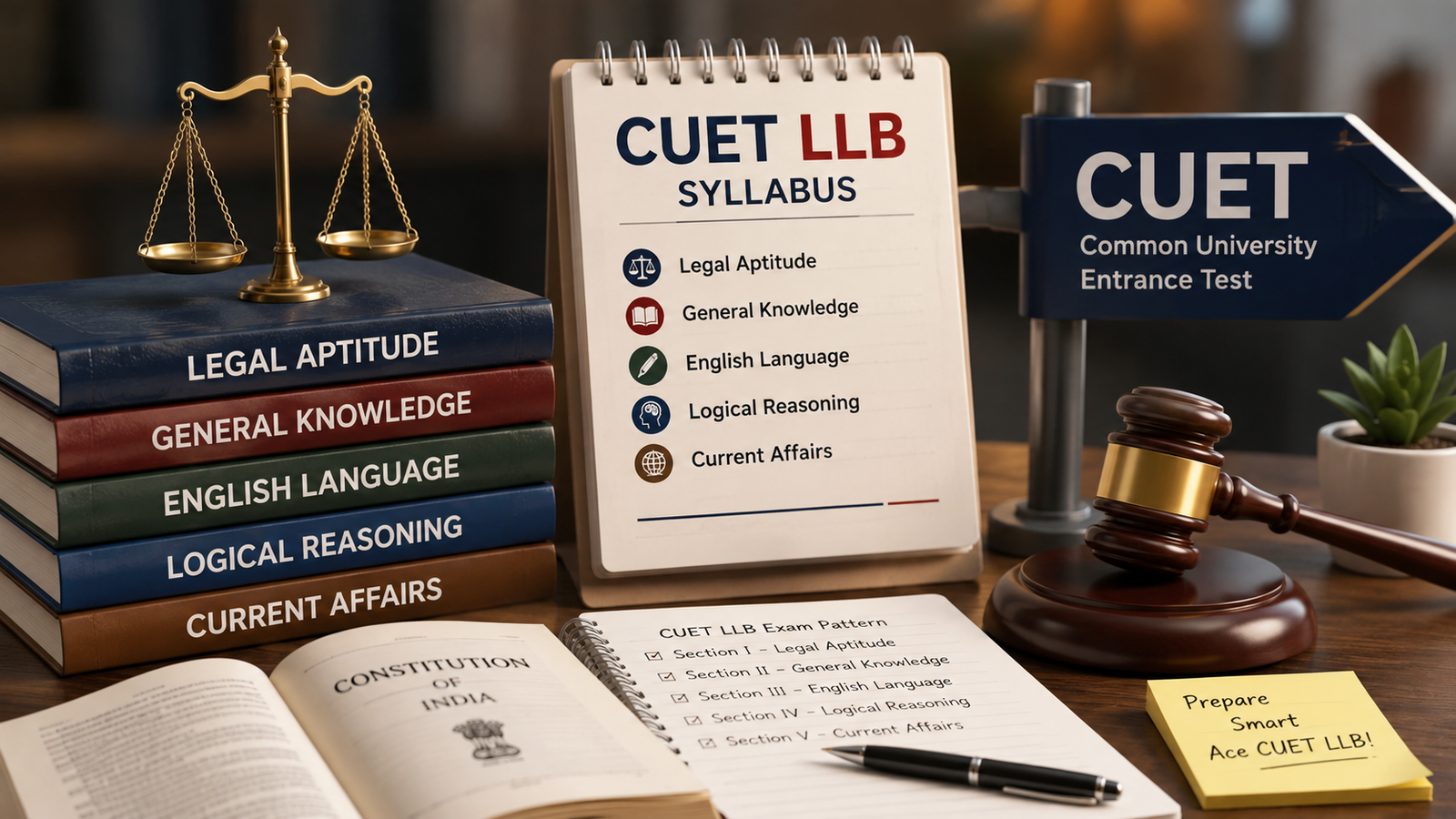
CUET has created a common admission route for participating universities, but candidates should remember that programme-specific eligibility and subject requirements can differ between institutions. Therefore, preparation should begin by checking the latest official information for the particular law programme you intend to pursue.
This guide explains the CUET LLB syllabus, important preparation areas, study techniques, revision methods, and practical strategies for aspiring law students.
Understanding CUET for Law Aspirants
CUET, or the Common University Entrance Test, is used by participating universities for admission to various undergraduate and postgraduate programmes. The examination provides candidates with a common testing platform rather than requiring completely separate entrance examinations for every participating institution.
For law aspirants, however, the term CUET LLB syllabus can sometimes cause confusion. Different law programmes may fall under different admission routes, and the subjects or papers required can vary according to the university and course.
Candidates should therefore confirm three things before starting preparation:
- Exact law programme they want to pursue
- Eligibility requirements of their preferred university
- CUET papers or subject combinations required for admission
This simple verification prevents students from preparing for subjects that may not apply to their chosen programme.
CUET LLB Syllabus: What Should Students Study?
The exact syllabus should always be verified against the current official examination bulletin and university admission requirements. Depending on the programme and applicable paper, preparation may involve language ability, general aptitude, reasoning, current affairs, and other specified areas.
A broad preparation framework can include:
| Preparation Area | Skills to Develop |
| Language | Vocabulary, grammar and comprehension |
| General Knowledge | Awareness of major national and international topics |
| Current Affairs | Understanding important recent developments |
| Logical Reasoning | Analytical and problem-solving ability |
| Quantitative Skills | Basic numerical reasoning where applicable |
| Legal Awareness | Basic understanding of legal developments when relevant |
Students should not automatically assume that every topic in this table forms part of their official paper. Use the prescribed syllabus for your specific CUET paper as the final authority.
Language and Reading Comprehension Preparation
Strong reading ability can be particularly valuable for students planning a legal career. Law involves interpreting information carefully, understanding arguments, and identifying differences between similar statements.
Language preparation may focus on vocabulary, sentence structure, grammar, comprehension, synonyms, antonyms, and verbal ability according to the applicable syllabus.
Develop a daily reading habit using quality newspapers, editorials, essays, and informative articles. After reading a passage, try to identify its central argument, supporting evidence, tone, and conclusion.
Vocabulary should be learned through context rather than memorising long lists of unrelated words. This improves retention and helps candidates understand unfamiliar words during comprehension exercises.
General Knowledge and Current Affairs
General awareness preparation becomes manageable when it is organised consistently. Instead of trying to memorise months of current affairs immediately before the examination, candidates can dedicate a small amount of time every day.
Important areas may include national developments, international affairs, important organisations, awards, major appointments, economic developments, science and technology, environmental issues, sports, and significant government initiatives.
For aspiring law students, following important legal and constitutional developments can also build useful background knowledge.
Create short monthly notes containing only important information. These condensed notes become particularly valuable during the final revision period.
Logical and Analytical Reasoning
Reasoning evaluates how efficiently candidates understand information and arrive at appropriate conclusions.
Depending on the applicable CUET syllabus, preparation can cover areas such as:
- Analogies
- Series
- Classification
- Statements and conclusions
- Logical sequences
- Coding and decoding
- Direction-based problems
- Relationships
- Analytical reasoning
- Problem-solving questions
Begin with concept-based practice without worrying about speed. Once accuracy improves, introduce timed exercises.
Keeping an error notebook is particularly effective. Record questions you answered incorrectly and identify whether the mistake resulted from misunderstanding, calculation, interpretation, or rushing.
Quantitative Aptitude Preparation
Where numerical ability forms part of the required paper, candidates should focus on fundamental mathematics rather than immediately attempting difficult questions.
Preparation may involve percentages, ratios, averages, profit and loss, basic arithmetic, time and work, simple numerical interpretation, and related concepts depending on the official syllabus.
The objective should be quick and accurate application of basic concepts.
A productive routine is:
- Understand the concept.
- Solve basic questions.
- Attempt moderate questions.
- Practise under a time limit.
- Analyse incorrect answers.
Regular practice is more effective than studying mathematics for several hours only once a week.
Legal Awareness for Aspiring Law Students
Students searching for the CUET LLB syllabus often assume that extensive legal knowledge is automatically required. Candidates should avoid this assumption and check whether legal knowledge is actually included in the paper applicable to their admission route.
Nevertheless, general awareness of India’s legal system can be beneficial for someone planning to study law.
Students can become familiar with fundamental constitutional concepts, major institutions, significant judgments, important legal developments, and the broad structure of courts.
The objective at the entrance-preparation stage should be conceptual awareness rather than attempting to study professional law textbooks unnecessarily.
Best Study Plan for CUET Preparation
A structured study timetable prevents candidates from spending excessive time on their strongest subjects while neglecting weaker areas.
For example, a daily schedule might include reading comprehension, reasoning practice, current affairs revision, and one additional syllabus-specific subject.
Every week, candidates should review their performance.
Ask:
- Which topic produces the most incorrect answers?
- Which questions consume excessive time?
- Are mistakes conceptual or caused by carelessness?
- Which topics have not been revised recently?
Use these answers to modify the following week’s schedule.
This makes preparation performance-driven rather than simply based on hours spent studying.
Importance of Mock Tests and Previous Questions
Mock examinations are useful only when candidates analyse them properly.
After completing a test, divide incorrect questions into three categories: concepts you did not understand, questions you understood but answered incorrectly, and questions where time pressure caused mistakes.
This analysis identifies exactly what needs improvement.
Previous questions and syllabus-aligned practice also help candidates understand question styles and improve familiarity with computer-based examination conditions where applicable.
During the early preparation stage, focus primarily on accuracy. Gradually introduce stricter time limits as the examination approaches.
Common CUET Preparation Mistakes
One major mistake is beginning preparation without confirming programme-specific requirements. A student may spend weeks studying unnecessary material because they relied on an outdated article or preparation book.
Another common mistake is collecting too many resources. Five books covering the same subject rarely provide five times better preparation.
Choose limited, reliable resources and revise them repeatedly.
Candidates should also avoid:
- Ignoring official syllabus updates
- Studying current affairs without revision
- Taking mocks without analysing mistakes
- Memorising concepts without practising questions
- Leaving weaker subjects until the final weeks
- Changing preparation resources frequently
Consistency usually produces better results than constantly searching for a supposedly perfect study resource.
Frequently Asked Questions About CUET LLB Syllabus
1. What is the CUET LLB syllabus?
The applicable syllabus depends on the CUET paper and law programme required by the participating university. Candidates should verify the current official syllabus and programme requirements.
2. Is legal knowledge compulsory for CUET law admission?
Not necessarily. Whether legal knowledge is directly tested depends on the relevant paper and admission requirements.
3. Is CUET used for law admissions?
Participating universities may use CUET scores for specified programmes, but candidates must check the admission route for their particular law course.
4. How should I start CUET preparation?
First identify your target universities and programmes, confirm required papers, download the current syllabus, and create a topic-wise study plan.
5. How many hours should I study daily?
There is no universal requirement. Two or three focused hours can be more productive than many hours of unfocused preparation.
6. Are mock tests important for CUET?
Yes. Syllabus-aligned mock tests can improve speed, accuracy, time management, and familiarity with question patterns.
7. How can I improve reading comprehension?
Read regularly, practise passage-based questions, build contextual vocabulary, and learn to identify arguments and conclusions quickly.
8. How should I prepare current affairs?
Follow reliable news sources, create concise notes, revise monthly, and practise relevant questions instead of simply collecting information.
9. Can I prepare for CUET without coaching?
Yes. Self-study can work well when candidates use reliable resources, practise consistently, take mock tests, and regularly evaluate performance.
10. When should I start mock tests?
Topic-based tests can begin early. Full-length mocks should become increasingly frequent after candidates have covered a substantial part of their required syllabus.