Displays have become the primary communication bridge between people and electronic devices. From industrial control panels and medical equipment to smart appliances, point-of-sale terminals, automotive systems, and handheld electronics, users expect information to appear clearly and respond quickly. A TFT LCD Module is one of the most widely used technologies for meeting these requirements because it combines reliable colour reproduction, compact construction, responsive performance, and flexible integration.
Modern TFT Modules are available in numerous screen sizes, resolutions, interfaces, brightness levels, viewing configurations, and touch options. Understanding these characteristics helps engineers and product developers select a display that delivers the right balance between performance, cost, durability, and user experience.
What Is a TFT LCD Module?
A TFT LCD Module is a liquid crystal display that uses thin-film transistor technology to control individual pixels. TFT stands for Thin Film Transistor. Each pixel is controlled electronically, enabling more precise colour, contrast, and image changes than simpler passive-matrix LCD technologies.
A complete module normally contains the TFT LCD panel, driver circuitry, polarising layers, backlight system, connectors, and associated electronic components. Depending on the application, it may also incorporate a capacitive or resistive touchscreen.
The technology is particularly suitable for applications requiring:
- Full-colour graphics
- Text and numerical information
- Icons and menus
- Charts and diagrams
- Images and animations
- Interactive touchscreen interfaces
Because of this versatility, TFT displays have become an important component in modern embedded systems.
How TFT Modules Work
The working principle of TFT Modules involves controlling liquid crystals positioned between layers of polarising material. Thin-film transistors regulate electrical signals supplied to individual pixels.
When voltage changes, the alignment of liquid crystal molecules changes. This influences how much light passes through the pixel. Red, green, and blue subpixels are then combined at different intensities to produce a wide range of colours.
The backlight is another essential part of the system. Most modern modules use LED backlighting because it provides efficient illumination, long operating life, compact dimensions, and good brightness.
The result is a display capable of presenting detailed graphical information while maintaining relatively low power consumption.
Important Features to Consider When Selecting TFT Modules
Choosing a display purely according to screen size can lead to poor results. Several technical characteristics should be evaluated during product development.
Resolution determines the number of pixels available for displaying information. Higher-resolution screens generally provide sharper text, smoother graphics, and greater visual detail.
Brightness becomes especially important for outdoor equipment or devices operating under strong ambient lighting. Indoor systems may require moderate brightness, whereas outdoor equipment may need high-brightness or sunlight-readable displays.
Viewing angle should also be considered. Technologies such as IPS can provide wider viewing angles and consistent colour reproduction, making them useful when users view the screen from different positions.
Engineers should additionally assess operating temperature, storage temperature, backlight life, connector design, mechanical dimensions, power requirements, and electromagnetic compatibility.
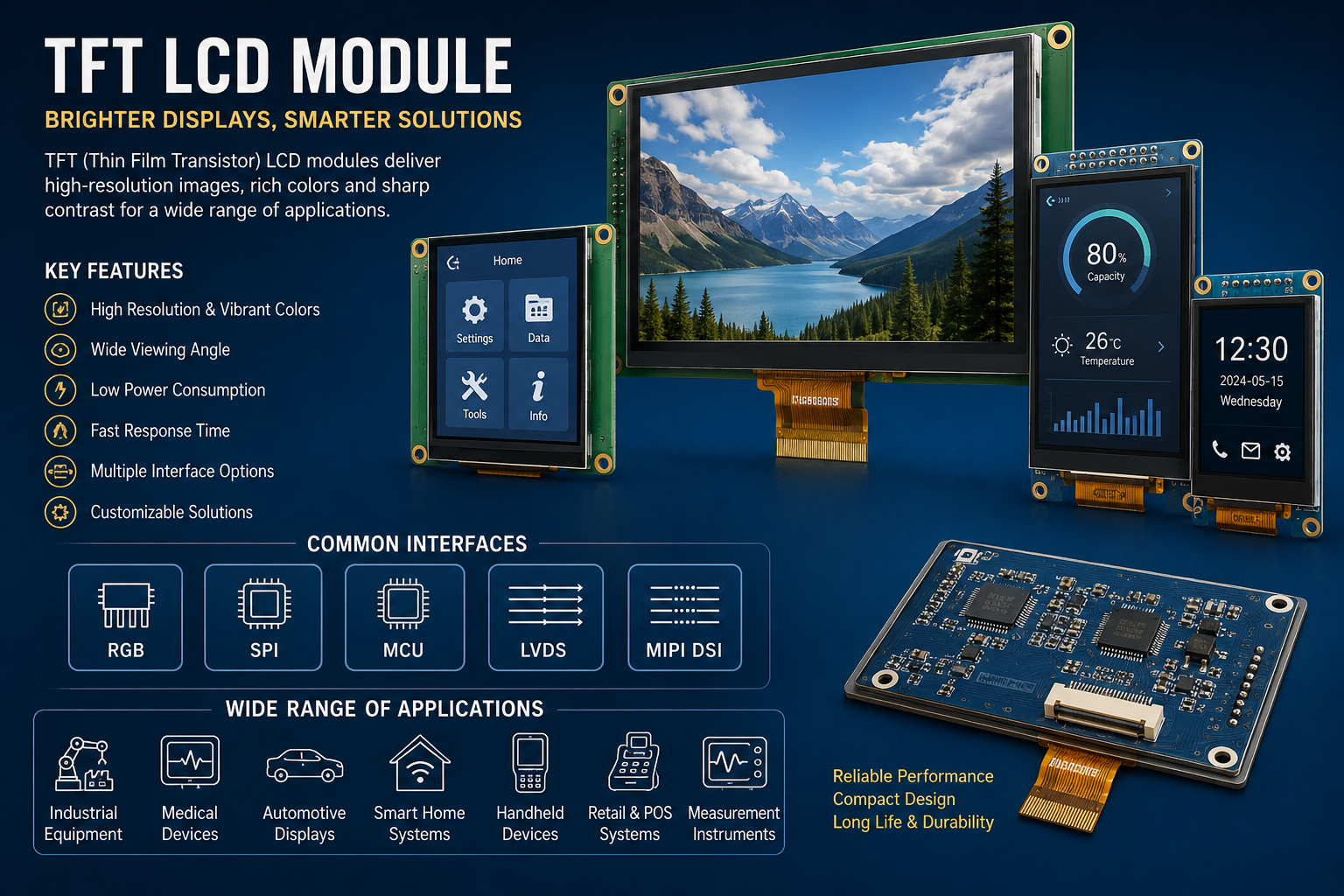
TFT LCD Module Interface Options
Communication between the host processor and the display is another major design consideration. Different interfaces support different performance levels.
| Interface | Typical Advantage | Common Application |
| RGB | Direct pixel transmission | Embedded graphical interfaces |
| SPI | Simple wiring | Small TFT displays |
| MCU | Straightforward controller integration | Industrial devices |
| LVDS | High-speed data transmission | Larger displays |
| MIPI DSI | High bandwidth and compact connections | Portable electronics |
The correct interface depends on display resolution, processor capability, required refresh rate, PCB architecture, cable length, and system cost.
A mismatch between the processor and display interface can complicate development, so compatibility should be checked early in the engineering process.
Applications of TFT LCD Modules
The flexibility of a TFT LCD Module allows it to serve many industries.
Industrial equipment uses TFT screens for machine monitoring, human-machine interfaces, diagnostic information, automation controls, and process management.
Medical devices can use displays to present measurements, operating parameters, patient information, and equipment status.
Automotive applications may include dashboard systems, navigation displays, control interfaces, charging equipment, and vehicle monitoring systems.
TFT displays are also widely used in smart-home equipment, security systems, laboratory instruments, handheld terminals, communication products, measurement devices, vending machines, and retail systems.
Their ability to combine information display with touchscreen control is especially valuable in products where traditional mechanical buttons would otherwise occupy significant space.
TFT Modules With Touchscreen Technology
Adding touch functionality can transform a conventional display into an interactive user interface.
Capacitive touchscreens provide responsive multi-touch operation and are common in modern consumer and professional equipment. They generally offer excellent transparency and a smooth user experience.
Resistive touchscreen technology responds to pressure rather than electrical capacitance. It may therefore be preferred for environments where operators wear gloves or use a stylus.
Selecting between the two technologies depends on operating conditions, user behaviour, budget, environmental exposure, and interface complexity.
Touchscreen integration should also consider cover glass, bonding method, touch controller compatibility, optical performance, and mechanical protection.
Advantages of Using a TFT LCD Module
One reason TFT technology remains widely adopted is its combination of performance and design flexibility.
Important benefits include high-quality colour graphics, fast response, compact construction, multiple resolution choices, various communication interfaces, touchscreen compatibility, and broad size availability.
Manufacturers can also customize certain TFT Modules for specialised products. Customisation may involve interface boards, connectors, cables, cover glass, brightness enhancement, touch panels, optical bonding, backlight modifications, or mechanical structures.
Such flexibility allows the display to fit the product rather than forcing designers to significantly redesign the enclosure or electronic architecture around a standard panel.
Standard TFT Modules vs Custom TFT Solutions
Standard displays and customised solutions serve different development needs.
Standard modules usually offer faster sourcing, easier prototyping, lower initial engineering costs, and established specifications. They can be ideal for prototypes, general-purpose products, and lower-volume equipment.
Custom solutions become valuable when a product requires specific mechanical dimensions, environmental performance, connectors, brightness, cover glass, touch integration, or branding.
Before requesting custom development, businesses should clearly define expected production quantities and long-term product requirements because extensive modification may increase engineering costs and development complexity.
How to Choose a Reliable TFT Module Supplier
Display quality is only one part of successful sourcing. Long-term availability and engineering support can be equally important.
When evaluating suppliers, consider:
- Technical documentation and datasheets
- Product consistency
- Quality-control procedures
- Engineering support
- Customisation capabilities
- Sample availability
- Production capacity
- Lead times
- Product lifecycle support
- After-sales communication
A dependable supplier should help engineers understand important specifications rather than simply recommending a screen based on dimensions.
Frequently Asked Questions About TFT LCD Modules
1. What does TFT mean in LCD technology?
TFT means Thin Film Transistor, referring to transistors used to control individual display pixels.
2. Is a TFT LCD Module suitable for industrial equipment?
Yes. Industrial-grade modules can support demanding operating environments when properly specified.
3. Can TFT Modules display full-colour images?
Yes. TFT technology is commonly used for full-colour graphics, menus, images, and interface elements.
4. Can a TFT display include touch functionality?
Yes. Capacitive and resistive touchscreen options are widely available.
5. What screen sizes are available?
TFT displays are manufactured in many sizes, ranging from compact embedded screens to relatively large industrial displays.
6. What determines display clarity?
Resolution, pixel density, contrast, brightness, viewing angle, and panel quality all influence perceived clarity.
7. Are TFT displays suitable outdoors?
They can be, provided suitable brightness, temperature tolerance, optical treatment, and environmental protection are selected.
8. What is IPS TFT technology?
IPS is a panel technology designed to provide wider viewing angles and improved colour consistency.
9. Which interface is best for TFT Modules?
There is no universal choice. The best interface depends on processor compatibility, resolution, data rate, and system architecture.
10. Can TFT displays be customised?
Yes. Depending on manufacturing capability and order requirements, touch panels, connectors, cover glass, brightness, bonding, and other elements may be customised.