
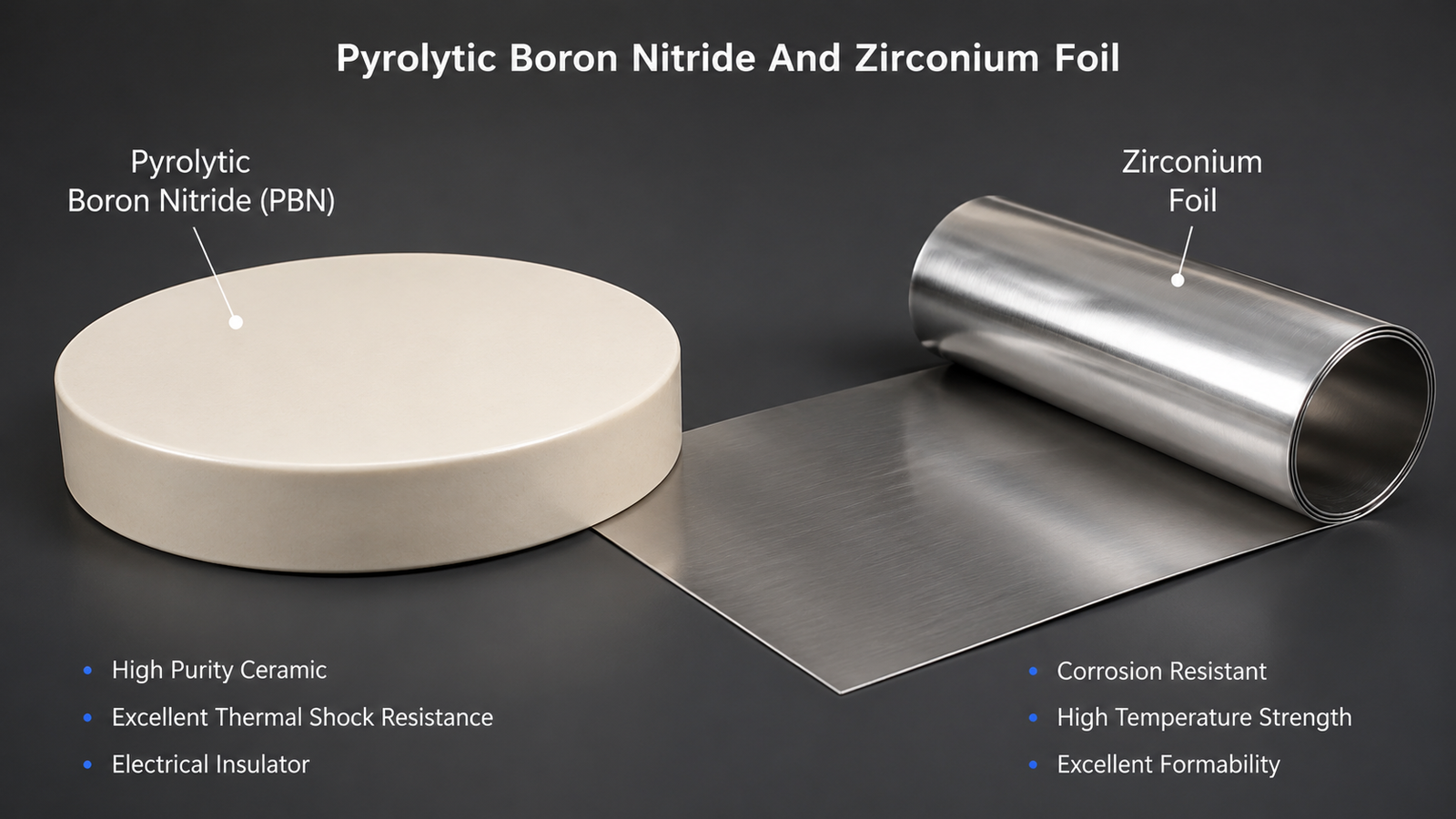
Choosing materials for ordinary products is relatively straightforward. Choosing them for semiconductor equipment, vacuum systems, scientific experiments and high-temperature processes is a different challenge altogether. A material may need to tolerate heat, resist chemical attack, maintain purity and deliver specific electrical or thermal behaviour at the same time.
That is why specialised materials such as Pyrolytic Boron Nitride and Zirconium Foil deserve attention.
These two materials perform very different jobs. Pyrolytic Boron Nitride is an advanced ceramic known for purity, electrical insulation and unusual thermal characteristics. Zirconium Foil is a thin metallic material valued for corrosion resistance, controlled thickness and specialised research applications.
Understanding these differences is the first step towards selecting the right material for a demanding project.
Pyrolytic Boron Nitride Is More Than a Conventional Ceramic
Pyrolytic Boron Nitride, or PBN, is a specialised form of boron nitride typically produced through chemical vapour deposition.
This manufacturing route is important because PBN is not simply ceramic powder compressed into a required shape. Material is deposited under carefully controlled processing conditions, allowing manufacturers to produce exceptionally pure components without conventional ceramic binders.
High purity makes a considerable difference in applications where unwanted elements could contaminate sensitive materials.
For this reason, PBN has become particularly relevant to semiconductor processing, crystal-growth equipment and specialised vacuum applications.
The Direction of Heat Matters in PBN
One of the most fascinating characteristics of Pyrolytic Boron Nitride is anisotropy.
In simple terms, PBN does not behave exactly the same way in every direction. Its layered crystal structure means heat transfer can be significantly different parallel to the layers compared with through them.
Why does that matter?
Imagine an application where heat needs to spread efficiently across one part of a component while heat transfer through another direction should remain comparatively limited. The directional thermal characteristics of PBN can become an important design advantage.
Combined with excellent electrical insulation, this gives engineers possibilities that ordinary conductive materials cannot easily provide.
What Makes PBN Attractive for Technical Applications?
Several properties contribute to the usefulness of Pyrolytic Boron Nitride:
- Excellent electrical insulation
- Very high material purity
- Strong thermal-shock resistance
- Good chemical stability
- High-temperature capability in suitable environments
- Low contamination potential
- Specialised vacuum compatibility
- Direction-dependent thermal properties
- Non-wetting behaviour with many molten materials
These properties explain why PBN is generally considered a functional engineering material rather than simply a structural ceramic.
It is chosen when its particular combination of characteristics solves a specific processing problem.
Where Does Pyrolytic Boron Nitride Fit Into Modern Industry?
Semiconductor processing is perhaps the most recognisable application area.
Manufacturing advanced semiconductor materials requires carefully controlled conditions. A crucible or processing component can become problematic if it introduces unwanted contaminants into the material being produced.
High-purity PBN helps address this challenge.
Typical applications can include:
- Crystal-growth crucibles
- Evaporation boats
- Electrical insulation components
- Vacuum-processing fixtures
- Semiconductor production equipment
- High-purity containers
- Thermal management parts
- Laboratory processing components
The exact suitability of PBN depends on temperature, atmosphere, geometry and chemical exposure.
Zirconium Foil Brings Different Advantages
Move from ceramics to metals and the engineering requirements change considerably.
Zirconium Foil is thin zirconium metal produced in controlled dimensions for technical, experimental and research purposes.
Zirconium is particularly recognised for corrosion resistance. A stable oxide film forms on its surface and helps protect the underlying metal in many chemical environments.
Another important characteristic is relatively low neutron absorption, which is one reason zirconium-based materials have an established role in nuclear technology.
When manufactured as foil, zirconium becomes useful for applications where researchers or engineers need these properties in a very thin metallic form.
Why Use Zirconium in Foil Form?
Thickness changes how a material can be used.
Zirconium Foil provides a large exposed surface relative to the amount of material present. This can be particularly useful for research involving surface reactions, oxidation, coatings or diffusion.
Foil can also be prepared in controlled dimensions, allowing researchers to compare specimens under different experimental conditions.
Important characteristics include:
- Strong corrosion resistance
- Metallic electrical conductivity
- High melting temperature
- Useful thermal characteristics
- Availability in thin sections
- Suitability for surface studies
- Low neutron absorption
- Compatibility with specialised experimental environments
These features make zirconium foil particularly relevant to materials science.
Where Is Zirconium Foil Used?
The applications for Zirconium Foil extend beyond a single industry.
It can be considered for:
- Nuclear materials research
- Corrosion experiments
- Surface-science studies
- Oxidation investigations
- Vacuum experiments
- Electrochemical research
- Thin-film studies
- Diffusion testing
- High-temperature experiments
- Surface engineering
Researchers may deliberately modify, oxidise, coat or expose the foil to controlled environments and then analyse the resulting changes.
For such work, knowing exactly what material has been supplied is critical.
PBN and Zirconium Foil: Two Materials, Two Different Roles
A simple comparison helps illustrate their differences.
| Consideration | Pyrolytic Boron Nitride | Zirconium Foil |
| Material family | Ceramic | Metal |
| Typical form | Crucibles and engineered parts | Thin foil or sheet |
| Electrical behaviour | Insulating | Conductive |
| Notable feature | High purity and thermal anisotropy | Corrosion resistance |
| Flexibility | Relatively rigid | Formable in thin sections |
| Semiconductor relevance | High for specialised processes | Application specific |
| Surface research | Selected applications | Strong potential |
| Nuclear relevance | Specialised | Important |
| Heat transfer | Direction dependent | Metallic conduction |
| Primary selection reason | Thermal/electrical functionality | Metallic and chemical functionality |
This makes one point clear: PBN and zirconium foil should not be treated as interchangeable materials.
What Should Buyers Check Before Ordering?
Advanced materials should be purchased according to specifications rather than simply by material name.
For Pyrolytic Boron Nitride, consider:
- Purity
- Required geometry
- Thickness
- Thermal orientation
- Surface condition
- Operating atmosphere
- Maximum temperature
- Dimensional tolerance
For Zirconium Foil, consider:
- Purity or grade
- Foil thickness
- Width and length
- Surface finish
- Temper
- Chemical composition
- Hafnium content where relevant
- Dimensional tolerance
Providing application details can help suppliers recommend a more appropriate material specification.
Frequently Asked Questions
1. What is Pyrolytic Boron Nitride used for?
It is used in specialised semiconductor, vacuum, crystal-growth and high-temperature applications.
2. Is PBN a ceramic?
Yes. Pyrolytic Boron Nitride is an advanced ceramic material.
3. Why is PBN considered high purity?
Its chemical vapour deposition manufacturing process can produce material without conventional ceramic binders.
4. Does PBN conduct electricity?
PBN is primarily valued as an electrical insulator.
5. What is special about PBN thermal conductivity?
It is highly directional because of the material’s layered structure.
6. What is Zirconium Foil mainly used for?
It is used in materials research, surface studies, corrosion testing, nuclear research and other specialised applications.
7. Is Zirconium Foil conductive?
Yes. Zirconium is a metal and therefore provides metallic electrical conductivity.
8. Why is zirconium corrosion resistant?
A protective oxide layer contributes significantly to its resistance in many environments.
9. Are PBN and zirconium suitable for high temperatures?
Both can serve elevated-temperature applications, but their limits depend strongly on atmosphere, material grade and operating conditions.
10. Which material should I choose?
Choose according to the required electrical behaviour, temperature, chemical environment, purity, geometry and mechanical requirements.
Read more – https://newsgrow.blogspot.com/2026/09/boron-nitride-crucibles-and-boron.html
https://newsgrow.blogspot.com/2026/09/pyrolytic-boron-nitride-and-zirconium.html