
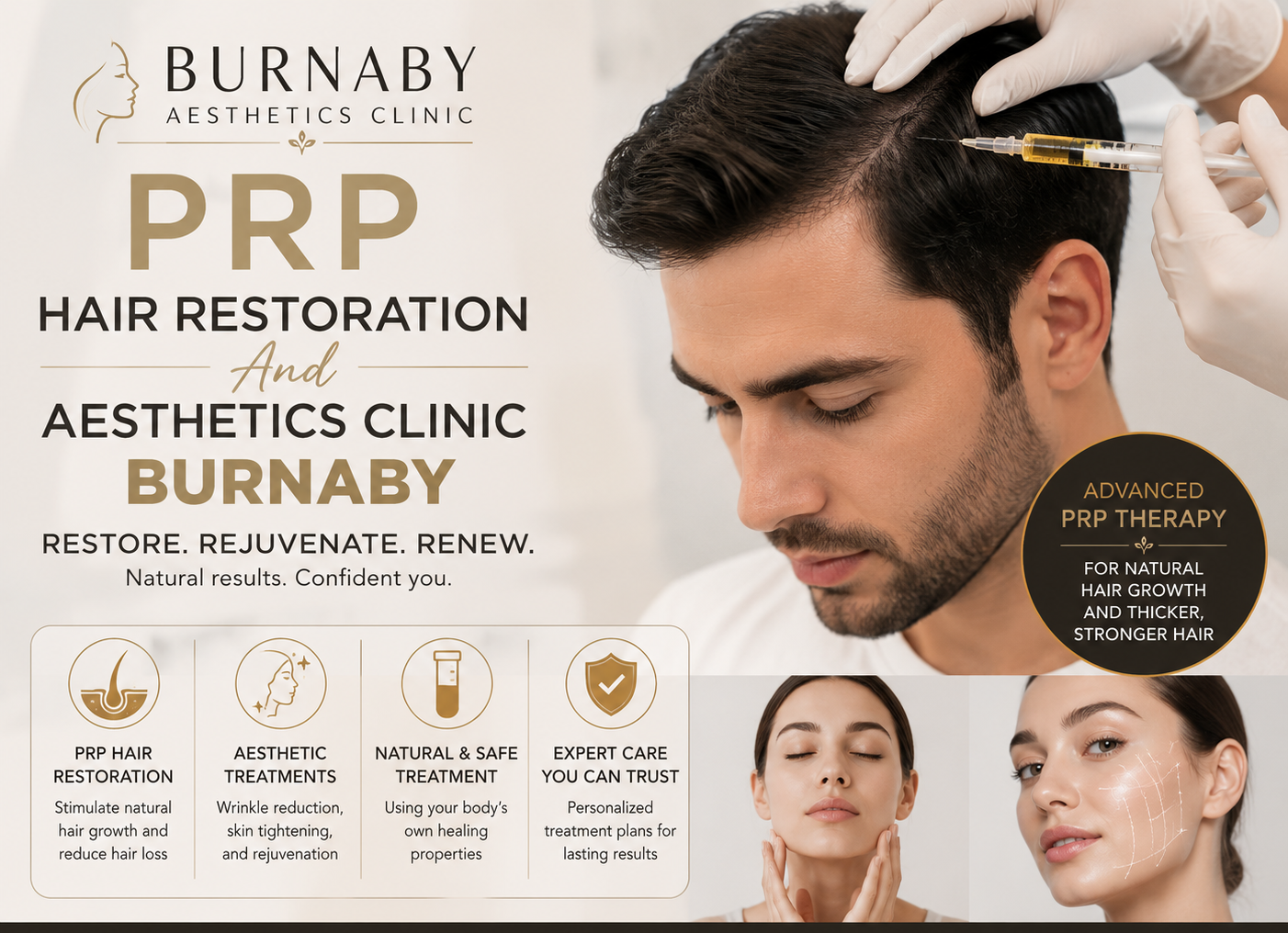
Burnaby’s aesthetics sector is seeing growing interest in non-surgical approaches to hair thinning, with PRP Hair Restoration emerging as one of the treatments being explored by adults looking for alternatives to conventional surgical procedures.
The treatment, which uses platelet-rich plasma prepared from a patient’s own blood, reflects a wider shift within aesthetic care towards minimally invasive and personalised procedures. People researching an Aesthetics Clinic Burnaby are increasingly encountering PRP alongside established hair-loss management options.
However, specialists emphasise an important point: hair loss has multiple causes, and PRP is not suitable for every patient or every stage of thinning.
What Is Driving Interest in PRP Hair Restoration?
Hair thinning is a concern affecting both men and women, but awareness of treatment options has expanded considerably.
Rather than waiting until hair loss becomes advanced, many people are now investigating changes in density, widening parts, thinning crowns and receding areas earlier.
This has increased interest in procedures that do not involve traditional hair-transplant surgery.
PRP Hair Restoration is particularly notable because the treatment uses an autologous substance—material obtained from the patient’s own body.
A small blood sample is collected and processed to isolate platelet-rich plasma before it is administered into targeted areas of the scalp.
How Does PRP Hair Restoration Work?
Platelets are commonly associated with blood clotting, but they also contain growth factors and signalling proteins involved in natural healing and tissue-repair processes.
PRP treatment aims to use these biological components to support the environment surrounding existing hair follicles.
A typical procedure may involve:
- Assessing the patient’s scalp and thinning pattern.
- Drawing a small quantity of blood.
- Processing the sample using a centrifuge.
- Separating and preparing platelet-rich plasma.
- Treating targeted areas of the scalp.
- Providing appropriate aftercare instructions.
The procedure does not involve removing and transplanting donor follicles.
Experts Stress That PRP Is Not a Cure for Baldness
As interest in PRP Hair Restoration increases, realistic expectations remain essential.
PRP does not manufacture new follicles. Its potential usefulness depends partly on the presence and condition of existing follicles.
That means someone experiencing early-stage pattern thinning may present a very different case from an individual with long-established areas where functional follicles are absent.
Results can also vary considerably.
Age, genetics, type of hair loss, follicle condition, overall health and treatment protocol can all potentially influence response.
Consumers should therefore be cautious about advertising that promises guaranteed or immediate hair regrowth.
Hair Loss Assessment Becomes an Important First Step
Another trend emerging within modern hair restoration is a stronger focus on identifying the reason for hair loss before choosing a treatment.
Genetics is only one potential factor.
Hair shedding and thinning may also be associated with:
- Hormonal changes
- Nutritional factors
- Stress
- Certain medications
- Scalp disorders
- Ageing
- Hair-care practices
- Underlying health issues
Sudden or unexplained hair loss may require medical investigation.
For people considering an Aesthetics Clinic Burnaby, this makes the initial consultation an important part of the treatment journey rather than simply a formality before PRP.
PRP and Hair Transplants Serve Different Purposes
The increased visibility of PRP has also created confusion about whether it can replace hair transplantation.
The two approaches are fundamentally different.
| Category | PRP Hair Restoration | Hair Transplant |
| Procedure | Minimally invasive | Surgical |
| Source | Patient’s plasma | Patient’s donor follicles |
| Follicle relocation | No | Yes |
| Typical recovery | Limited | Longer recovery |
| Treatment approach | Often multiple sessions | Surgical procedure |
| Primary goal | Support existing follicles | Restore coverage by moving follicles |
For this reason, treatment selection depends heavily on the individual’s hair-loss pattern and goals.
Burnaby’s Aesthetic Care Market Reflects Wider Personalisation Trend
Interest in PRP is occurring alongside broader changes within aesthetic medicine.
Consumers increasingly expect treatments to be personalised rather than offered as standard packages.
An Aesthetics Clinic Burnaby may now assess hair and scalp concerns alongside skin texture, pigmentation, signs of ageing and other aesthetic priorities.
Depending on the provider’s qualifications and services, treatment options may include PRP procedures, microneedling, skin rejuvenation, chemical peels and other non-surgical approaches.
The underlying trend is moving towards targeted treatment plans based on individual concerns.
What Should Consumers Ask Before Choosing PRP?
With more information about aesthetic procedures appearing online, verifying treatment quality is becoming increasingly important.
Before undergoing PRP, consumers can ask:
- Who will perform the treatment?
- What qualifications does the practitioner have?
- How will my hair loss be assessed?
- Why is PRP suitable for my situation?
- How is the PRP prepared?
- What side effects are possible?
- How many sessions could be recommended?
- How will results be monitored?
- Are maintenance sessions sometimes required?
- What alternatives are available?
A professional provider should be able to discuss both potential benefits and limitations.
Expectations Shift From Instant Results to Long-Term Monitoring
Hair growth does not happen overnight.
Because follicles operate through natural growth cycles, changes following PRP Hair Restoration may require months to evaluate.
Rather than relying exclusively on subjective impressions, practitioners may use standardised photographs and observations of hair density, thickness, scalp visibility and shedding patterns.
Multiple treatment sessions may also be recommended depending on the clinical protocol and individual response.
Importantly, improvement should never be guaranteed.
Frequently Asked Questions
1. What is PRP Hair Restoration?
It is a minimally invasive procedure using platelet-rich plasma prepared from the patient’s blood to target areas of hair thinning.
2. Why is PRP gaining attention?
Interest is partly connected to demand for non-surgical and personalised approaches to hair restoration.
3. Is PRP a hair transplant?
No. Hair transplantation relocates follicles; PRP does not.
4. Can PRP create new follicles?
No. PRP is intended to support existing follicles rather than create new ones.
5. Can women undergo PRP?
Women with appropriate forms of hair thinning may be considered following professional assessment.
6. Is PRP available for men?
Yes. It may be considered for appropriate cases of male hair thinning.
7. Are PRP results immediate?
No. Hair changes generally require time to become noticeable.
8. Is one PRP session enough?
Protocols differ, but PRP is frequently offered as a series of treatments rather than an instant one-session solution.
9. Is PRP guaranteed to restore hair?
No. Individual outcomes vary.
10. Why should hair loss be assessed first?
Different forms of hair loss have different causes and may require different treatment approaches.
https://newsgrow.blogspot.com/2026/08/nad-iv-therapy-and-advanced-laser-hair.html
https://newsgrow.blogspot.com/2026/08/best-laser-hair-removal-burnaby.html
https://bhoomijanatural.info/your-guide-to-choosing-the-best-laser-hair-removal-burnaby-clinic/
https://newsgrow.blogspot.com/2026/08/burnaby-skin-clinic-and-lip-fillers.html
https://newsgrow.blogspot.com/2026/08/burnaby-dermal-fillers-and-naturopath.html
https://newsgrow.blogspot.com/2026/08/prp-hair-restoration-and-aesthetics.html
https://shopnets.com/prp-hair-restoration-in-burnaby-a-modern-approach-to-managing-hair-thinning/